
To help us provide you with free impartial advice, we may earn a commission if you buy through links on our site. Learn more

- Spacious, focused, detailed and quite dynamic sound
- Good spec and great whole-home options
- Nicely made and finished
- High-frequency issues
- No physical inputs
- Surface controls could do with some lighting
JBL has a new range of wireless multiroom/multichannel speakers – it’s called Cove. The idea is to take on the likes of Sonos (still the default choice in this space despite its widely reported and self-inflicted travails lately) and Bluesound (the OG hi-res multiroom ecosystem) and horn in on a market that shows no sign of slowing its growth.
The smallest and most affordable of what is currently a three-strong Cove lineup is this M1, a mains-powered speaker specced to compete in every respect. And when you consider JBL’s absolute domination of the affordable, battery-powered wireless speaker market, it doesn’t take much imagination to fancy the M1’s chances.
Nothing happens in isolation, though, and the Cove M1’s competition is both credible and capable. So can JBL crash the party, or will it crash and burn?
How much does it cost?
At launch, the JBL Cove M1 costs £199, lining up directly against some extremely well-regarded alternatives. The Sonos Era 100 (£179) is the most obvious, but smart consumers won’t overlook the Apple HomePod Mini 2 (£149), the Denon Home 150 (£179) or the Audio Pro A10 mkII (£209).
Is it designed well?
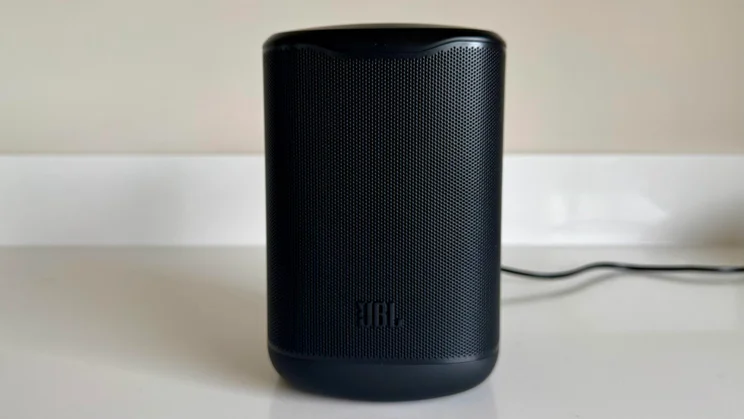
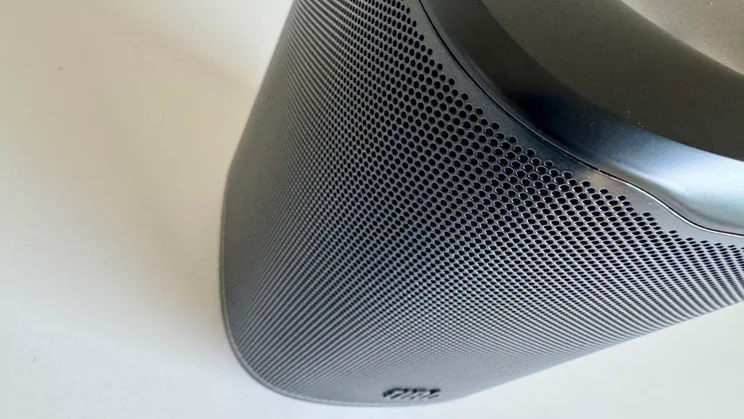
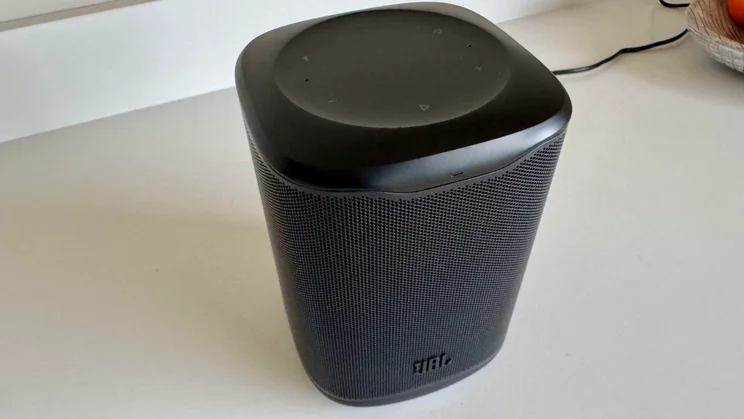
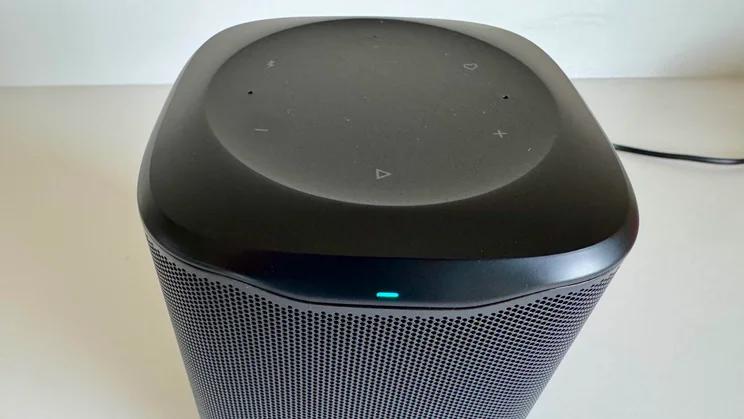
This product type has a clear template, and the Cove M1 doesn’t deviate from it. It’s that “square prism that wants to be a cylinder” we’re all familiar with – in the case of the Cove M1, it’s 125 x 125 x 184mm tall (WDH). It stands on a rubberised circular foot, and there’s a corresponding circle of touch controls on the top surface. Between the two, it’s almost entirely a tightly perforated grille.
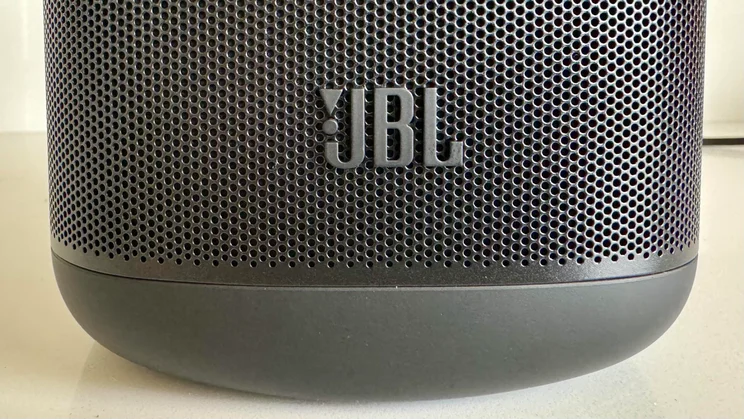
The build quality and finish meet the standard the asking price demands and the standard JBL established some time ago. There’s a white finish (only available online at the moment) in addition to the black of my review sample – and the overall look, right down to the colour-coded brand logo, is a lot more understated than you may have been expecting if you’re familiar with JBL’s ranges of Bluetooth and party speakers.
What connection options does it have?
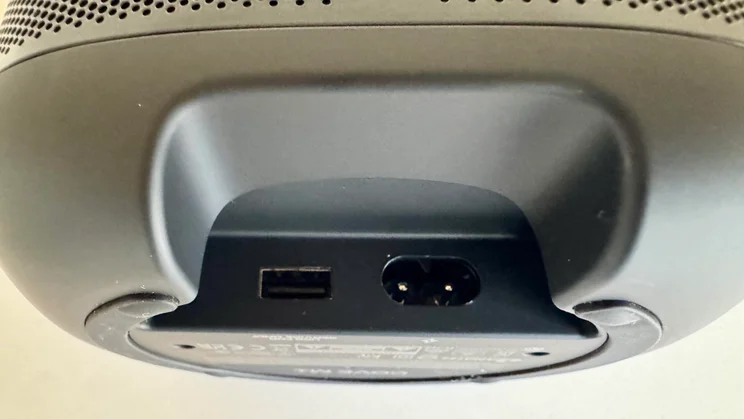
The Cove M1 has a USB slot for servicing and a figure-of-eight socket for mains power – and that’s your lot for physical connections. Happily, your wireless connectivity options are rather more wide-ranging.
Bluetooth is available – it’s version 5.3, is compatible with SBC and AAC codecs, and also features Auracast support. And thanks to dual-band wifi, the JBL is compatible with the ‘Connect’ versions of Qobuz, Spotify and TIDAL. It’s Roon Ready, and works with Apple AirPlay 2 and Google Cast.
How do you control it?
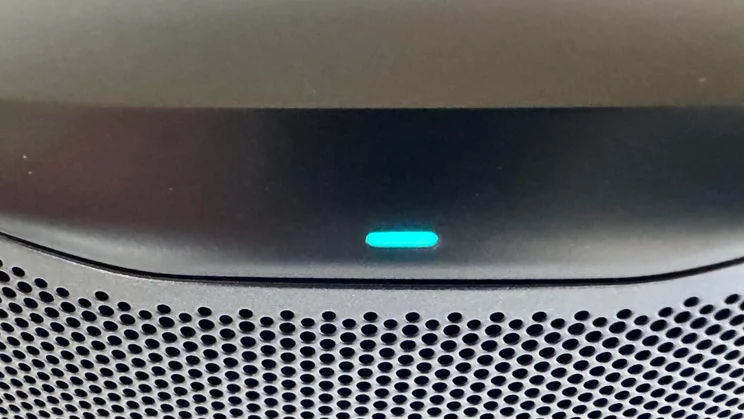
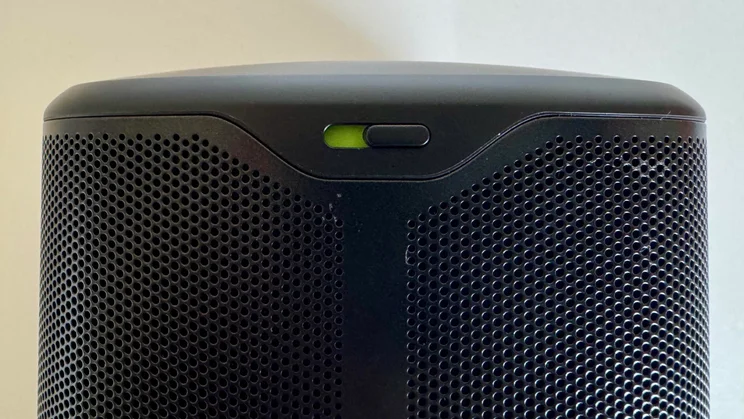
The Cove M1 gives you several well-executed control options, including Amazon Alexa compatibility. A rear switch lets you mute the microphones when you want privacy; keeping them on reveals a sharp-eared, responsive Alexa. A small LED near the top edge of the front of the speaker illuminates to indicate Alexa is listening.
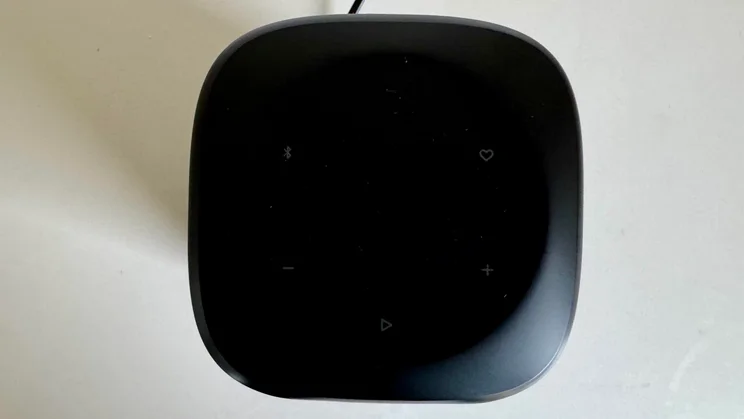
On top of the speaker are capacitive touch controls that are responsive enough, but could use some backlighting. Here’s where you can control play/pause, adjust volume and put the speaker in Bluetooth pairing mode. There’s also a button with a heart-shaped icon; it’s called the ‘Moment’ button, and lets you start playback from a specified music service, ambient sound or Spotify Tap immediately. If you have another Cove speaker in your home, a quick press-and-hold will have it playing the same music as your M1.
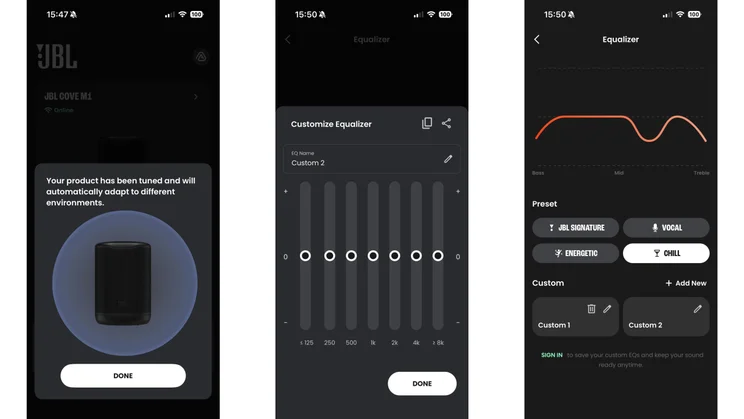
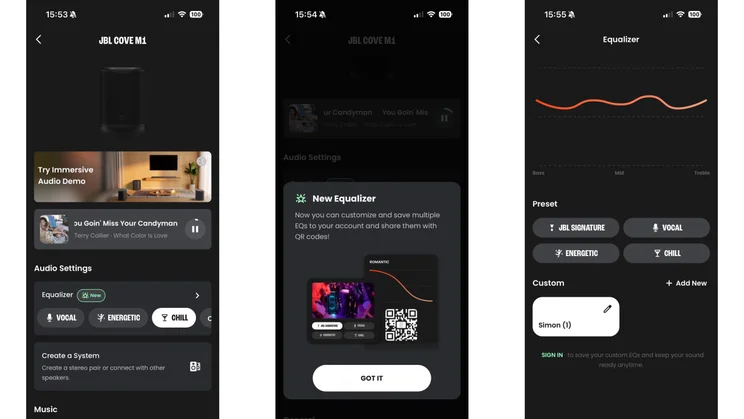
You’ll specify what content the Moment button accesses in the JBL One control app, and there’s more to the app than just this. It gives access to a seven-band EQ (you can save custom settings, as well as access four presets), allows your M1 to become part of a stereo pair with another M1, to be a rear speaker in a cinema system with an appropriate JBL soundbar, or to become part of a multi-room setup.
It’s also where you can set your M1 up in double-quick time. Open the app, and it will find the speaker as soon as it’s on. After that, one tap of the Moment button starts a rapid room-correction routine, and you’re in business. It really couldn’t be any more straightforward.
What driver arrangement and audio technologies does it use?
Unlike its larger sibling, the Cove M1 doesn’t have up-firing drivers for spatial audio, but it still packs plenty of drivers. A 105mm mid/bass driver sits near the bottom front of the speaker, with a 20mm soft-dome tweeter above it and two more tweeters positioned toward the left and right of the speaker, respectively.
The Cove M1 has 110W of Class D power on board, and JBL claims a frequency response of 55Hz to 20Hz. A single M1 or a stereo pair operates at a full-on native resolution of 24bit/192kHz, but will downscale for stability if you’re using multiple Cove speakers in a whole-room setup.
What is the sound quality like?
The JBL One control app can quite significantly affect the speaker’s frequency response. However, when it comes to tonality and overall audio character, the Cove M1 is quite resistant to user input. Its sonic attitude remains in every circumstance.
In most respects, that’s not a bad thing. Compared to most single-enclosure speakers of this size, the Cove M1 is quite expansive and airy. It presents music with plenty of space, and that spaciousness goes a long way towards offering what is sometimes an almost unlikely amount of scale. The JBL sounds considerably larger than it is and should have no problem filling rooms even if they’re larger than ‘modest’.
It doesn’t sacrifice unity of presentation to achieve this sense of scale, either. As long as you leave the EQ settings alone, the M1 presents music with proper singularity and togetherness, and a nice even frequency response doesn’t harm it in this respect.
At the bottom of the frequency range, the JBL delivers respectable extension, decent textural and timbral detail, and enough control over attack and decay to express rhythms with fair confidence. While tweaking the control app can scupper this clean, prompt bass response, the speaker handles the low end with skill at its default setting.
A strong mid-range, but problematic high frequencies
It communicates well through the mid-range, giving voices plenty of character and projecting well. Detail levels are high, the tonal balance is carefully neutral, and the presentation is nicely composed even at quite high volume. The Cove M1 also has plenty of dynamic headroom at high volume. Even when loud, the Cove M1 has another gear when recordings undergo a big shift in attack or intensity.
However, top frequencies are slightly problematic. There’s no arguing with the detail the JBL can invest in trebles, and it has reasonable substance to balance out the undoubted bite and shine it also brings. But the top end has a mild grittiness, an edge to the tonality that has nothing to do with the number of tweeters JBL has deployed and everything to do with the way they’ve been implemented. Volume exacerbates the issue, and although the room-calibration algorithm dampens the top end, anyone listening in a particularly reflective space may find the JBL is altogether too much of a good thing when it comes to high-frequency reproduction.
Should you buy the JBL Cove M1?
The JBL Cove M1 has one or two small issues, but easy setup, multi-room and multi-channel possibilities, and straightforward, stable control options go a long way towards making up for them.
It comes up a little short of being a default choice – there are a lot of very worthwhile alternatives vying for your money with their own areas of expertise. But, at the very least, it deserves a place on your shortlist.


