
To help us provide you with free impartial advice, we may earn a commission if you buy through links on our site. Learn more
- Focused, detailed and quite expansive sound
- Impressive specification for the money
- Good standard of construction and finish
- Plodding low-frequency response
- Impossible to dial in a neutral PEQ setting
- Needs a wider choice of finishes
A nice little desktop audio system can make all the difference to days spent sitting at a desk and staring at a computer. And if anyone knows anything about serving up an affordable yet worthwhile PC speaker system, it’s Creative Technology Ltd of Singapore.
The company has been doing heroic work with soundcards, speakers, and headphones since the early 80s, and the new Creative XF1 speaker system is its latest attempt to turn the mundanity of your workday into a little oasis of audio entertainment, without breaking the bank.
Of course, Creative is far from the only company with the same ambition. So the XF1must overcome strong and credible competition from the likes of Logitech and SteelSeries if it’s going to make its way towards the top of your shortlist.
How much does it cost?
The Creative XF1 desktop stereo speaker system costs £140 in the United Kingdom, putting it in close competition with the SteelSeries Arena 3 (£130) and the Logitech Z407 (£95), as well as one or two older products in Creative’s own lineup, like the T100 (£110) and Pebble X Plus (£130).
Is it designed well?
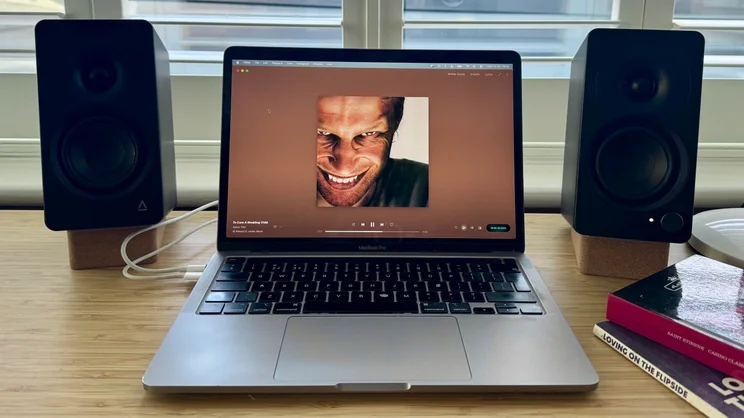
In the context of the asking price, there’s absolutely no arguing with the design of the Creative XF1or the standard of build and finish that’s on display.
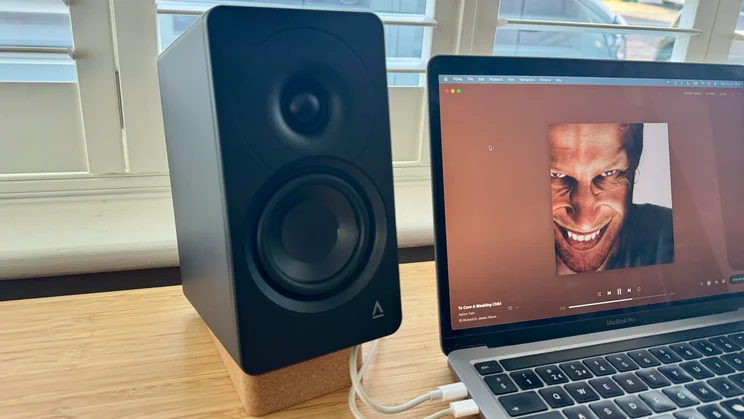
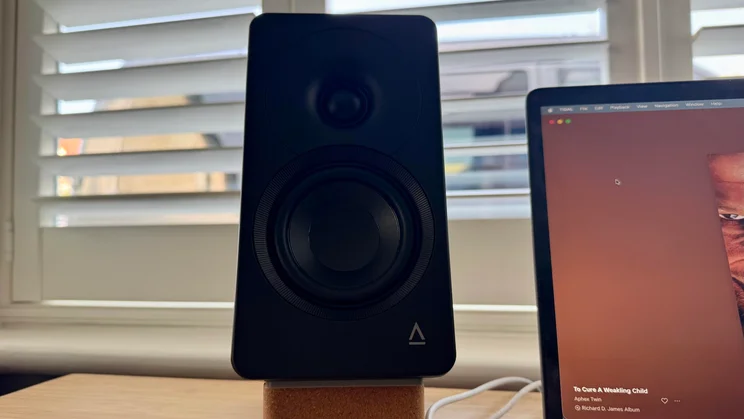
It’s compact at just 100 x 155 x 191mm (WDH), allowing space for other stuff on your desktop. The cabinets are made almost entirely from MDF, and both available finishes (black and white) have a nice, quite soft matte effect. The cabinets are curved along each horizontal edge and are well put together. No screws or fixings are visible on the front baffle.
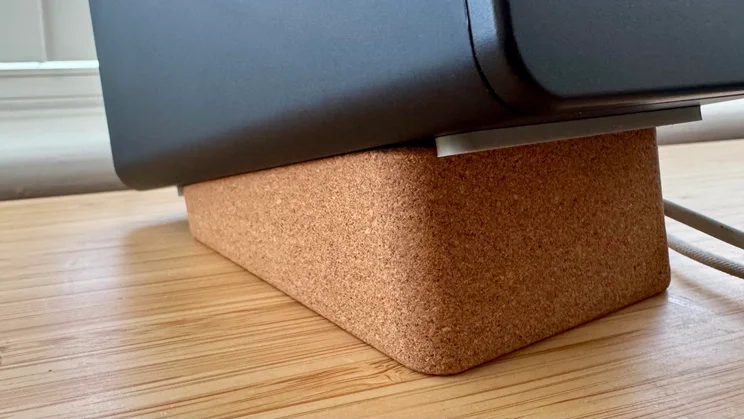
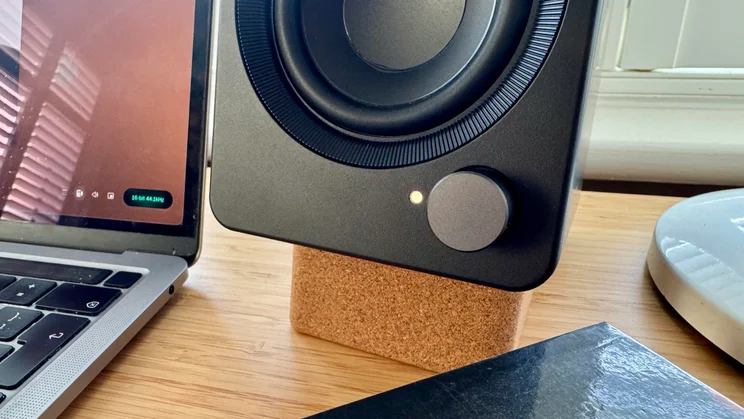
The XF1 comes with a couple of wedge-shaped cork stands; these screw to the bottom of the cabinets and angle the speakers up at 15 degrees. This is useful in a desktop scenario, as it points the drivers toward the listener’s ears rather than their torso.
What connection options does it have?
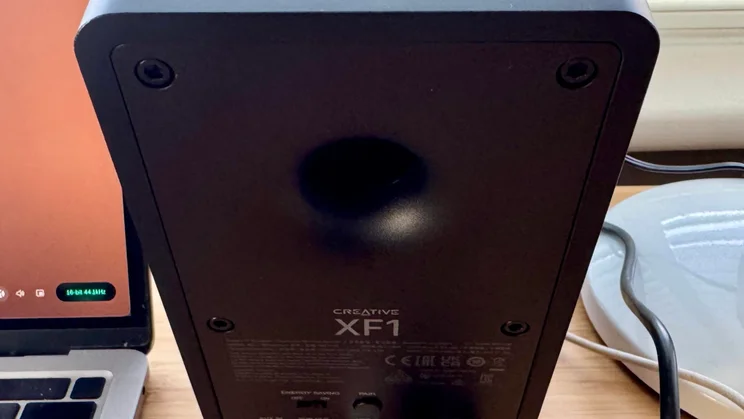
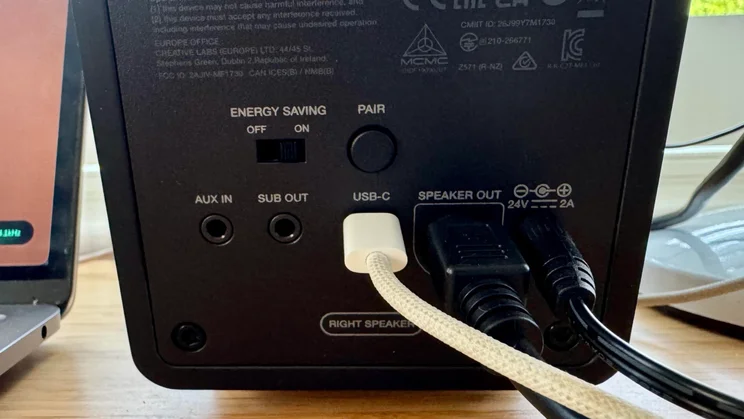
The right speaker handles all connectivity and requires a wired connection to mains power. It has a USB-C port and a 3.5mm analogue socket for physical connections, alongside a 3.5mm socket that functions as a pre-out for use with a subwoofer.
Wireless connectivity is via Bluetooth 6.0 with SBC, AAC and LDAC codec compatibility; a button on the rear of the speaker (where all the physical connectivity is sited) initiates Bluetooth pairing.
How do you control it?
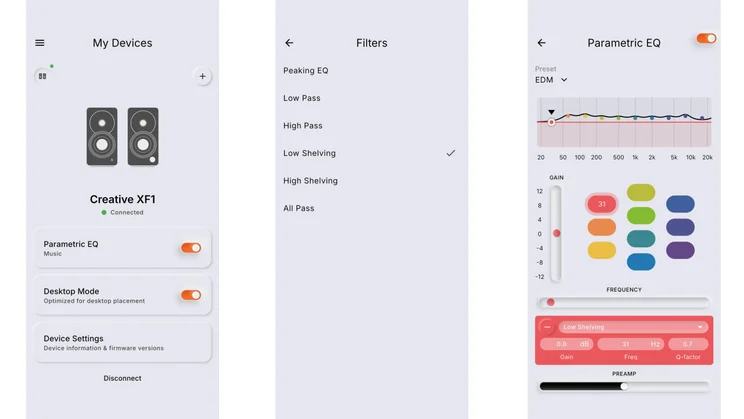
The XF1 has two user interfaces: a physical control dial and the Creative Nexus control app for iOS and Android.
The single turn/press dial is on the bottom of the right speaker’s front baffle, with a single telltale LED next to it. Press and hold the button to turn the system on or off, rotate it to adjust volume, and press it quickly to cycle through your input options. The LED glows red when the power is off, white to indicate the USB-C input is active, green for the analogue input, and blue for Bluetooth.
The app, meanwhile, offers none of those functions. It’s handy for checking for firmware updates and letting the system know it’s on a desktop (or not), but its most useful feature is the 10-band parametric EQ. Using this, you can have a disproportionate amount of input into how the XF1 sounds. In addition to creating and saving custom settings, you can access an extraordinary number of presets for music, movies and gaming.
What driver arrangement and audio technologies does it use?
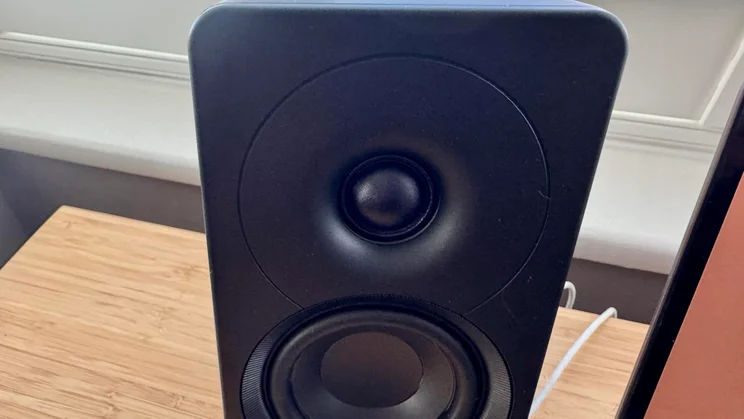
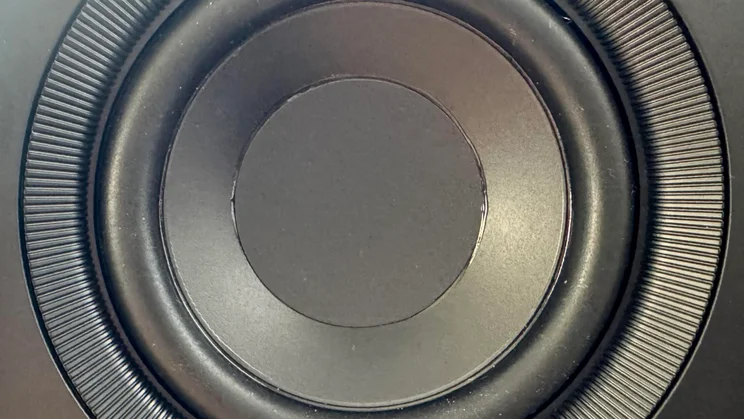
Each speaker features a 19mm soft-dome tweeter and 76mm mid/bass driver; Creative developed the larger driver using its “finite element analysis” methodology to minimise distortion.
The right speaker may control the whole operation, but the XF1 is an active system designed in a bi-amp configuration. Each driver has Class D amplification: the tweeters get 10W each, and the mid/bass drivers get 26W apiece, for a total system power of 72W. A rear-firing bass reflex port near the top-rear of each cabinet bolsters the driver array. Creative quotes a frequency response of 55 Hz- 40 kHz.
The XF1 comes with a four-core cable to connect the speakers; the right speaker uses it to send all power and audio information to the left speaker. The digital-to-analogue conversion chipset that handles incoming digital audio info operates at a native 24-bit/96kHz resolution, so the XF1 can function as a true high-resolution system if you send in the best stuff via USB-C.
What is the sound quality like?
Creative deserves congratulations for developing a desktop audio speaker system that in many ways sounds nothing like a desktop audio system.
When you’re sitting close to a pair of stereo speakers, as you inevitably are when they’re on the desk in front of you, the sound can quite easily be too immediate and unresolved. That’s not the case here. The XF1 is an airy, spacious listen that can create a plausible soundstage and a sensation of stereo focus even though it’s very close to your head. Unlike headphones that pump sound straight into your ears, this system delivers an open, well-separated presentation that feels infinitely better.
The overall tonality has a hint of warmth that contributes to a reasonably welcoming sonic signature. The XF1 isn’t shy when attacking the top end either, but its warmth limits the system’s high-frequency extension. If you’re fine with this, great. If you’re not, be aware that even the 10-band parametric EQ can’t overcome what seems like a baked-in, mildly tonal toastiness.
Detailed at the top, but issues at the bottom
From the top end down, the Creative’s detail retrieval and contextualisation are impressive until you reach the lowest frequencies. It’s particularly adept at communicating the midrange, offering real insight into the texture and timbre of voices and instruments, and alert to even the finest harmonic variations. Combined with the gratifying airiness of the overall presentation, it makes for an informative listen.
The bottom end has one or two issues, though. The XF1 can dig quite deep and hit impressively hard, but it doesn’t control its low-frequency activity as well as it does the rest of the frequency range. This slight lack of positivity in the attack and decay of bass sounds negatively affects the system’s ability to express rhythms with confidence. And the detail levels that are so impressive higher up the frequency range desert the Creative at the bottom end, leaving bass that sounds monotonal and a little bit plodding.
Despite this rather cumbersome low-frequency response, the XF1’s dynamic variation escapes unscathed. It can put decent distance between the quietest and loudest events in a recording without getting shouty or sounding stressed. This isn’t a compelling quality in a desktop system—unless you enjoy being startled—but it clearly illustrates the Creative XF1’s capabilities.
Should you buy the Creative XF1?
If you’ve paid any attention to this website, you’ll know your choice of affordable desktop and/or computer speaker systems is far from limited. You’ll also know that Creative is generally there or thereabouts at any given price point.
So it’s no surprise the XF1 is a strong contender at the money, with areas of sonic expertise complementing its tidy dimensions, madly in-depth app, and great build and finish. Is it perfect? Certainly not. Does it deserve a place on your shortlist? Most definitely.


