
To help us provide you with free impartial advice, we may earn a commission if you buy through links on our site. Learn more

Call me easily pleased, but one of my favourite things about Marshall speakers is that the name of each series is a nod to the brand’s history and connection to the music industry. Since gaining notoriety in the 1960s by producing guitar amps popularised by rockstars, including Pete Townshend, Jimi Hendrix, Eric Clapton and Jimmy Page, the British-founded manufacturer has crafted one of the strongest brand identities around.
Its aesthetic is instantly recognisable, and the tuning of its audio products always lends itself especially well to the rock and roll movement that landed Marshall on the map. And the map of the UK is actually where many of the brand’s speakers take their names from.
Each speaker represents a formative location in the company’s journey. Marshall’s legacy is worn as a badge of honour at a time in which the past is increasingly forgotten, rewritten or actively denied. Its latest Bluetooth speakers are entries in the new Homeline IV range, and updates to three of its most popular London location-named products: the Acton, the Stanmore and the Stockwell. The Acton IV and Stanmore IV release this month, while the Stockwell III arrives in August.
The trio all speak in Marshall’s iconic design language but have received some notable upgrades on their predecessors, which I’ve detailed below. We’re aiming to have reviews live soon, so keep an eye out for those on the site in the coming weeks!
Marshall Acton IV and Marshall Stanmore IV
The two speakers share an identical aesthetic but are different sizes. The smaller, cheaper of the pair, the Acton IV (£260), weighs 2.65kg and houses a 4in woofer alongside two 0.75in tweeters. The Stanmore IV (£350), meanwhile, is significantly heavier at 4kg, and houses a larger 5in woofer. The output of both speakers is the same, however, at 60W.
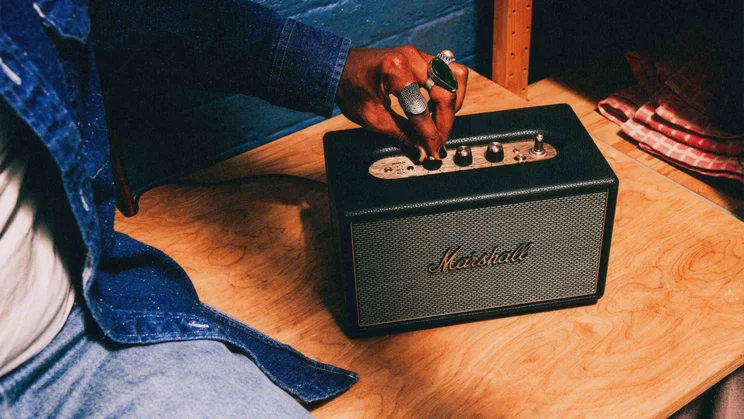
In a briefing on the products, Marshall was open about the fact that the fourth-generation models don’t make “massive sonic improvements”, but several upgrades should result in improved stereo performance. First, they use new tweeters able to reach higher frequencies. Second, they support the LDAC codec, meaning you no longer have to rely on the SBC codec and can stream audio at a higher resolution. And thirdly, Marshall says that new waveguides enable both the Acton and Stanmore to disperse sound more effectively to create a wider soundstage.
Upgrades in important areas
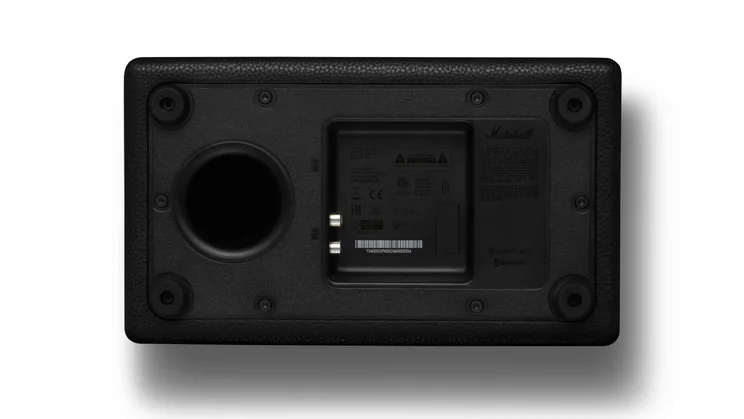
Bigger changes come in three other areas. The rear of the speakers is far cleaner following Marshall’s decision to move the connection ports to the base instead. Alongside the power input, there’s a new RCA input. Marshall has also moved the bass port to the base to improve acoustic control and enhance bass, resulting in a tidier appearance.
The UX panel on top of the speakers has received a slight makeover, too, with Marshall’s customisable “M” button joining the three amp-inspired control knobs, on-off switch, source indicator and AUX input present on the Acton III and Stanmore III.
Another welcome change comes in the repairability department. The grille that clips onto the front of the speaker is replaceable, as are the speaker’s control knobs and feet. The Acton IV and Stanmore IV are available this month, with the former priced at £260 and the latter costing £350.
Marshall Stockwell III
The Stockwell series is portable and has a rechargeable battery, unlike the Acton and Stanmore, which are primarily for home use and require mains power.
It has a PU leather strap with a metal badge and velvet lining for easy carrying, an IP55 rating for dust and water resistance (a big upgrade on the IPX4 rating on MkII), and a battery that should last around 40 hours – twice that of the second-gen model.

The third-gen model is the same height, width and weight as that speaker (181 x 150mm, 1.3kg), but is slightly deeper (72mm) to make it more sturdy on various surfaces. r notable changes. As is the case on the Acton and Stanmore IV, Marshall has rethought the user interface on top of the speaker. The power button has been separated from the volume knob, there’s a three-way switch that handles play/pause and track skipping, and Marshall’s programmable “M” button makes an appearance here, too.
A tweaked driver arrangement but still True Stereophonic
Inside the speaker, you’ve got front and back 1.75in full-range drivers, which are slightly smaller than they were on the Stockwell II, and a larger 3in woofer – the primary reason this model is deeper than its predecessor. The driver arrangement still uses Marshall’s True Stereophonic technology, though. The name of this is a little misleading – it doesn’t deliver stereo sound – but instead sends out sound waves from both sides of the speaker and uses an algorithm to keep you in the sonic sweet spot wherever you’re standing in relation to the Stockwell.

A couple of other aspects of the Stockwell III to note: it has a removable silicone sleeve that looks like leather and provides a welcome amount of drop protection, and there will be six spare parts available from launch for both the black and cream colour variants.
The Marshall Stockwell III is already available to buy in certain regions, but will hit UK shelves on 25 August with an RRP of £200.
Marshall Heddon streaming hub
All three of the aforementioned speakers have built-in Auracast, meaning you can sync and play audio on them simultaneously. Marshall says Auracast is key to its ability to meet broader home speaker needs by delivering multi-room options. As part of this push to create a robust multi-room home audio ecosystem, it launched the Marshall Heddon earlier this year.
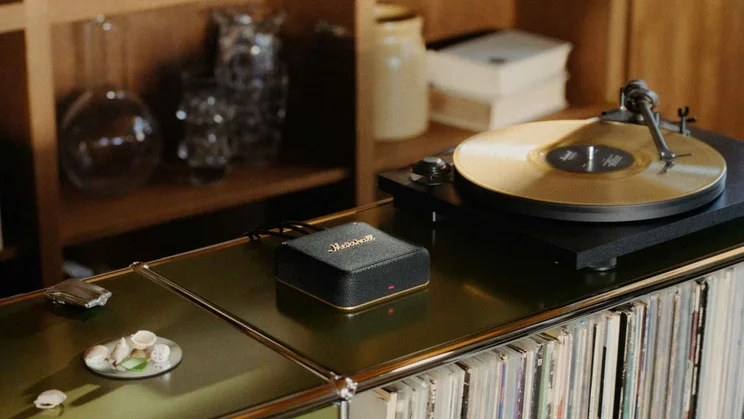
The Heddon hub will set you back £180 and streams audio over your Wi-Fi connection before sending the audio signal to connected Marshall speakers. For newer models such as the Homeline IV range (the Acton IV and Stanmore IV), it will do this via Auracast, while older options like the Woburn, Tufton, and original Acton, Stanmore and Stockwell need to be connected to the Heddon via AUX or RCA.
It’s not cheap, but the Heddon gives Marshall’s loyal customer base a way to incorporate their legacy devices into a wider network of speakers, which is a smart move.


