
To help us provide you with free impartial advice, we may earn a commission if you buy through links on our site. Learn more
- Long battery life
- IP68 rating and military-grade durability
- Powerful output that doesn’t distort at high volume
- High price
- Bass-heavy default tuning
- App requires you to make an LG account
If you’re looking for a big, high-output Bluetooth speaker for outdoor gatherings, the LG xboom Blast is probably on your shortlist. It may share the same price tag as the larger LG xboom Stage 501, but it’s a completely different proposition. It’s more focused on outdoor use, though it’s considerably bigger than your average portable speaker.
Like all LG speakers released in the past 18 months, it’s a collaboration with will.i.am, and it has three core selling points: durability, battery life and big sound. It promises “military-grade” protection plus water and dust resistance, 36 hours of battery life and 210W of power in battery mode (or 220W when plugged into AC power) from four speaker drivers and triple passive radiators.
I’ve just finished testing it to see whether it’s worth buying instead of rugged, portable wireless party speakers from Sony, JBL and the like.
How much does it cost?
Priced at £450, the LG xboom Blast matches the cost of the brand’s bigger Stage 501 speaker but targets an audience focused on outdoor durability over sheer size and weight. It weighs about the same as the wedge-shaped Stage 301 (£299), but is much better suited to outdoor use.
At its price, it competes with rivals like the Sony ULT Field 7 (£299) and the JBL Boombox 4 (£429), both of which also offer long battery life and dust and water resistance. More affordable boombox-style Bluetooth speakers include the Tribit StormBox Blast (£150) and Anker Boom 2 Plus (£160).
What features does it have?
Durability is at the core of the LG xboom Blast, and its specs beat its main rivals. Those include an IP68 rating (meaning it’s fully dustproof and can survive continuous submersion) alongside military-grade MIL-STD 810H shock testing. That military test includes high-temperature exposure, rain, drop testing, sand, dust, saltwater and vibration resistance. It’s comprehensive; some of the competition gets close with the IP rating, but the extra MIL-STD tests help this to stand out.
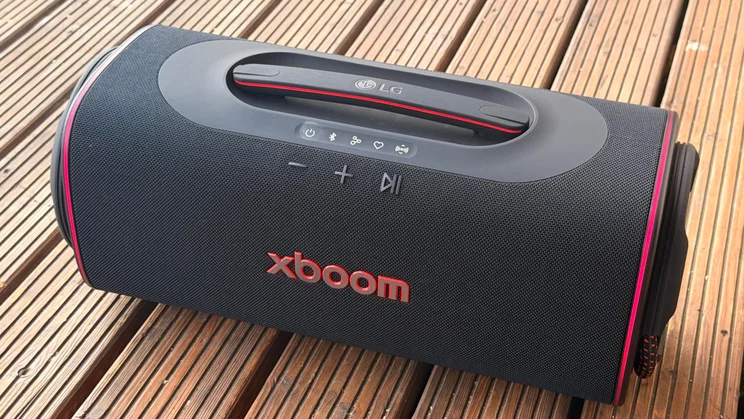
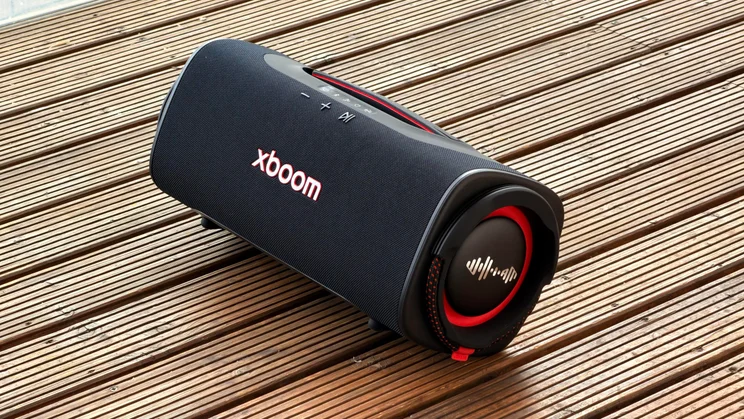
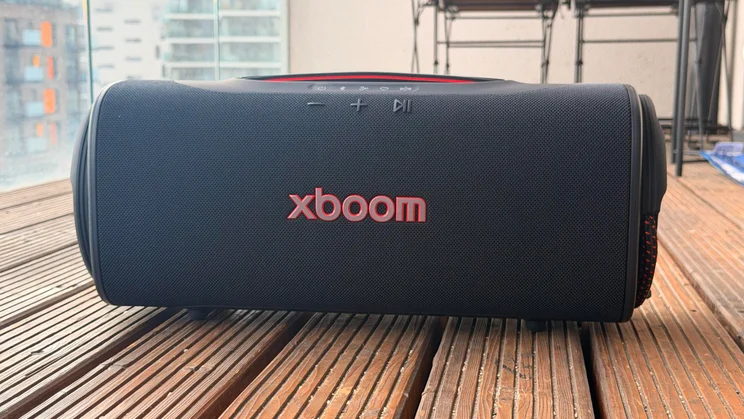
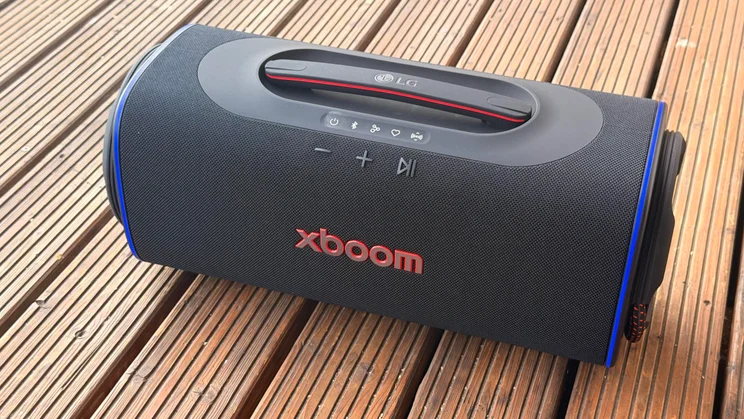
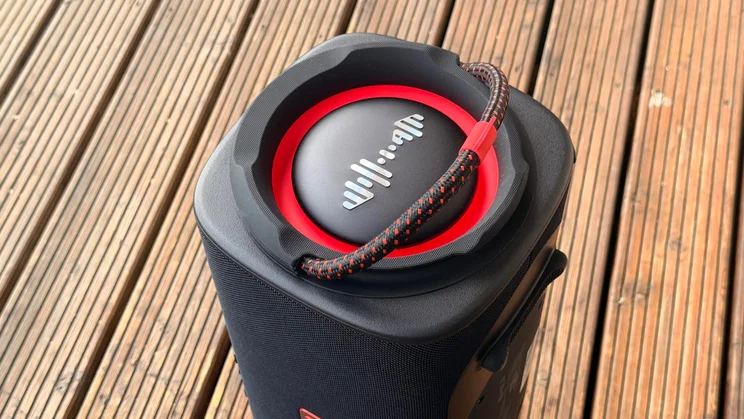
It’s an extremely tough, rugged speaker; it feels solidly constructed, and I like the general, no-nonsense design. The speaker is shaped a bit like a gym bag or duffle bag with sturdy feet to keep it stable on a surface. The feet also let you tilt and angle the Blast upwards.
The next big feature is battery life. The built-in battery pack is rated at 36 hours of playback, more than the larger Stage 501. Both speakers have replaceable and swappable battery packs to keep the party going.
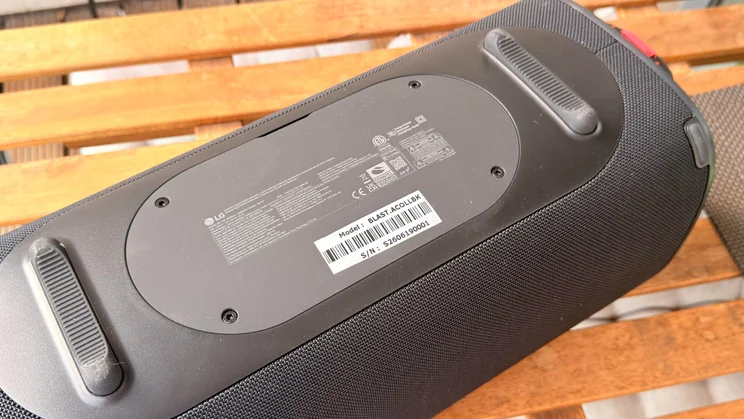
These are a little fussier to access on the xboom Blast, with you needing to remove four screws at the bottom. That makes sense, given the improved durability, but it’s worth flagging that swapping the battery is easier on the bigger speaker.
Impressive battery life and handy extras
I put its stamina to the test and found it drained 10% after three hours of playback at half volume, indicating a total life of around 30 hours. This may be because of power-hungry features like AI Sound and AI Lighting, so while it wasn’t on track for the full 36 hours, battery life is still very good. 50% volume is ridiculously loud (hitting around 80 decibels), so you shouldn’t need more than that too often.
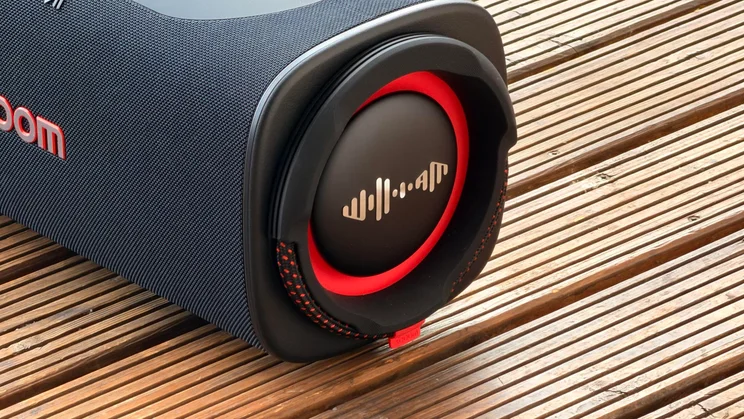
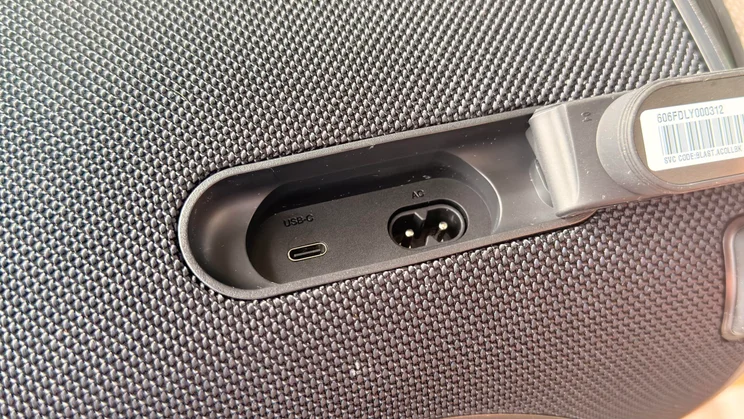
The Blast also supports multi-speaker linking. This lets you connect multiple Auracast-supported LG speakers or play stereo sound from two Blasts via Party Link. The speaker also supports Bluetooth multipoint, USB audio input, and USB-A charging of external devices. There’s subtle RGB lighting on the sides, too. The lighting is customisable and can sync with your music using the AI Lighting mode.
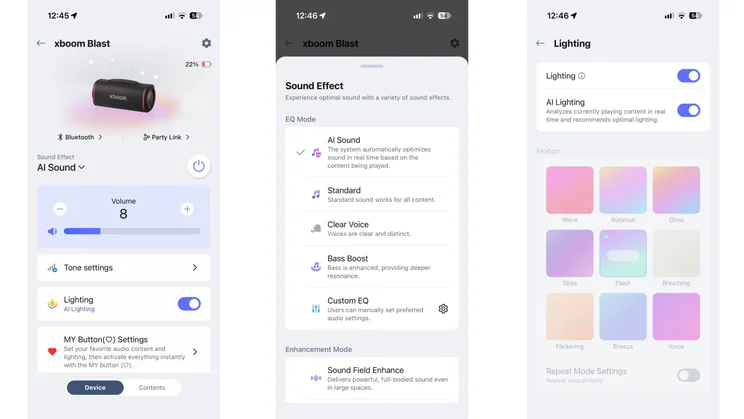
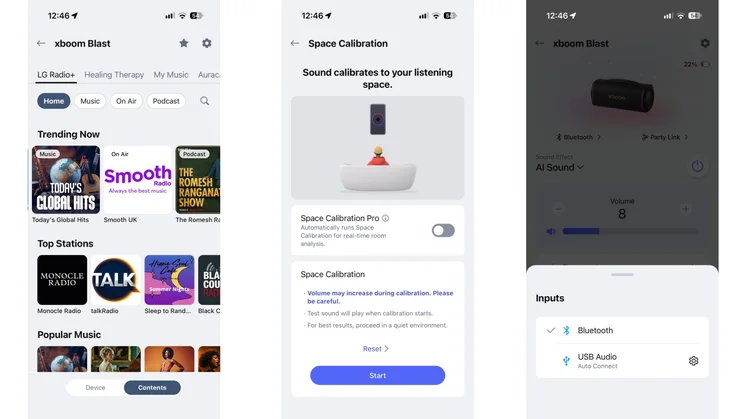
You also get access to “Space Calibration” in the LG ThinQ app. This tunes the audio to suit the room the speaker’s in. Annoyingly, you have to create an account to access the app’s extra features and firmware updates.
How I tested the LG xboom Blast
I used the LG xboom Blast as my main speaker, both indoors and outdoors, for all listening for two weeks. To test its sound, I cycled through various genres including electronic dance music, rock, pop and more, to assess its bass response and clarity at volume. I also listened to spoken content like podcasts and YouTube videos.
I tested Bluetooth and USB audio, and ran a controlled battery-drain test. The xboom Blast was tested in direct comparison to its stablemate, the Stage 501, and I used the AI Lighting, AI Sound, and Space Calibration features extensively to see how they changed my listening experience.
Why you can trust me
I have over a decade of experience writing about consumer electronics, and during that time I have tested numerous Bluetooth speakers and home audio products. I’ve written for titles such as Esquire and Digital Spy, and was Technology Editor for Good Housekeeping UK.
How easy is it to control?
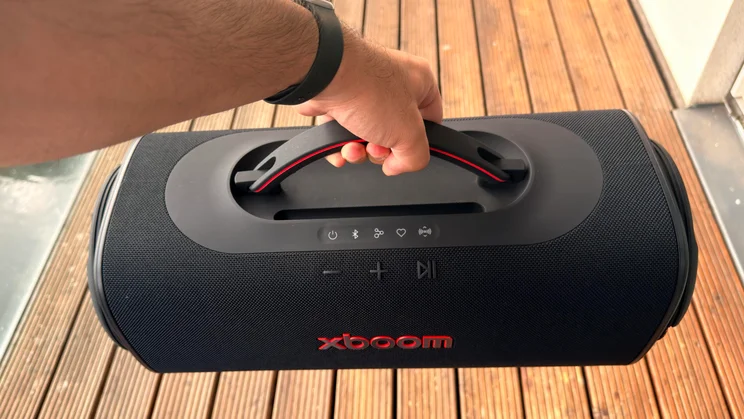
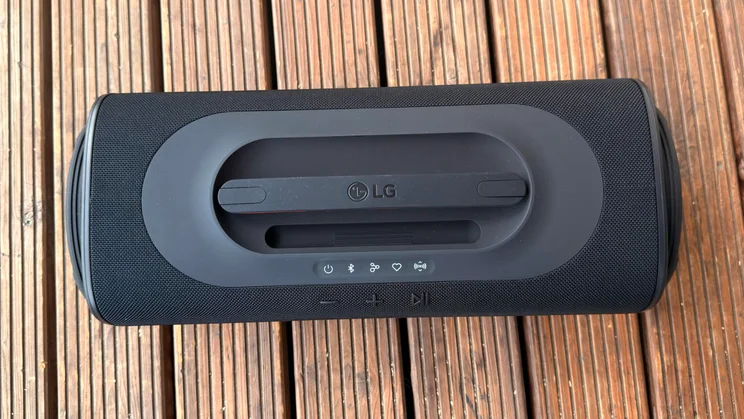
Like the Stage 501, the xboom Blast can be controlled via physical buttons on the top panel, including a dedicated power button, Bluetooth pairing button and volume up/down buttons. You double- or triple-tap the play/pause button to skip forward or backwards. It’s intuitive, and you can control most of what you’d want right from the speaker.
Next to the power and pairing buttons are buttons for the “Party Link” functionality, a heart-icon key that launches the “MY function” to quickly jump to a preset you’ve set in the ThinQ app and, lastly, a Sound Modes button that cycles through sound effects.
By default, this hops you from Bass Boost over to Sound Field Enhance (an outdoor mode), then to Playtime Enhance (a battery-saving mode that ruins sound quality) and over to Standard before doing the whole thing over again. You can change your default sound mode in the app, though, so you could start from AI Sound, for example, if you prefer that.
I dislike having to set up an LG account to use the app, but it’s straightforward to use and reasonably useful. You get built-in streaming from LG Radio+, and I particularly like that you can turn off the speaker via the app; it’s a small thing, but it can be quite convenient.
How portable is it?
At 6.48kg, this isn’t among the more portable options on the Bluetooth speaker market. Options like the Bose SoundLink Max and SoundLink Plus deliver powerful sound from more compact packages, while the JBL Flip 7 and Marshall Emberton 3 both weigh under a kilogram. These are far more portable than the xboom Blast, but nowhere near as loud or powerful.
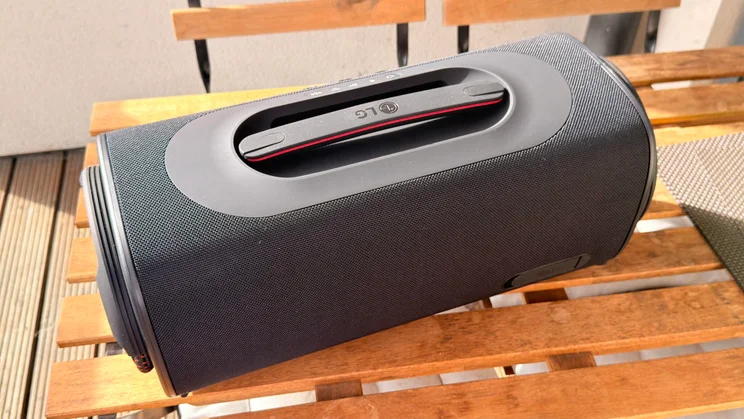
LG made many good decisions about this speaker’s portability. The Blast has two carry options: a sturdy, retractable handle when held sideways, and a small but strong rope strap that wraps around the right side. Overall, the Blast is far more portable than the Stage 501 while still being unquestionably beefy. I also love that LG has incorporated a place to prop up your phone while it’s in use (right in front of the top handle).
However, I think LG could’ve leaned a little further into the duffle bag aesthetic and added a shoulder strap or attachment points for one. That feels like it would have been the easiest way to move this speaker around.
Even without that, it’s more travel-friendly than many other big speakers with hard-to-grab handles. I don’t think it would be too challenging to bring to outdoor gatherings, beach days or even a camping trip, although it may be overkill in that last scenario!
What’s the sound quality like?
The Blast uses two 5.25in neodymium woofers along with two 20mm “Peerless” tweeters. The most noticeable thing about the sound is that it’s exceptionally bassy, much more than I expected even right after testing the bigger Stage 501.
Like that speaker, the Blast’s Bass Boost mode is on by default, but this time it’s really thumpy and does mess with the midrange. The bassline on Myles Smith’s Stay was a fair bit boomier than usual, which made the vocals a little harder to hear. It’s a satisfying, texture-rich thump for bass lovers, but doesn’t work for every track.
But that’s not the end of the story, thanks to the level of in-app customisation. The Standard and AI Sound modes are less bassy and sound fantastic. The speaker can produce stereo sound from a single box, something most smaller speakers can’t do, and I really enjoyed the panning stereo effects on tracks like Charlie Puth and Jung Kook’s Left and Right.
I felt AI Sound mode suited most music best, as it provides enough bass presence while still letting vocals breathe, and with the bass slightly tamed, you can hear that the tweeters deliver high frequencies without harshness. The spatial field feels appropriately wide for a speaker this size.
Even at much higher volumes than I’d comfortably listen to while working from home, I found distortion kept in check. I pushed it to higher volumes with tracks by Massive and Portishead, and still heard remarkably clear, textured bass. But, as mentioned, it’s incredibly loud. The speaker hit well over 100dB when pushed to its limits, something I avoided doing for too long to avoid annoying my neighbours.
Should you buy the LG xboom Blast?
Depending on your priorities, the LG xboom Blast might be your ideal speaker. It certainly delivers on its promise of being rugged, long-lasting and very powerful. Its relatively portable design, IP68 rating, military-standard durability and replaceable battery pack also mean it’s built to last.
However, by default, its sound is overly bass-heavy for my ears. That may be ideal for a party, but you’ll need to experiment with the in-app sound modes if you want something more balanced for everyday listening. But my biggest issue with the xboom Blast is its price tag. £450 is a serious amount of money for a Bluetooth speaker, and only those serious about big sound should consider the xboom Blast. For those people, it ticks pretty much every box. For casual outdoor use or mixed use at home and further afield, you can get better-value options with better-balanced sound out of the box.


