
To help us provide you with free impartial advice, we may earn a commission if you buy through links on our site. Learn more
- Reduces effort effectively
- Surprisingly comfortable
- Very easy to use
- Looks kind of silly
- Upper models are expensive
Ever since I first watched Ellen Ripley ejecting the xenomorph with triumphal and righteous violence out of the airlock and into space, I’ve wanted to try out that suit. Imagine what you could do with the help of the P-5000 Powered Work Loader strapped to your limbs: you could lift incredibly heavy weights, walk for hours without getting tired, defend the weak and protect the vulnerable… a pipe dream, perhaps, but you might be surprised to discover that there’s a company working at making at least part of this fantasy a reality.
The company (and the product) is called Hypershell and it’s an honest-to-goodness powered exoskeleton, designed to provide assistance for walking and running. It’s available for anyone to buy and, costing roughly the same as a decent bicycle, it’s not as expensive as you might think. I’ve been trying out one of the company’s second-generation products on and off for the past few weeks and I can tell you, it is not as outlandish as it might sound.

What do you get for the money?
It’s not as expensive as you might expect, either. Given the niche application and the (currently) small target market, a base price of £899 for the X Pro S seems quite reasonable. The other two, more premium models are pricier still but again, not unattainably so: the X Max S costs £1,299 and the X Ultra is £1,699, the key differences being the amount of power the motors can generate, the battery life (the Ultra S comes with two batteries), which translates to the range of each model, and the materials used.
| HyperShell X Pro S | HyperShell X Max S | HyperShell X Ultra S | |
|---|---|---|---|
| Price | £899 | £1,299 | £1,699 |
| Peak power output | 800W | 1000W | 1000W |
| Range | 17.5km (eco | 30km | 30km (x2 batteries) |
| Construction materials | Aluminium/carbon fibre | Aluminium/carbon fibre | Titanium/carbon fibre |
| Weight | 2.59kg | 2.57kg | 2.54kg |
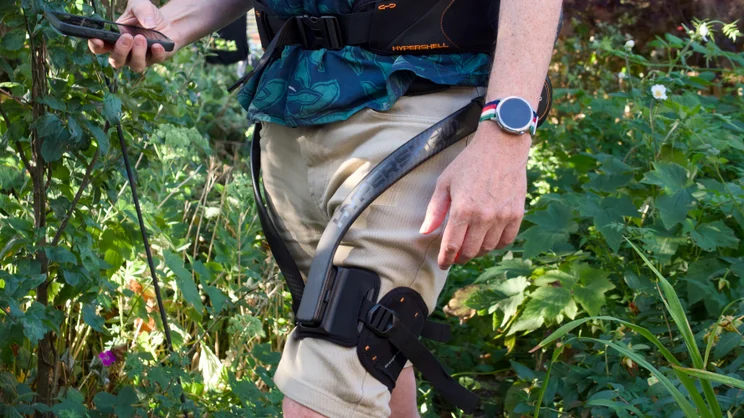
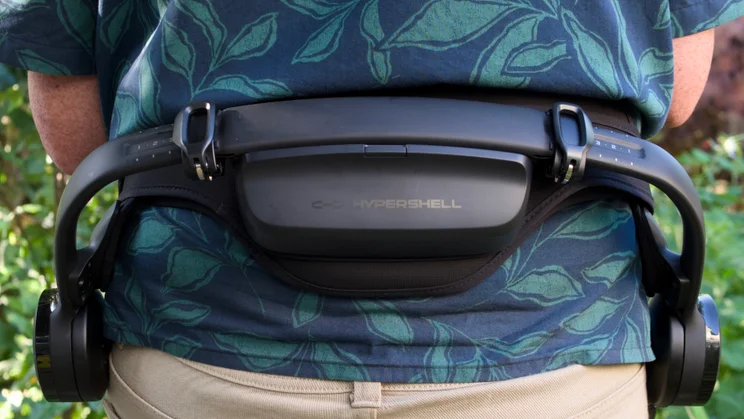
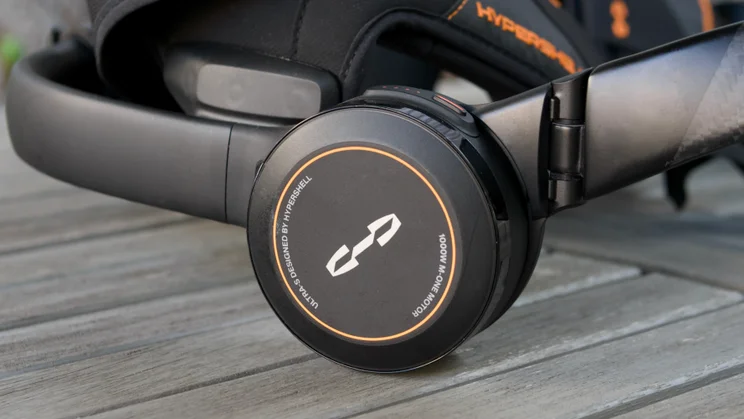
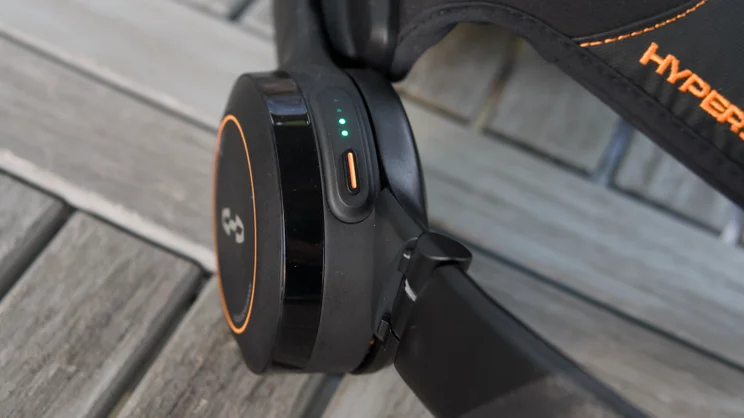
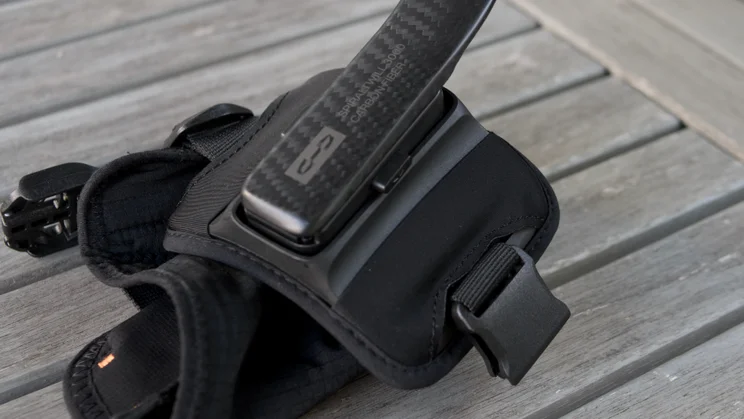
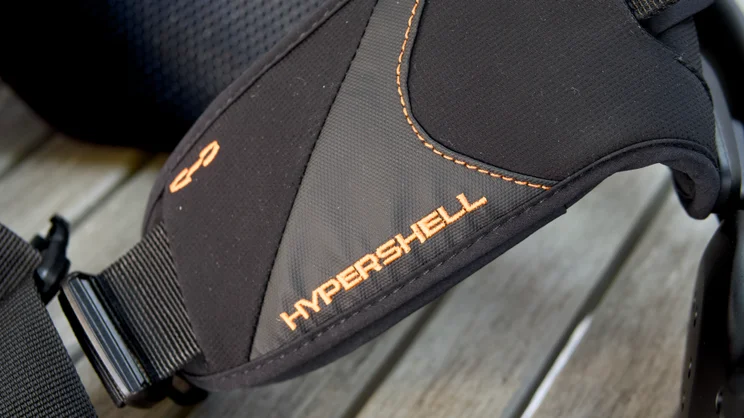
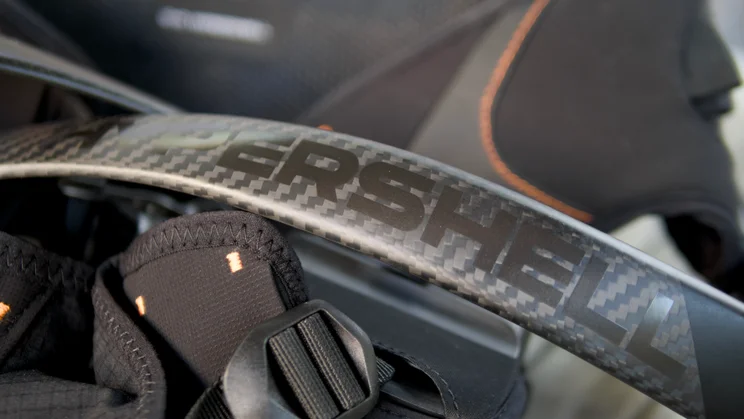
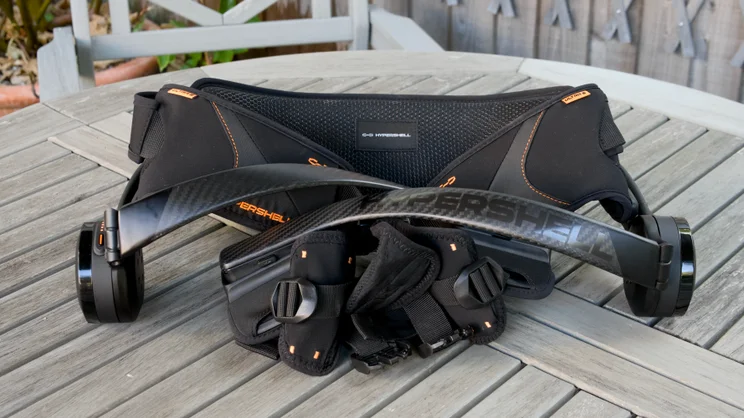
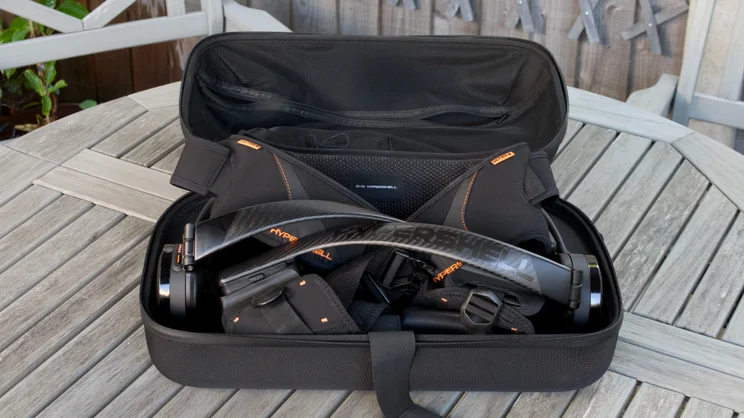
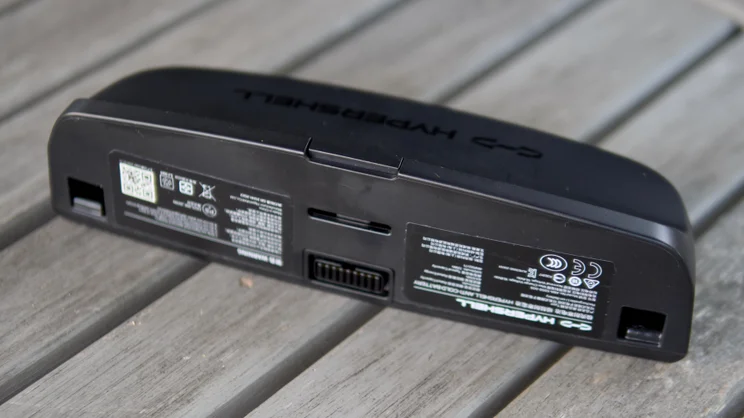
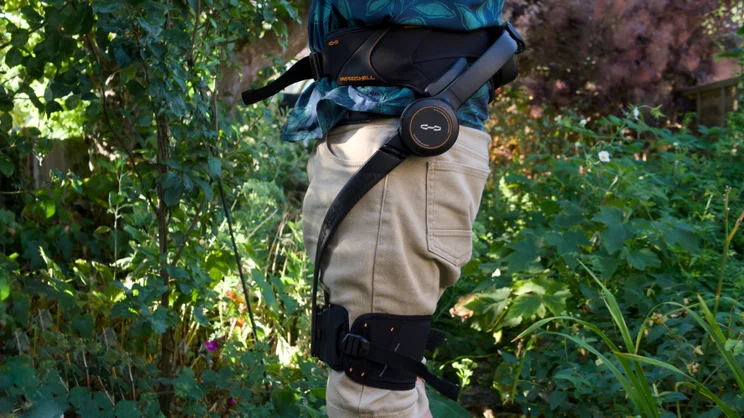
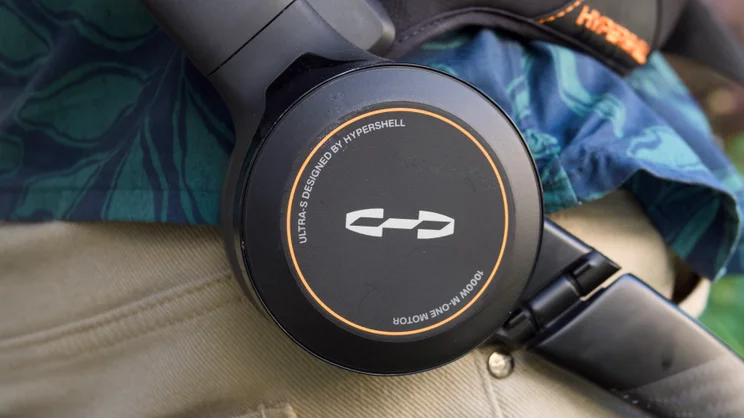
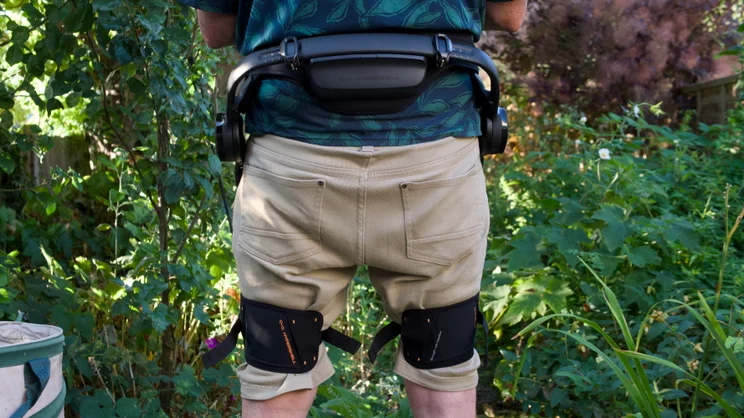
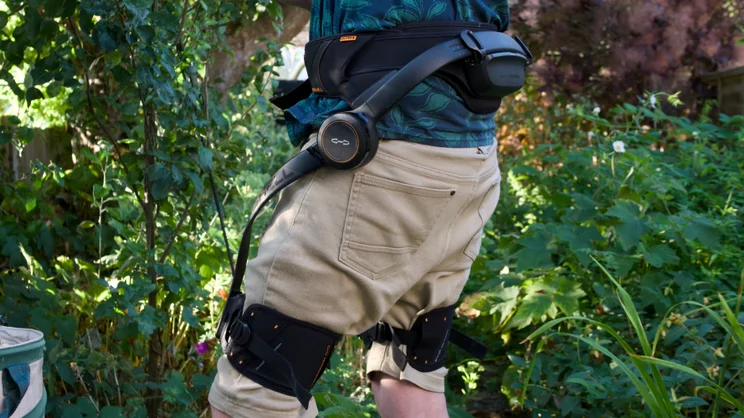
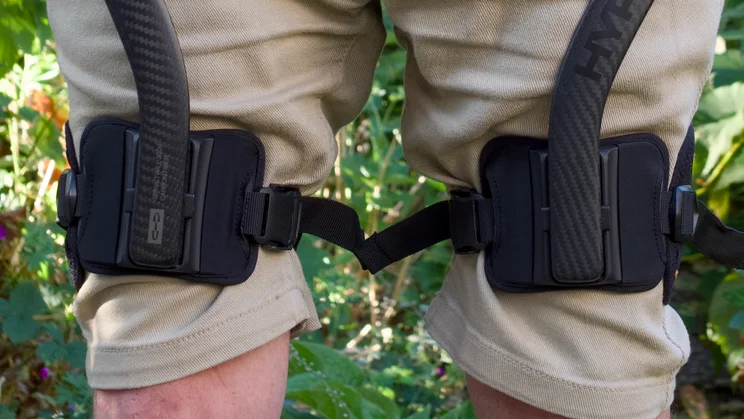
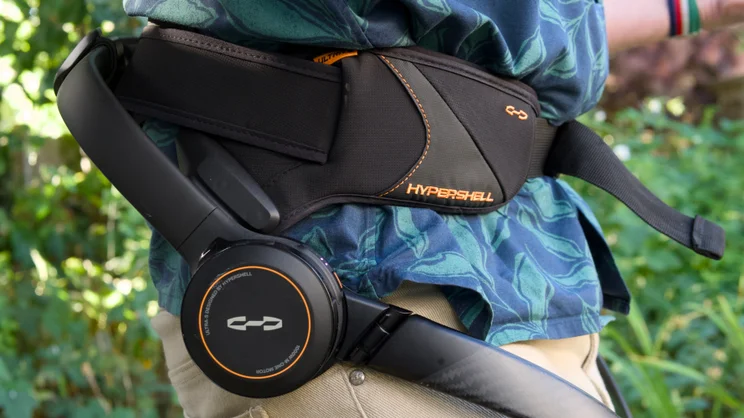
All the models fit the same and work the same way: you have a hip brace that you wear a bit like the hip belt on a rucksack, with a pair of motors attached to the left and right and a rechargeable battery snapped onto the rear. From each motor, a pair of carbon fibre struts extends down the outside of your thighs and twists over the top of the leg, terminating in an adjustable loop that secures just above the knee.
Once you’ve secured the whole thing in place, it’s simply a matter of pairing the Hypershell with the mobile companion app, where you can analyse performance, switch modes and adjust power levels. There are plenty of options available to tweak to help get things the way you want them. The main way of controlling assistance is by adjusting the power.
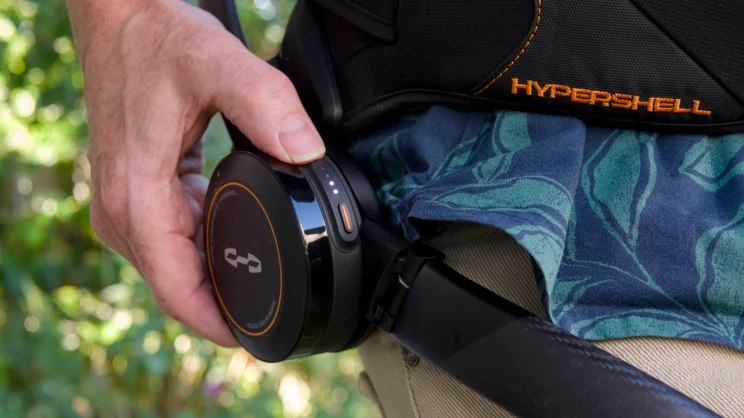
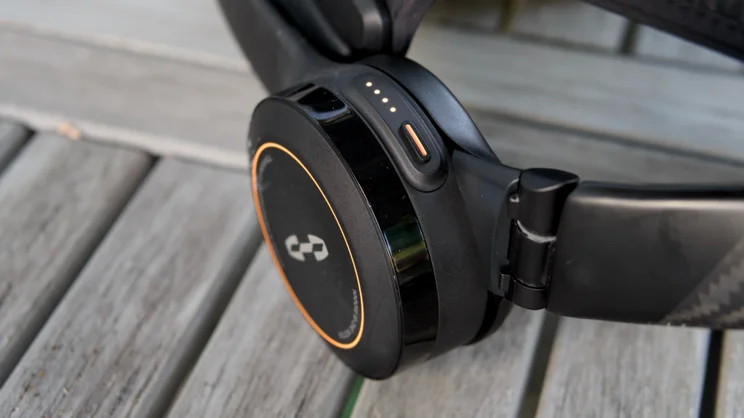
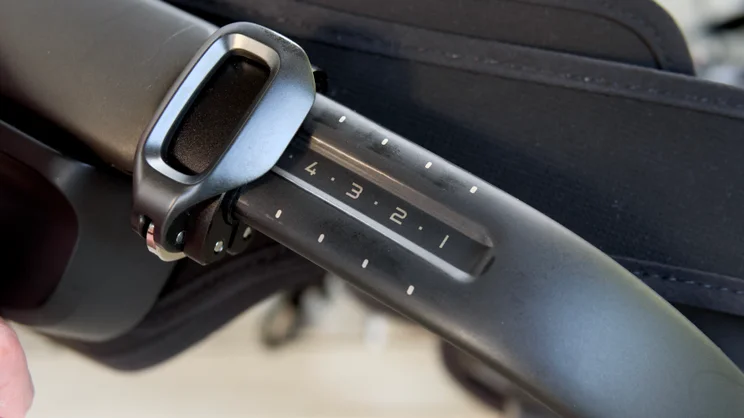
There are two main modes here – Eco and Hyper – and you can adjust the level within each of these modes in 5% increments from 0% to 100%. A third mode – Fitness – reverses the motors and provides resistance as you walk or run, giving you an extra workout, while Rocket Mode ramps up assistance even further for an extra boost, although this only works in 30-second bursts. You can also control the Hypershell with a button on the right hip motor, while a series of four LEDs indicate which power level and mode you are using.
As for what’s new, this latest model is equipped with a feature called HyperIntuition, which uses AI to detect your motion, whether that be running, walking, or climbing/descending the stairs, and adapt the way it provides assistance automatically. Previously, you had to select the assistance mode manually from the smartphone app. This proved remarkably effective, detecting when I was walking, running or climbing stairs with seamless accuracy.
Hypershell also says the new model is more responsive to your movement and more compact when it folds away. It also now has independent lab certification from TÜV Rheinland and SGS verification proving that it can reduce oxygen use by up to 39% and average heart rate by up to 42%.
Who is the HyperShell X S series for?
Much as it has been fun to write this review, the HyperShell isn’t really designed for people like me. I like to go running and walking to stay fit. I don’t really need assistance to do so. On the contrary, I want to get tired when I work out because that helps me improve from a physical perspective.
But for others, it could be a game-changer. For people who walk a lot for work, perhaps, it could prevent them feeling exhausted after a demanding day or week on their feet. Alternatively, for those struggling with fatigue or joint pain, it could help them stay active when otherwise that might not be possible.
The product also has a market among outdoor professionals, too. HyperShell says that more than 20 search and rescue organisations are already using them to reduce fatigue and help their guides stay sharper (and safer) while working in extreme conditions.
What does it feel like to use?
The first thing to address is comfort and embarrassment levels. As for comfort, the device does feel a little odd to start with, but it’s no worse than wearing a bulky rucksack. I wore it at the peak of the recent heatwave to walk the area around where I live, did a couple of runs while wearing it, and wore it around the house in fitness mode to give myself a little extra background workout. I won’t say I ever fully got used to wearing it, but it wasn’t uncomfortable, either.
What might be a bigger problem for you is getting over being seen wearing this thing out in public. I confess I’m pretty thick-skinned about these sorts of things; after forcing myself to wear the Dyson Zone in public, nothing fazes me. The good news is that if you’re wearing it out on the moors with your full walking gear on, it blends in with your other gear quite nicely. In running gear, though, it’s going to stand out a bit more.
As for the feel of the assistance itself, that isn’t quite what I had expected. I thought it might make me feel a bit like I do when I ride an e-bike: as if I’ve suddenly got rocket boost power in my legs, instantly making me faster. In reality, the experience with this product is very different.
Whereas on an e-bike the power is applied all the way through the pedal stroke, the motors on the Hypershell don’t appear to help push you forward. Instead, most of the assist kicks in as you lift your leg off the floor. The motors do push your leg downwards, too, but it doesn’t appear to help with actually pushing off the floor. That part is still mostly up to you.
The effect becomes most apparent in Rocket mode (peak power), which flings your legs forward with real force. It feels a bit like you’ve just found a job with the Ministry of Silly Walks, though, and I felt more comfortable leaving it in Eco mode for walking, reserving Hyper mode for running or climbing steep slopes and stairs. The Hypershell also works to soften the impact of the “landing phase” of each step, although this is another aspect that I found difficult to assess the impact of.
The biggest effect you’ll feel if you ever get to try one out, however, is when you take it off after wearing it for a while. I took it out for a run one morning, and when I switched the power assist off at the end, it felt like I’d attached weights to my legs.
How did I test the HyperShell X Ultra S?
Still, while it may not feel like it’s making you faster, it should help with fatigue in the long term, by reducing the physical “cost” of running or walking. It’s one of the well-founded principals on which carbon plate running shoes operate, so this ought to be even more effective.
To test it out, I set up a quick experiment. I did two simple walk-run sessions on a friend’s treadmill, recording each while wearing a heart rate chest belt and two smartwatches, plus a Stryd footpod to keep an eye on my vitals.
First, I carried out the session while wearing the Hypershell set to 100% in Hyper mode. I walked for 30 minutes at a steady 5km/h, followed by a steady 15-minute run after a two-minute rest at 10km/h, with the incline on the treadmill set to 1%.
Next, I carried out the same session without wearing the Hypershell 24 hours later, to ensure proper recovery. No alcohol was consumed between the tests (honest!) and I got a good, solid sleep in between. My Garmin watch said I was in “Prime” condition for the second workout and fully recovered from the first workout, which is about as good as it gets.
The idea with the treadmill was to keep the potential variables to a minimum, while recording how much physical effort was expended in each session. If the Hypershell was working, I’d expect a significant indication of lower overall effort on the first day compared to the second day.
How much assistance does the Hypershell X Ultra S provide?
So how did it do? I’ll be honest, I wasn’t expecting much, especially as the workout was so short. But I was wrong. The two walks felt largely the same to me (perhaps I should have set the speed a little higher) and this was reflected in the stats: a 1bpm difference in average heart rate and very little difference in cadence and respiration rate.
Only the Body battery metric indicated, potentially, a slightly higher expenditure of effort. (Note: the indoor walk mode on my Garmin doesn’t record as many metrics as the treadmill run mode, which explains the missing power and stamina numbers for the walk section.)
As soon as I started to run on day two, however, it immediately felt significantly more challenging from a cardiovascular point of view; shockingly so. Running felt harder, breathing was tougher and my heart felt like it was beating at a far higher rate.
The recorded data backed up these observations. My heart rate was, on average, 24bpm lower when wearing the Hypershell; a significant difference. Plus, I used half the amount of my available “Stamina” according to Garmin’s estimations. I wasn’t expecting to see or feel such an obvious effect.
| Session 1 (With Hypershell) | Session 2 (without Hypershell) | |
|---|---|---|
| Average HR (bpm) – WALK | 101 | 100 |
| Average HR (bpm) – RUN | 134 | 158 |
| Average power (W) – RUN | 261 | 265 |
| Stamina – RUN | -6% (99%-93%) | -12% (99%-87%) |
| Cadence (spm) – RUN | 154 | 158 |
| Cadence (spm) – WALK | 114 | 114 |
| Body battery net impact – RUN | -3 | -5 |
| Body battery net impact – WALK | -3 | -4 |
One interesting thing I noticed was that my cadence was 4spm (steps per minute) lower when wearing the Hypershell. Now, I wasn’t trying to match cadence, I just ran by feel, keeping things as economic as possible, but it seems my body was reacting to wearing the Hypershell by lengthening my stride. Perhaps this is part of why the first run felt more efficient.
A colleague, Louise, also tested the device on her regular 5km running route. The first time she wore it out, she beat her 5km personal best by 40 seconds. She’s not sure if that was due to the placebo effect of expecting the Hypershell to help her run faster, but it clearly didn’t hamper her efforts.
How long does the battery last?
So, we’ve established that the Hypershell is effective, and you might be getting excited about what it can do for you. But how long does the battery last? If it can’t last the distance, after all, there’s not much point in spending so much money. In theory, it’ll last an age. Hypershell rates the 72Wh battery for up to 30km, but that’s in Eco mode and the lowest level of assistance. You’re unlikely to be using it in that mode for long, so it’s likely your mileage (or kilometre-age) will be considerably lower.
The good news is that even in Hyper mode at 100%, my 45-minute walk-run session – about 5km in distance terms – only consumed 55% of the 72Wh battery. I reckon you’d just about be running out of juice at around the 10km mark at max assistance. Hyper mode at 100% is overkill for walking, so you’re probably looking at at least 20km, which is loads.
And if you do need a bit of extra juice, you can swap in a freshly charged battery quickly and double the range to 40km plus; plenty for even more extreme challenges. As far as charging goes, it took around 50 minutes to go from 45% to 100%, so not the quickest but fast enough that you could give it a decent top-up in your bag with a portable USB charger while sitting on a rock at the top of a mountain having a leisurely picnic lunch.
Should you buy the Hypershell X Ultra S?
This is a hard question to answer, because as I said at the top of the review I am not the target market for this product. All I can report is my own experiences: those are overwhelmingly positive. It works a lot more effectively than I expected it to. It’s reasonably comfortable, and it’s very easy to use. Even the price is reasonable, given that this is advanced and fairly niche technology. I’d have expected it to cost an awful lot more.
Certainly, if you have mobility or joint pain issues and you’re desperate to get out and about more, the advantages would vastly outweigh the investment, even in the more expensive model. And I would certainly recommend giving one a try if you can get yourself along to a retailer – Selfridges is offering demos in London, if you’re unsure, or you can order one and return it after 14 days although you’ll need to be careful not to damage it.
Either way, having been initially sceptical at the outset, I must admit I’m now somewhat won over by this futuristic exotic product. And although I can’t personally see myself having much of a use for it (that xenomorph invasion is probably a few years off just yet) I can absolutely see the practical applications.


