
To help us provide you with free impartial advice, we may earn a commission if you buy through links on our site. Learn more
Written by Guy Cocker
The Consumer Electronics Show (CES) always features concept products whose sole purpose is to show off a company’s cutting-edge tech with zero expectations of these products ever making it to market. With Samsung and LG’s ever-expanding 130in TVs, I’m ok with that, because they’d never even fit onto an average home’s wall, let alone be affordable if they did. But when I saw Lenovo’s Legion Pro Rollable, I was not only left hoping that this concept will indeed see the light of day, but I couldn’t wait to get one to play with properly.
For the uninitiated, Legion is Lenovo’s gaming brand, under which it sells a plethora of laptops, desktops and RGB-enabled peripherals. Legion has made a name for itself by offering well-specced and feature-rich devices at way more reasonable prices than competitors like Asus and Razer. Indeed, my own Legion 5 2025 laptop on which this hands-on is being written features a Ryzen AI CPU, an RTX 5060 GPU and a gorgeous OLED display, all while costing just £900.
Sadly, I doubt that kind of value will extend to the Legion Pro Rollable, if it ever does make it onto the Lenovo Store. Firstly, it’s basically a maxed-out Legion Pro 7, which currently sells for around $4,000/£3,500 even without the rollable screen. Lenovo didn’t confirm if the larger display needed the RTX 5090 GPU that sits inside this concept machine or whether a 5080 would suffice, but I expect a top-level GPU to be needed to push the pixels that an ultrawide display is counting on.
But, I’m getting ahead of myself. What does the Legion Pro Rollable actually offer to gamers with deep pockets and a love of innovative new technology?
Wide to wiiiiide
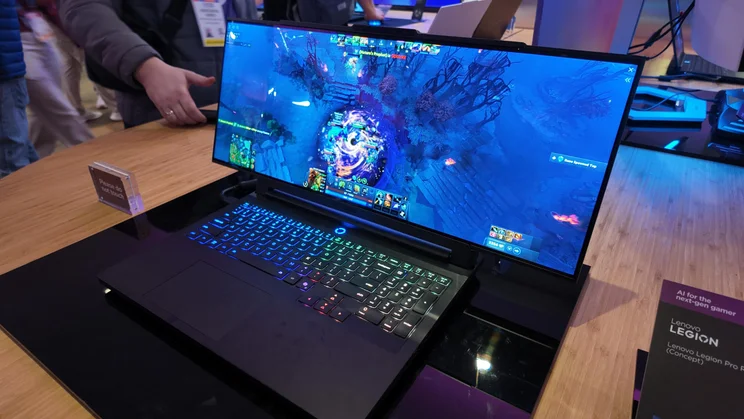
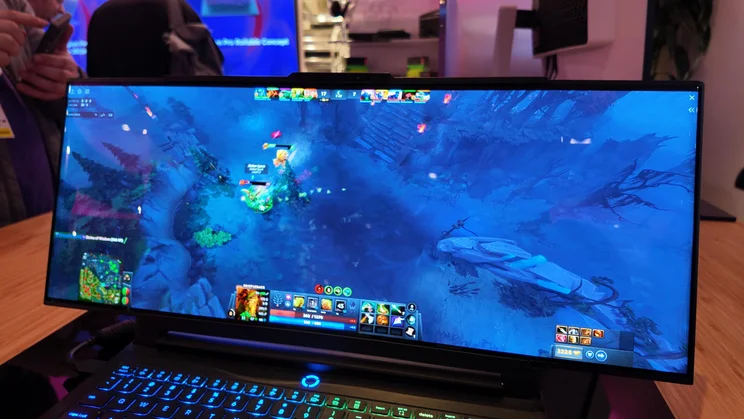
The headline feature of this laptop is that its screen can expand into three different states: wide, wider and ultrawide. That’s thanks to the rollable OLED panel that powers its display. Lenovo introduced a similar rollable OLED laptop at CES last year in the form of the ThinkBook Plus Gen 6 Rollable.
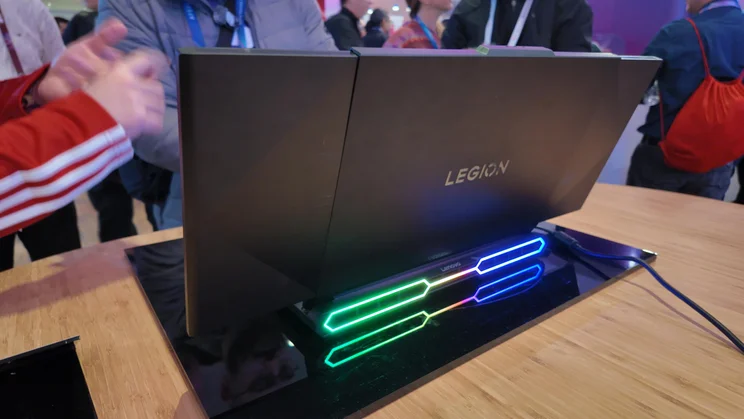
However, the main difference was that the screen on the ThinkBook rolled upwards, rather than outwards like on the Legion. The ThinkBook basically transformed into a phone or tablet-like portrait display when expanded, whereas the Legion looks much more like an ultrawide gaming monitor when unfurled. The ultrawide format is a favourite for gamers who like to be able to see as much of the game as possible, as it gives them a tactical advantage in eSports titles like shooters and MOBAs.
The screen format change is activated by holding the “Fn” key and the left or right arrow keys, depending on whether you want it to expand or retract. The process takes a few seconds between each of the three states, and you can hold the direction button down if you want to skip the middle “intermediary” position. The screen stays on as it changes aspect ratios, and it’s all done in a mechanical and smooth fashion.
Technically speaking, the screen goes from being 16in in its standard 16:10 configuration, to then becoming a 21.5in 21:9 screen, which Lenovo calls “Tactical” mode, and then 24in in its ultrawide 24:9 “Arena” mode. On a technical level, that’s mightily impressive, given that both those expanded screen sizes are significantly larger than even the biggest gaming laptops, which usually max out at 18in.
Not quite backpack-ready
During my hands-on time with it, I noted that the machine felt well-built and sturdy, although I have more concerns around durability than I would on a regular gaming laptop. That screen is always going to be more delicate than a standard laptop display, while there’s also the potential for the motors to need a repair depending on how often you roll the screen in and out. Let’s be honest, this is a laptop you’ll want to show off to friends, so that could mean a lot of expanding and retracting.
There was also a noticeable crease where the main display ends, but it’s certainly not as noticeable a crease as you get on most folding phones. I was more bothered about the size of the bezels, which were thicker than on regular displays, although I expect this to improve if this product ever makes it to market. I also sadly didn’t get to actually play a game on the device, just watch videos of gameplay, and while they gave a good impression of what it will be like, there’s nothing like being immersed in actual gameplay.
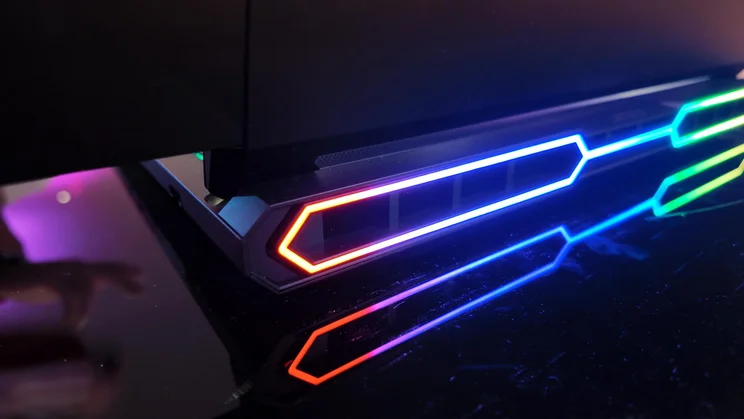
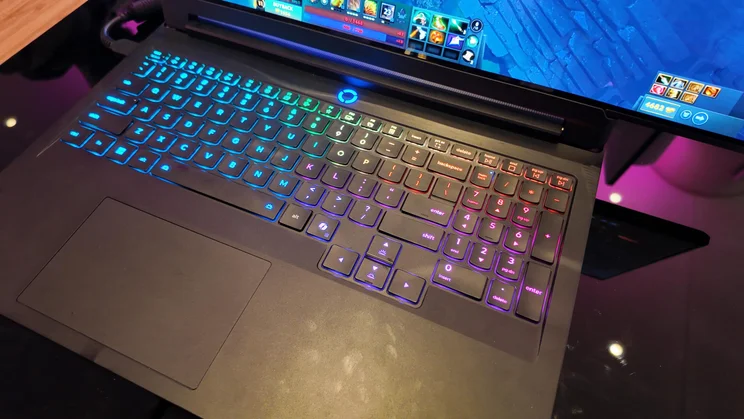
This is still a gaming laptop, which means the RGB lighting on the keyboard and rear of the machine has made it over from the Legion 7 Pro. I think it looks cool, although I’m perfectly willing to accept that not everyone is enamoured with this gaming aesthetic — for those people, you can turn the lighting off if you want to.
The Legion Pro Rollable concept is based on the maxed-out Legion 7 Pro, which has an RTX 5090 GPU and a top-tier Intel Core Ultra 9 CPU. I suspect that’s last year’s Intel processor, and that a newer Series 3 model would be used in a retail machine, if it were to come out this year. Sadly, there’s no price or release date available for the Legion Pro Rollable, but I imagine it would cost at least $5,000, given the price for the existing 7 Pro laptop and the cutting-edge display being used here.
eSports expectations
Lenovo claims that the product is the result of the company’s recent involvement in eSports. Players have apparently been asking the manufacturer if they could fit a wider screen onto a laptop, so that they could gain a competitive advantage in games like League of Legends while they’re travelling on the road. As those who use an ultrawide monitor will attest, it’s a great way to play games, giving you a competitive edge in eSports titles like Counter-Strike and a more immersive experience in cinematic games like Cyberpunk 2077.
As a device, the Legion Rollable reminded me of my experience with the Samsung Galaxy Fold 7 this year, in that it’s trying to do multiple things well, rather than being the best at one thing like the S25 Ultra I went back to. For example, I loved the Fold 7’s large unfolded display, but I hated the second-tier cameras and the fact that the cases for it made it bulky and unwieldy. Similarly, I imagine the Legion Pro Rollable will be great when it’s in Ultrawide mode, but I’d probably still buy a standard Legion and invest the extra in a separate Ultrawide monitor, and save a lot of money in the process. But I admit that’s the boring real-world approach, and a lot of people would love a rollable gaming laptop to show off to friends.
The Legion Pro Rollable so far has no planned release date, but given the reaction to the device at CES, I expect Lenovo will be assessing how it can bring it to market in the coming year.


