
To help us provide you with free impartial advice, we may earn a commission if you buy through links on our site. Learn more


Lenovo runs the entire gamut of laptop and tablet use cases, and nowhere is this better exemplified than in its MWC 2026 product offering. We’ve got Yoga 2-in-1 tablets and laptops for creatives; IdeaPad and ThinkPad laptops for productivity; and Legion tablets and laptops for the gamers.
I’ve also seen a pair of concepts that – I’ll be honest – didn’t quite set my pulse racing. The Lenovo Yoga Book Pro 3D has a glasses-free 3D display for creating in three dimensions, which feels a bit like technology from 2010; the Lenovo Legion Go Fold foldable gaming handheld is more interesting, but judging by the build quality, it’s still a little way from being fit for consumers.
I’ll be concentrating on the new Yoga and IdeaPad products here. I got a close look at the Yoga 9i 2-in-1 Aura Edition, the Yoga Pro 7a and the IdeaPad Slim 5i Ultra in Barcelona this weekend – here’s what I discovered.
Lenovo Yoga 9i 2-in-1 Aura Edition
First up, a beautiful 14in 2-in-1 laptop-tablet hybrid aimed squarely at creatives. The Yoga 9i 2-in-1 Aura Edition is the 11th generation of 9i: it swaps out Intel’s second-generation Ultra 7 processors for the newer third-generation (Panther lake) and tackles an issue that Lenovo says many of its users raised.
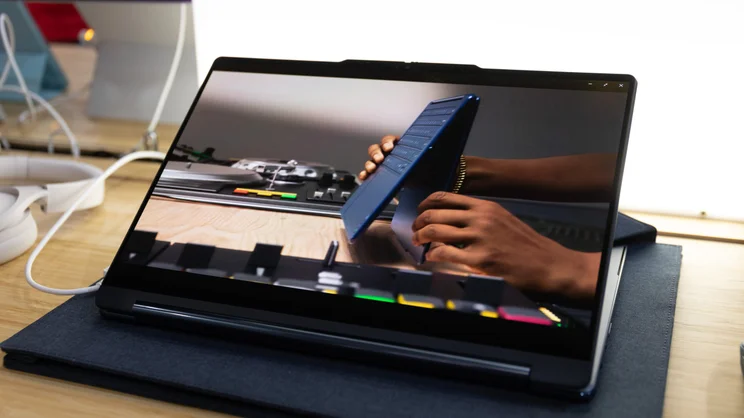
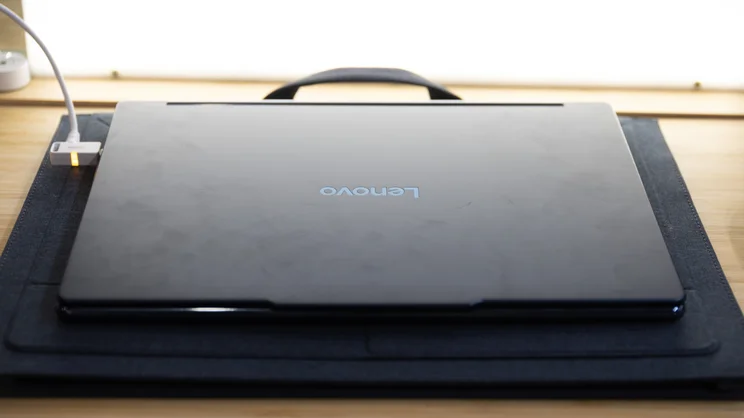
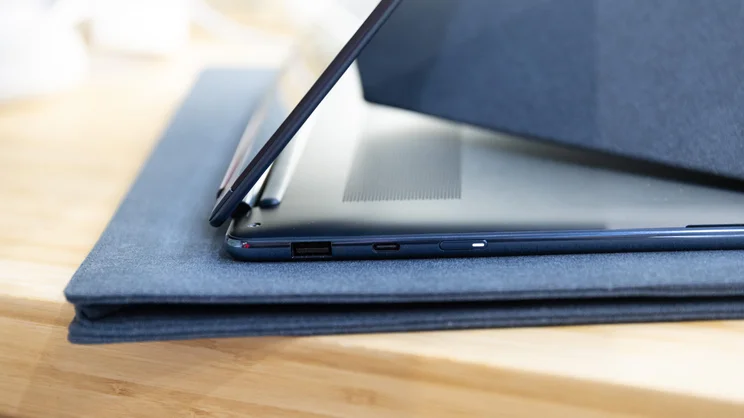
The tablet comes with a new Yoga Pen Gen 2 case that snaps to the rear of the display magnetically. The point here is that when folded into Canvas Mode, the new Yoga 9i is slightly elevated/angled, to more closely resemble how an artist would normally position their canvas. It’s pretty subtle – only about 15-20 degrees or so – but I gave it a go and found that my wrist rested in a more natural, and therefore less contorted, position. I should also say that as ever, writing and drawing on the display is a sublime experience: I noticed no latency and found the experience more pleasing than, say, that of TCL’s new A1 Nxtpaper.
The Yoga 9i is mostly identical to its predecessor in other respects, though. It’s the same 2,880 x 1,800 OLED display with the same 120Hz refresh rate and the same wide gamut coverage (100% DCI-P3). You’ll get 512GB of SSD storage and 16GB of LPDDR5X RAM, plus a basic 5MP webcam on the front. On the connectivity front, it’s got two USB-C Thunderbolt 4 ports, a single USB-A 3.2 Gen 2 port, HDMI 2.1 port and an audio jack. It weighs 1.29kg and measures 15.29mm at its thinnest.
As with its predecessors, the 2-in-1 can be positioned five different ways: Canvas, Tablet, Tent, Stand or Laptop Mode. It’s beautifully designed and feels well-made, as you’d expect from such a high-end product.
The Yoga 9i 2-in-1 Aura Edition will be available March 2026, with prices starting at around €1,799 (UK pricing TBC).
Lenovo Yoga Pro 7a
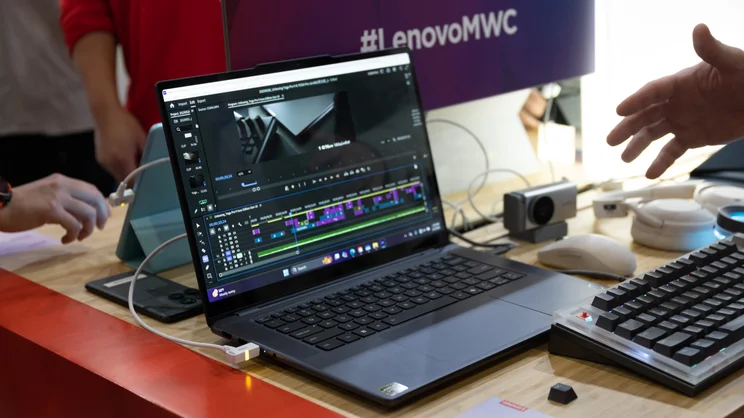
A twist on 2025’s Yoga Pro 7, the 7a is a substantially more powerful take on the premium laptop. It’s packing one of AMD’s Ryzen AI Max+ Series processors (exact model TBC) and up to an extraordinary 128GB of RAM to make creative workflows a doddle; this grunt is aided by dual fans and heat pipes to keep the system cool as it puts out up to 95W TDP for seriously demanding tasks.
It also includes a Yoga Pen Gen 2, which you can use on the Force Pad trackpad to draw, annotate and manipulate your designs. I tried this out on the show floor and left with mixed feelings – I love the concept, but the execution needs work. It was hard to tell where on the page your writing was going to appear, and it was far too easy to accidentally place your “pen” outside the page – resulting in the cursor reappearing and causing havoc (I accidentally resized the notes app window and closed it a few times).
The Yoga Pro 7a is a smidge bigger than the Pro 7, with a 15.3in OLED display rather than 14.5in. It seems as though the resolution is lower, however – 2.5K compared to the 2.9K (2,944 x 1,840) on last year’s model. You’ve got four Dolby-Atmos powered speakers embedded in the body of the Pro 7a, for some relatively mighty audio reproduction.
The Yoga Pro 7a will be available June 2026. Prices are estimated to start at €2,499 (UK pricing TBC).
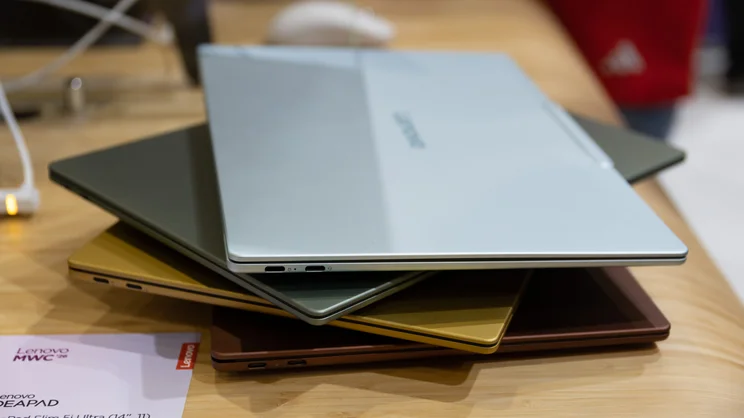
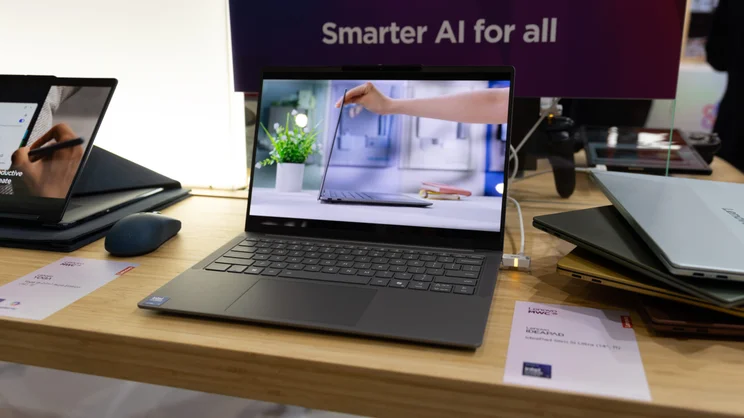
Lenovo IdeaPad Slim 5i Ultra
The 11th generation IdeaPad Slim 5i Ultra is a typical ultrabook – incredibly slim (just 11.9mm at its thinnest) and light (1.15kg in total), and yet impressively durable. That’s thanks to a precision-milled aluminium chassis, which as ever promises toughness without compromising on weight.
There’s a 65W battery inside: battery life is rated at around 20 hours of video playback, while a rapid-charging feature grants you two hours of use from 15 minutes of charge. Nestled alongside the battery is an Intel Core Ultra chip – this is a second-generation Lunar Lake model, however, not the new Panther Lake. That’s still a big step up from 2025’s Slim 5i. There will be a few models to choose from, but the high-end version comes with 32GB of RAM and 1TB of storage.
Like the Slim 5i, you can still pick the Ultra up with either OLED or LCD panel technology, with both offering 120Hz refresh rates and a resolution of 2,560 x 1,600.
The IdeaPad Slim 5i Ultra 11th Gen will be available June 2026, with an estimated starting price of €899 (UK pricing TBC).
AI enhancements
All three of the tablets/laptops described here will benefit from the launch of Lenovo Qira, an AI assistant that effectively exists across all of your Lenovo devices. It’ll automatically keep content synchronised across the various Lenovo tablets and laptops you own and watch while you design, making suggestions when asked based on your recent interactions.
It can also do the usual AI stuff – automated note-taking, transcribing and translating, for example. I watched as a Lenovo team member circled a section of text from a document and drew a star next to it using the Yoga Pen Gen 2 – Qira then lifted that text out of the document and copied it into the notes app automatically. That’s becoming a common feature of AI-ready devices, and it’ll be useful for students – which is why the demo was done on the student-oriented Lenovo Idea Tab Pro Gen 2.


