
To help us provide you with free impartial advice, we may earn a commission if you buy through links on our site. Learn more
- Powerful integrated GPU
- Great battery life
- Wonderful display
- Not many ports
- Keyboard action feels hollow
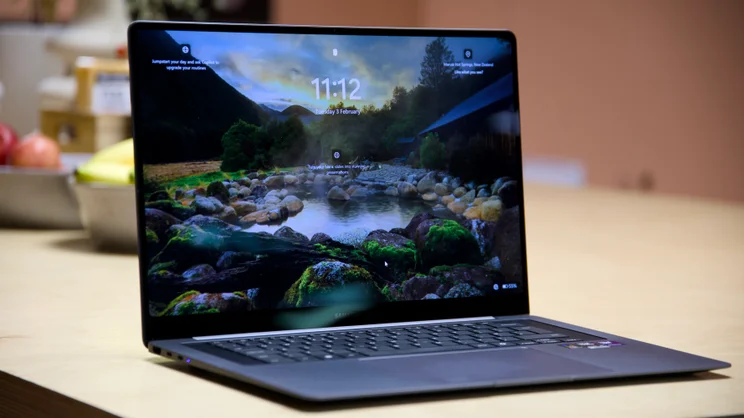
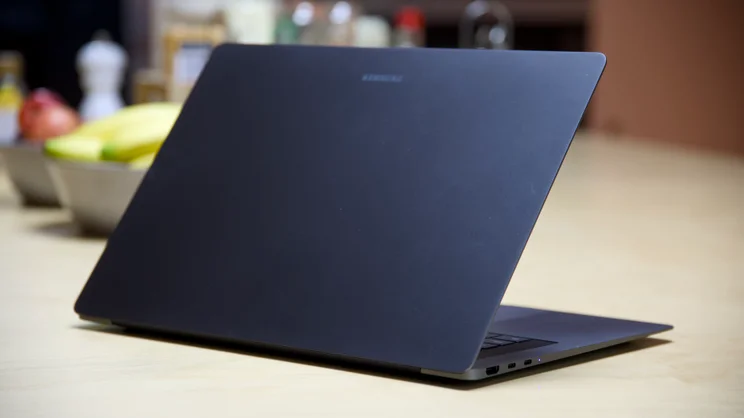
On the face of it, there’s nothing particularly special about the Samsung Galaxy Book6 Pro 16. It’s grey, it’s rectangular; from a distance, it looks like any other laptop.
But this is a product that is more than just any old silver slab. It combines Samsung’s manufacturing mastery with one of the best displays you can get on any laptop, and it houses Intel’s latest super-charged silicon. It may not look particularly special, but it’s what’s underneath that really counts.
What you need to know
The Samsung Galaxy Book6 Pro 16 sits near the top of Samsung’s flagship laptop range for 2026. It was launched at CES in Las Vegas alongside cheaper Book6 and more powerful Book6 Ultra models. And it comes with Intel’s latest Core Ultra Series 3 CPUs inside – the first laptop chips in the world to be produced on a 2nm manufacturing process.
The model reviewed here is the largest Samsung produces. It comes with a 120Hz 16in Dynamic AMOLED 2x touchscreen with peak claimed brightness of 1,000 nits HDR (500 nits SDR) and a resolution of 2,880 x 1,800 pixels.
It can be bought with up to 32GB of RAM and 1TB of SSD storage, has Wi-Fi 7 and Bluetooth 5.4. There’s a 1080p webcam, fingerprint recognition and a huge haptic touchpad for pointing and clicking, plus a quad-speaker setup for audio. This is a laptop that’s mainly targeted at creative professionals, for video editors and 3D modellers, but it can do pretty much anything else you care to throw at it.
Price and competition
Configuration tested: 16in 120Hz Dynamic AMOLED 2x touchscreen, 16-core Intel Core Ultra X7 358H, 12-core Intel Arc B390 GPU, 32GB RAM, 1TB SSD. Price (estimated RRP): £2,199
For testing, Samsung sent over the second most powerful model in the range: the 16in Book6 Pro with the Core Ultra X7 358H CPU inside. This has a 16-core CPU that runs at up to 5.1GHz and a 12-core GPU – the Intel Arc B390. It’s worth pointing out that this is just as powerful as the top-spec Ultra model, which has almost the same hardware setup but costs more. The main difference is that the Ultra comes with a discrete Nvidia GPU, either the RTX 5060 or 5070.
As for price, the standard Galaxy Book6 models start at £949, the Pro at £1,399 and the Ultra at £2,999. The model I have here for review, as detailed above, costs £2,199. Note, though, that these are currently estimated prices, as the volatile situation with RAM costs means they’re subject to change.
The obvious competition for the 16in Galaxy Book 6 Pro is the M4 Pro-powered 16in MacBook Pro, released back at the beginning of 2024, which currently costs £2,699. That gets you a 14-core CPU, a 20-core GPU, 24GB of RAM and a 1TB SSD. The MacBook is the more powerful machine, but I prefer the Samsung’s AMOLED screen, and it undercuts the MacBook by a significant margin at these prices.
If you’re after a Windows alternative, I’d encourage you to consider the Acer Nitro 16S AI at £1,599. It’s a gaming laptop, yes, but a remarkably slim one, and it outperforms the Samsung thanks to its discrete Nvidia GeForce RTX 5070Ti GPU. It can’t match the Samsung’s sleek good looks or its battery life, but it’s better value for money.
Otherwise, you’re looking at our laptop of the year for 2025 – the Honor MagicBook Pro 14, which packs in an astonishing amount for a relatively low price. There’s no discrete GPU and the Arc 140T can’t match the Arc B390 for sheer power, but for £999 you’re still getting an awful lot of laptop for your money: a top-end Core Ultra 9 285H CPU, 32GB RAM and a 1TB SSD, plus a glorious 3K OLED display.
Design
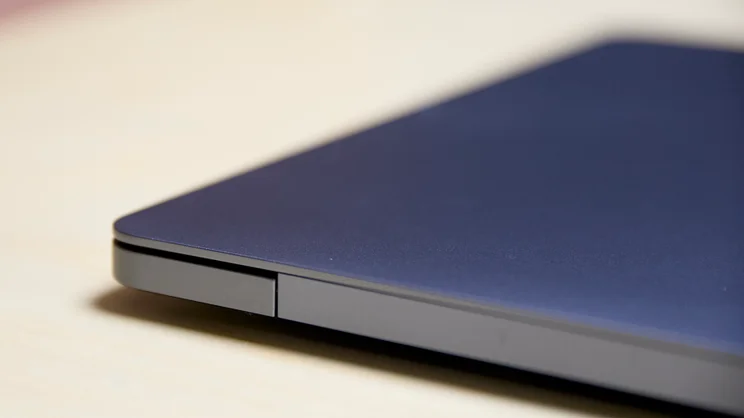
At the top of this review, I said there wasn’t anything particularly special about how this laptop looks. I stand by that comment, but when you get close, you can’t help but notice loads of neat touches that help it feel that little bit special. The first is the heavy-duty aluminium chassis, which feels like it would survive an encounter with an angry bear and come out healthy.
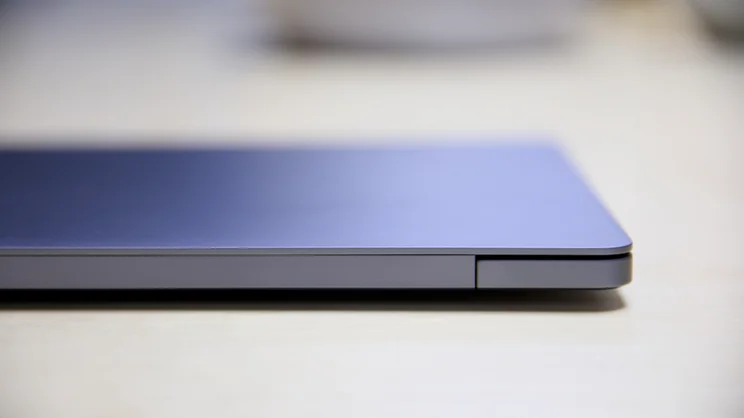
The lid-opening mechanism is equally sturdy, snapping shut with a resounding thunk thanks to strong magnets. Yet, you can open it with one finger without the laptop sliding around all over the place or teetering back and forth like a drunken Weeble. Its subtle wedge profile (when closed) lends it a smart, sleek look, too, and there are just enough angles and edges to set it apart from the MacBook Pro without making the laptop uncomfortable to carry.
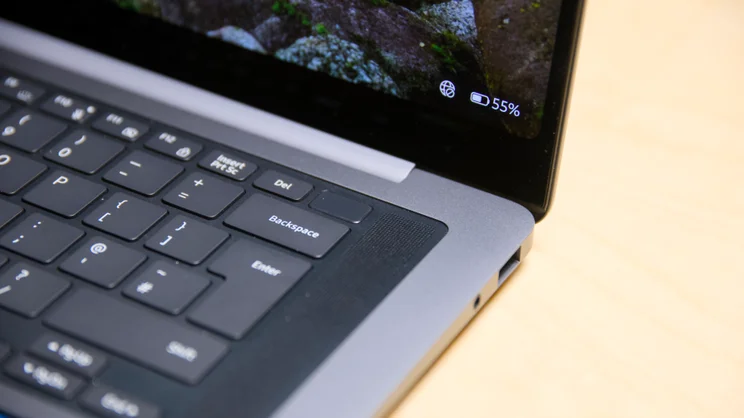
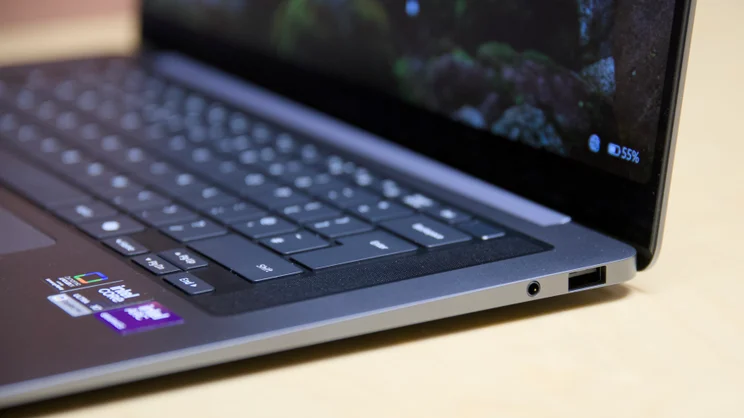
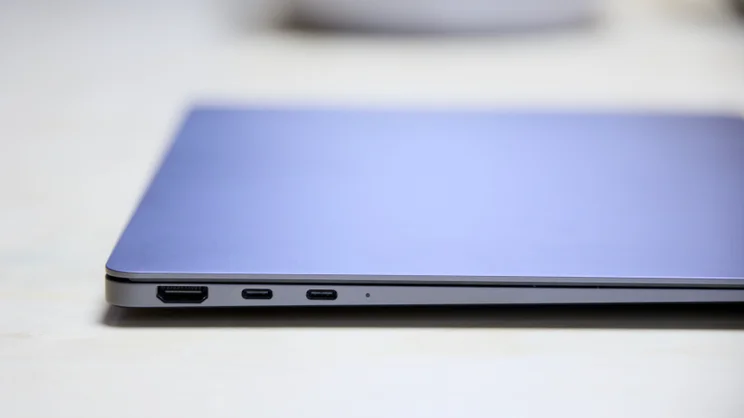
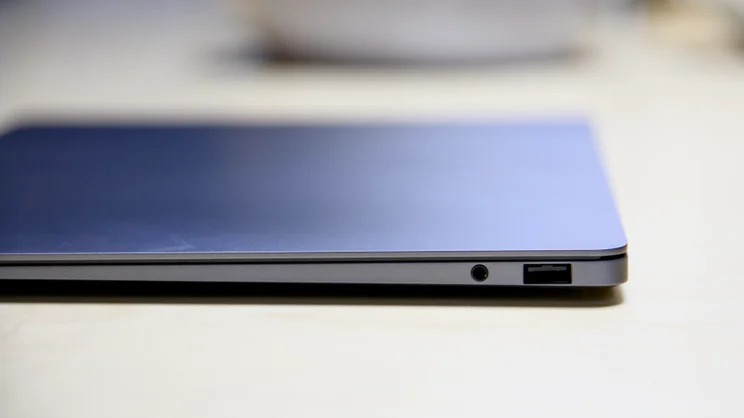
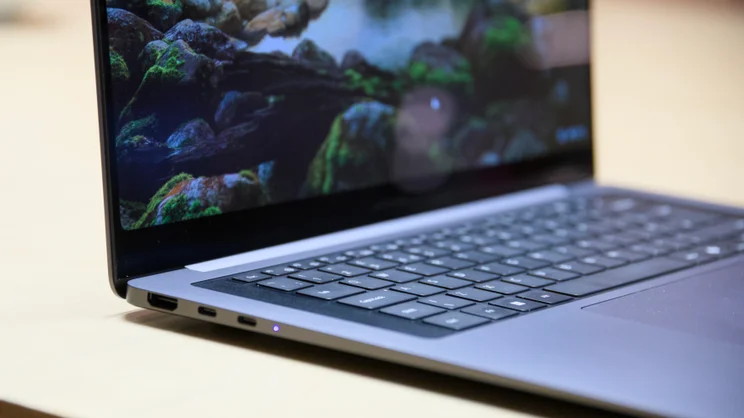
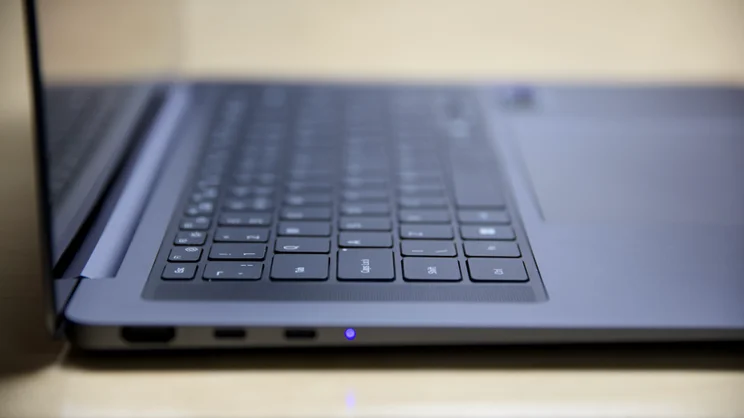
Size and weight are respectable, but nothing eyebrow-raising at 357 x 248 x 16.8mm and 1.61kg, while ports and sockets are as you’d expect – minimalist. There’s just one USB-A 3.2 port on the right edge next to your 3.5mm headphone jack, with a pair of Thunderbolt 4 ports and a single full-size HDMI 2.1 output on the left edge.
Keyboard, touchpad and webcam
The keyboard on the Galaxy Book6 Pro is good. Some might bemoan the lack of a number pad, but that does mean the keyboard sits dead centre, providing a more natural feeling typing position. It looks neater, too – I appreciate the added symmetry – although I’m not a fan of the half-height cursor keys. There’s plenty of room here for full-size keys.
The key action itself is positive, but feels a little light and hollow. There’s nothing wrong with it, per se, and the base feels solid enough, but it doesn’t quite sound or feel as progressive or as luxurious as I’d like on a laptop of this pedigree. The 1080p webcam is middling, too, producing rather soft, over-compressed images in low light. It’s nothing special, but not particularly offensive, either.
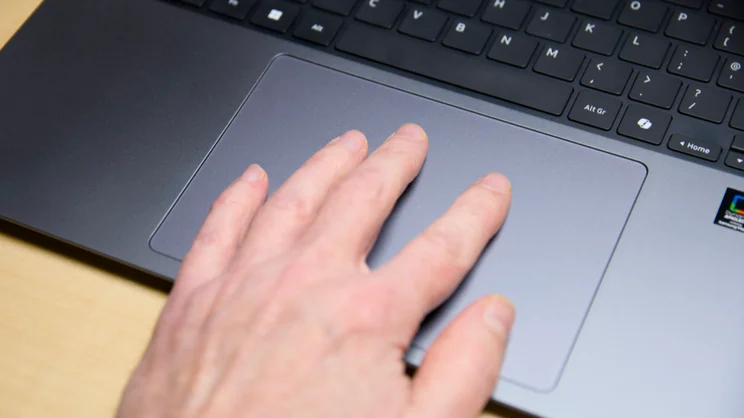
The touchpad, on the other hand, is a master work. It’s absolutely huge, spanning 151mm – around 42% – of the width of the wristrest, and measures 106mm tall. Despite its size, I’ve had no issues with activating it by accident, and because it’s a haptic touchpad, you can click all over it, even along the very top edge. It’s a joy to use.
Display and audio
The display is even better. I wouldn’t be overstating it to say that the 120Hz 2,800 x 1,800 Dynamic AMOLED 2x touchscreen on my review model is among the best screens I’ve ever encountered on any laptop.
The stats are good enough: there’s enough brightness – I measured peaks of 1,153cd/m2 – to do any HDR movie or TV show full justice, and good enough colour accuracy in any of the laptop’s selectable colour profile modes to satisfy even the most picky of creative professionals. With the AdobeRGB colour profile selected, I measured the average Delta E colour error at 1.33. In sRGB mode, it was 1.02, and in DCI-P3 mode, it was 1.12 with a white point that was largely spot on at 6,667k.
The numbers are certainly impressive, but when you see it doing its thing for the first time, your jaw will hit the floor. It’s one of those screens that, when fed with the right material, looks stunningly vibrant without going over the top. Feed it one of the many gorgeous HDR city nightscape clips on YouTube, and it rewards with gleaming neon lights and crisp details, while keeping candy-coloured glow to a minimum. Everything looks just right.
Audio-wise, it’s a tad less impressive with less warmth and richness than I had been expecting. There’s plenty of detail and volume – even more if you switch on the laptop’s Dolby Atmos Dynamic setting – and the speakers don’t break up if you push them right the way up to maximum, but compared with the speakers on a MacBook Pro or Air, they’re not as smooth.
Performance and battery life
That’s not a huge issue, though, because for the most part, the Samsung Galaxy Book6 Pro delivers where it counts. And where it counts is performance and battery life. The key to this is Intel’s latest generation of silicon – Core Ultra Series 3 (the CPU formerly code-named Panther Lake). In this particular machine, we have the Core Ultra X7 358H, a 16-core part running at up to 5.1GHz with a 12-core Intel Arc B390 integrated GPU, and an NPU rated at 50 TOPs.
It’s the model down from the Core Ultra X9 388H in the Asus Zenbook Duo I tested, but despite that, its performance in my testing proved almost as good. In the benchmark charts you can see below, for the CPU-bound tasks in our in-house media conversion tests, it only fell a small amount short of the X9 388H – it was 2.2% off – and the same held for the Geekbench 6 CPU test.
In more graphics-heavy tasks, the X7’s 12-Xe core Intel Arc B390 GPU again helped the Galaxy Book6 Pro 16 to similar results as the Asus Zenbook Duo, with an average frame rate of 42fps in the Shadow of the Tomb Raider benchmark in 1080p resolution with settings pushed to Ultra, where possible and XeSS disabled, and 60fps with XeSS enabled and in Balanced mode.
I also fired up Doom: The Dark Ages for a little demon splattering and saw frame rates of between 40fps and 50fps while exploring most environments, dropping to between 30fps and 40fps when things got frantic. That’s with most graphics settings set to Low and XeSS set to Native Anti-Aliasing.
Generally, the Book6 delivered equivalent frame rates to the Zenbook Duo. I guess that’s not surprising given the GPU is of the same specification – it’s only the CPU that is a little slower. Overall, though, the gaming performance is very impressive on the Book6 Pro. Yes, you will get better frame rates out of a gaming laptop with a discrete Nvidia GPU, but it almost certainly won’t give battery life as good as this.
And that’s where the Samsung Galaxy Book6 Pro truly shines. With the display set to a brightness level of 170cd/m2, playing back a low-resolution SDR video with flight mode engaged, the 78Wh battery helped it to last 18hrs 31mins, which is quite something for a laptop with this amount of power and a screen this large. The M5 MacBook Pro 14in beat it, but not by a huge margin, and it’s comfortably the longest lasting 16in Windows laptop we’ve reviewed.
Lastly, the Galaxy Book6 Pro 16’s 1TB of Samsung-branded SSD storage delivered an impressive 5,252MB/sec of sequential file reads and 2,811MB/sec of sequential file writes in testing, Those figures aren’t as impressive as the M5 MacBook Pro, which was up there at over 6,000MB/sec for both reads and writes – but still more than useful, and faster overall than the Asus Zenbook Duo (2026).
Samsung Galaxy Book6 Pro review: Verdict
There is no doubt that the Galaxy Book6 Pro is a top-quality laptop. It has a wonderful display, decent performance, impressive battery life and even a modicum of serious gaming capability, courtesy of that 12-core Intel Arc B390 integrated GPU. And it’s a lovely thing, too, carved out of a solid block of aluminium – all shark-like lines and stark minimalism.
There are some issues. By 2025 standards, the Galaxy Book6 Pro 16 is expensive. Our laptop of the year last year – the Honor MagicBook Pro 14 is currently £999 and delivers performance that’s not a million miles away, while the recently reviewed Acer Nitro 16S Ai costs £400 less and delivers considerably better gaming performance.
But neither can quite match the all-round appeal of the Galaxy Book6 Pro and, for those seeking a serious Windows-based alternative to the MacBook Pro 16, it’s the best we have right now, with a beautiful all-round build, impressive performance and great battery life.


