
To help us provide you with free impartial advice, we may earn a commission if you buy through links on our site. Learn more
- Fast, dependable
- Dependable
- Long lasting
- Not as easy to fix as the Neo
- More expensive than last time out
- You can get more power from a Windows machine for less
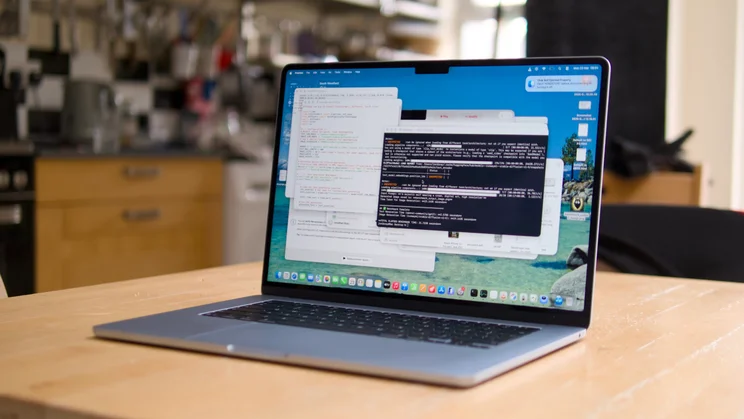
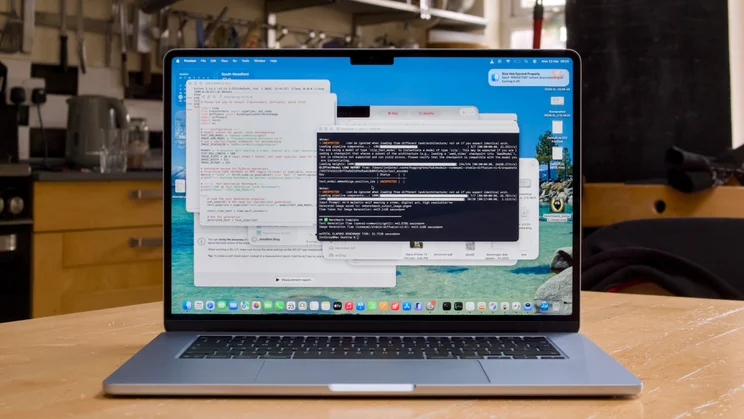
The MacBook Air has for the first time since its relaunch on Apple Silicon in 2020, taken a back seat this year; the Neo’s low price, and bright colours have overshadowed it, while a price increase – and lack of redesign – has made it less appealing as an everyman laptop.
But does that mean you should discount the MacBook Air if you’re on a tight budget? That’s the conundrum many potential MacBook Air customers now find themselves faced with. And that’s the question I’m going to answer for you in this review.
What you need to know
The first reason you might consider the M5 MacBook Air over the Neo is that it is a much more powerful device. Inside is an upgraded Apple M5 processor, which delivers superb all-round performance, there’s more RAM and storage as standard – and the Liquid Retina display supports P3 wide colour, which the Neo does not.
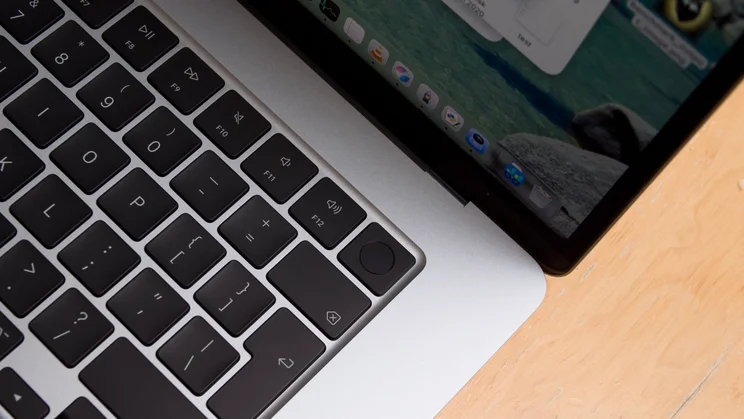
It has better battery life, with claimed 18-hour video playback compared to the Neo’s 15 hours. It has Face ID and all models come with a fingerprint reader. The keyboard is backlit and comes with a haptic Force Touch touchpad.
Plus, it’s a far more configurable laptop. If you need a bigger display, you can buy the MacBook Air with a 15in screen. It’s also possible to configure the Air with up to 32GB of RAM and a 4TB SSD, where the Neo is limited to a maximum 8GB and 512GB. All are valid reasons to choose the M5 MacBook Air over the MacBook Neo.
Price and competition
Configuration tested: Apple M5 Processor (10-core CPU, 10-core GPU), 15in Liquid Retina display, 32GB RAM, 2TB SSD. Price: £2,299
The base price for the 13.6in M5 MacBook Air has risen by £100 this year and it now starts at £1,099, while the 15.3in model is £200 pricier at £1,299. The base specification 13.6in Air comes with 16GB of RAM, a 512GB SSD and the M5 chip with a 10-core CPU and an 8-core GPU. Upping the RAM or storage at this point gets you the M5 with a faster 10-core GPU.
The 15.3in MacBook Air is arguably better value as it comes with the 10-core GPU as standard and starts at £1,299 with 16GB of RAM and a 512GB SSD. That’s the model I’d opt for if I was buying a MacBook Air from new.
Your alternatives are principally the MacBook Neo, which I’ve already discussed. It’s a great MacBook but lacks the oomph of the MacBook Air. Or up the scale with the M5 MacBook Pro – a slightly heavier machine with better sustained performance and battery life. However, the standard M5 MacBook Pro only offers marginal performance gains and starts at the far higher price of £1,699.
If you’re willing to stomach considering a Windows 11 laptop, there are plenty of options at around this price. We’re rather fond of the Honor MagicBook Pro range, so much so that we awarded the 2025 model our product of the year award last time out thanks to the sheer amount of power on offer at the price.
It is a faster laptop than the MacBook Air M5, comes with 32GB of RAM and a 1TB SSD as standard and an OLED display, and battery life is just as good. You can still buy one of these machines for £1,099 but stocks are likely to run low as the year progresses as there’s a new model coming very soon.
Microsoft’s Snapdragon X Plus-powered Surface Laptop 7 is another option. It’s just as nicely made as the MacBook Air M5, as easily repairable as the Neo, and has great battery life to boot. It lacks the M5 MacBook Air’s power, though.
However, if you don’t mind sticking with an older machine, you’re probably better served by looking for a deal on the outgoing M4 MacBook Air, which boasts many of the advantages of the M5 MacBook Air, but at a lower price. At the time of writing, you can get an M4 MacBook Air with 16GB of RAM and a 256GB SSD at John Lewis for £899.
Design
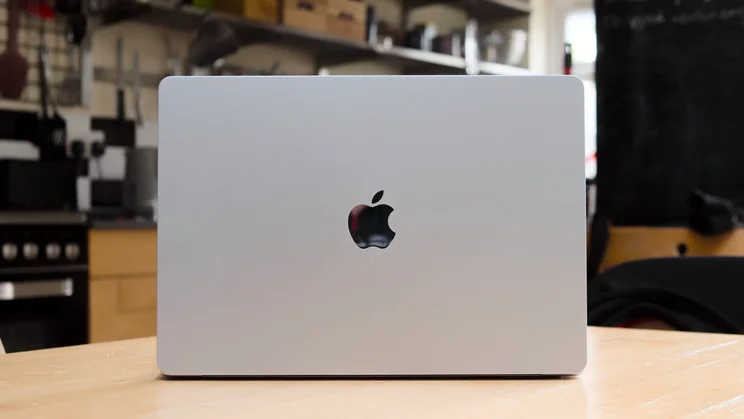
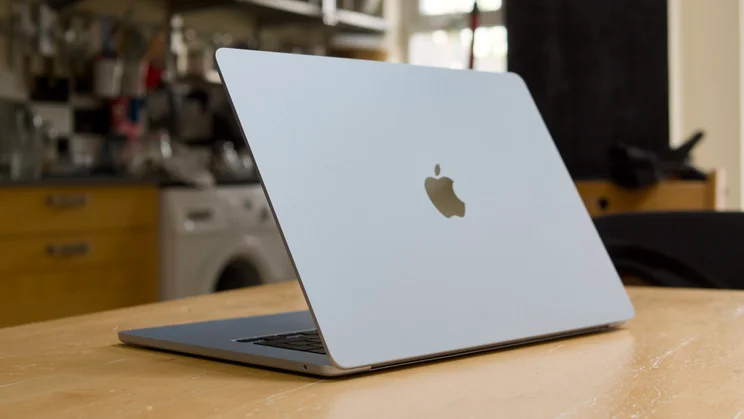
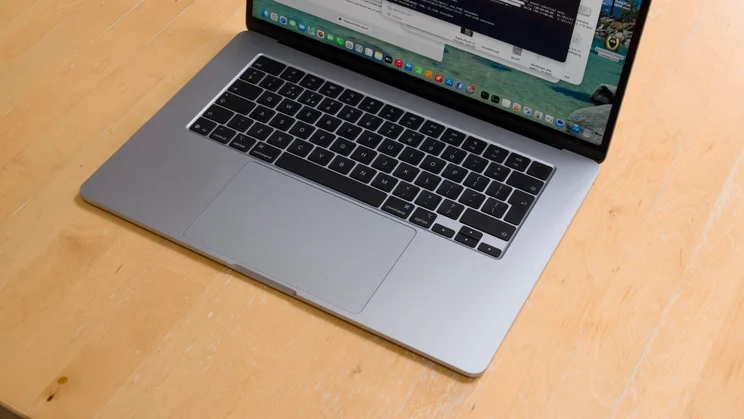
Alas, there isn’t much to say about the design. It’s great, but it’s the same as it has been since the M2 MacBook Air debuted back in 2021. You’ll be familiar with it by now: a boxy all-aluminium chassis that’s stiff and robust, and pleasingly minimalist in appearance.
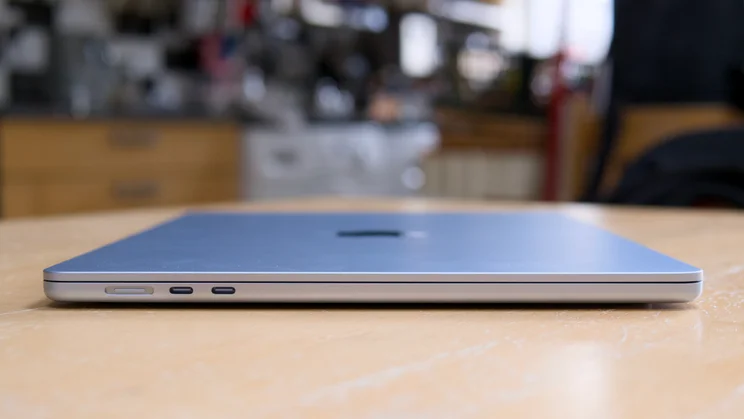
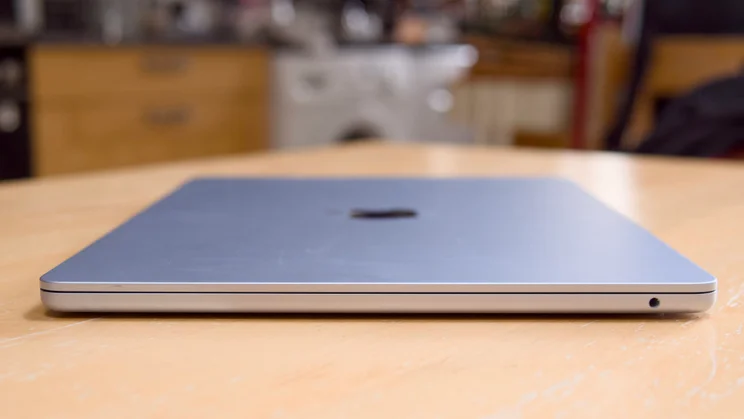
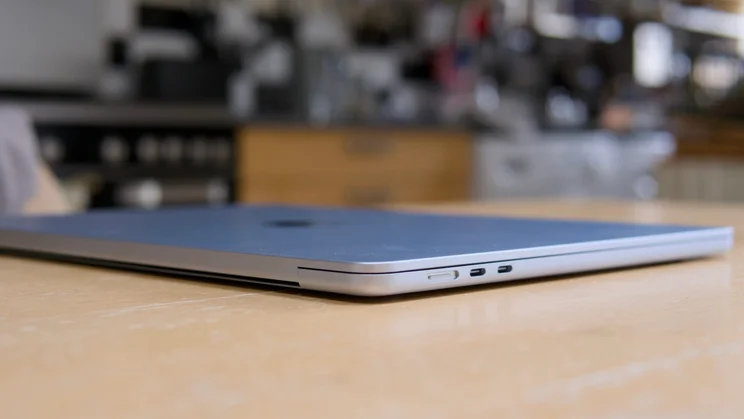
Physical features include a pair of Thunderbolt 4 USB-C ports on the left edge towards the rear and a MagSafe charging connector, a 3.5mm headset jack on the right edge, four hard rubber feet on the underside and a mirror finish Apple logo stamped centrally in the flat lid. And it’s available in the same four colours as before: silver, starlight, midnight and a (very) subtle sky blue.
Pop it down on your desk and you’ll be able to open the lid with one finger and not have it slide about or tip over. It isn’t the lightest, though: the 13.6in MacBook Air weighs 1.4kg, which is a good deal heavier than the heftiest laptops in its class. The Asus Zenbook A14, for instance, sneaks in under 1kg, and the 15.3in model is 1.51kg.
The MacBook Air isn’t as easy to get inside or to repair as some rivals, either. The MacBook Neo is a breeze to access, as is the Microsoft Surface Laptop 7. But this one requires quite a bit of prying, even once you’ve removed the eight screws from the base of the laptop.
What’s more, the battery packs are stuck down with adhesive strips instead of being secured with screws, which is a faff.
Keyboard, touchpad, webcam and speakers
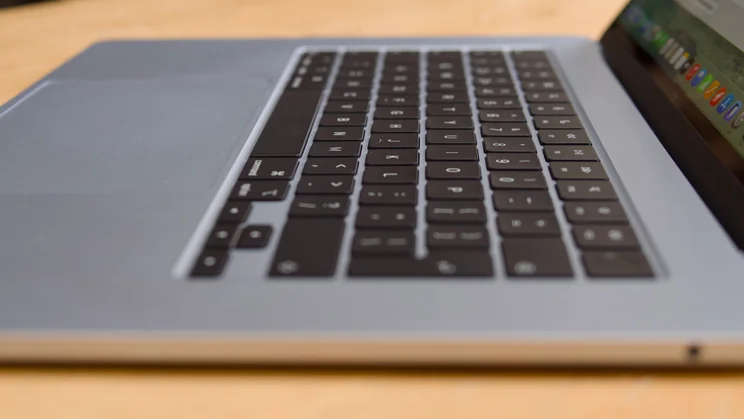
Once again, there’s not much to update you on when it comes to text entry and mousing. I’ve been using a MacBook Air M2 for a few years now and can attest to its typability. I’ve written thousands and thousands of words on this keyboard and it hasn’t worn out or broken yet.
The Air’s Force Touch trackpad is just as good. It employs haptic feedback tech as always, which means you can click lightly anywhere on its surface – unlike most mechanical trackpads, which have a deadzone along the top edge – and the sensitivity is adjustable so you can tweak it to your liking.
The 1080p webcam is excellent, producing sharp, well-balanced images for video calls in good and poor lighting, although it’s high time that Apple got rid of the intrusive notch housing it. And the six-speaker audio system is as good as ever, producing rich and warm audio. The MacBook Air’s speaker system has been the benchmark for laptop audio for some years now and it remains so today.
Display
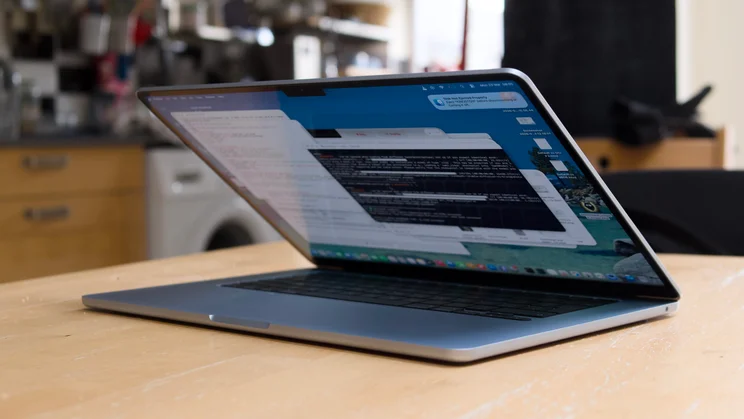
Apple still hasn’t made the leap to OLED on its laptops, but the IPS Liquid Retina panel on the M5 MacBook Air is impressive nonetheless. It has a resolution of 2,880 x 1,864 for a pixel density of 224ppi, in our measurements it reached peak brightness levels of 526cd/m2 – a little higher than Apple’s 500 nit claim – and it’s capable of reproducing most of the P3 colour gamut. I measured this at 93.5% of DCI P3 in the native “Colour LCD” profile.
It’s a more vibrant display than the sRGB-limited MacBook Neo and better as a result for serious photo and video editing. Colour accuracy is excellent. With “colour LCD selected” in MacOS Tahoe’s display settings, it returned an average Delta E of 0.8 vs sRGB and 0.9 vs DCI-P3.
At full brightness, dark areas do look a touch grey, and this leads to a contrast ratio of 882:1, but I have no complaints other than that. And it does have something that the MacBook Neo and plenty of other laptops at around this price do not: the ability to match its colour temperature to the lighting in your particular room, thus reducing eye strain.
All told, the M5 MacBook Air’s display is superb; I certainly don’t have any complaints. However, it isn’t quite best in class, with Windows machines from the likes of Asus and Honor offering sharper, more vivid OLED screens in rival laptops.
Performance and battery life
You’d expect a performance bump from the processor, and so it transpires with the new MacBook Air. But the M5 is a bit more of an improvement over the previous generation than usual. That’s because the integrated GPU has been redesigned with AI workloads in mind. Specifically, each GPU core – you get either 8 or 10, depending on which configuration you purchase – contains what Apple is calling a Neural Accelerator – enabling it to deliver (in Apple’s words) “over 4x the peak GPU compute performance for AI compared to M4”.
That’s great if you actually work with local LLMs every day. I ran a simple Python-based text and image-generation benchmark and found that the M5 in the MacBook Air was around twice as fast as the M2 chip in my daily driver.
But the M5 also provides quite a big jump when it comes to regular day to day tasks as well. In our media-focused 4K video and image conversation benchmarks, performance for the M5 leapt forward by 32% over the M4 in the MacBook Air I tested last year. And it provided a steady step forwards in the Geekbench 6 CPU and GPU benchmarks as well, as can be seen in the charts below.
This is no gaming beast – the fact that it’s running on MacOS sees to that – but it will play less demanding titles without too much fuss.
As for battery life, that hasn’t moved forward in quite the same way. In my testing, with the display set to a brightness level of 170cd/m2 , the 15in MacBook Air lasted 14hrs 59mins. That’s not bad for a 15in machine – and it will be perfectly good for a full day of mains-free use. However, by the standards of modern Snapdragon and Intel Core Ultra series 3 powered machines, the Air is beginning to lag behind.
The 15in Microsoft Surface Laptop 7 I tested a couple of years back lasted more than two hours longer in this test; even the Core Ultra Series 2-powered Honor MagicBook 14 Pro (2025) lasted an hour longer than this.
M5 Apple MacBook Air review: Verdict
This is a review that, in all honesty, didn’t really need to be written. So little has changed, that you could have read last year’s review and most of it would hold today. Yes, the price has risen by £100, but with rocketing RAM and storage prices elsewhere in the industry it’s surprising that it hasn’t gone up by any more. And, yes, there’s a new chip that delivers a decent bump in performance, if not battery life.
The question is, is the M5 MacBook Air still the laptop to beat for those who need the headroom of extra RAM and horsepower? Just about. It’s still dependable, fast, stable and reliable, comfortable to use and lasts as long as you need it to away from the mains.
However, with the advent of the much cheaper MacBook Neo and the arrival of Windows laptops that are just as efficient and more powerful (and pack more RAM and storage capacity for the money), the appeal of the MacBook Air is weaker than it has been for some time.


