
To help us provide you with free impartial advice, we may earn a commission if you buy through links on our site. Learn more
- Super lightweight
- Strong performance
- Long battery life
- No touchscreen model in UK
- Expensive
MacBook-killer is a phrase thrown about with rather too much regularity by technology journalists. Sometimes it’s justified, but often it’s just clickbait or a cloak for special pleading. Notwithstanding, in the case of the new Asus Zenbook A16, it is a phrase that can be used without accusation of hyperbole, partisanship or exaggeration.
In every important, quantifiable way, the Asus Zenbook A16 is a better choice for the majority of laptop users than the recently updated Apple MacBook Air 15 or indeed any other 16in thin-and-light laptop.
What you need to know
When Asus launched the Zenbook A14 twelve months ago, it made quite an impression here at Expert Reviews. We praised it for its superb OLED screen, excellent battery life and lightweight yet robust design.
The Zenbook A16 is the A14’s big brother. It’s just as impressively light and well-made, but it comes with a 16in 2.8K OLED screen. It is also the first laptop built around one of Qualcomm’s new second-generation X2 Snapdragon processors, specifically the Snapdragon X2 Elite Extreme X2E-94-100 – an 18-core CPU with a maximum clock speed of 4.7GHz. With it, comes a new improved Adreno GPU and a new 80 TOPS Hexagon 6 NPU (neural processing unit).
Make no mistake, with its new X2 components, Qualcomm is moving away from the cheap and efficient pitch of the X1 series and gunning for the best laptop chipsets from AMD, Intel and Apple.
Qualcomm also claims that the Prism emulation system has taken a step forward and that now the vast majority of Windows programs, regardless of age or provenance, will run on ARM silicon. If you need to check on compatibility, there’s a handy website.
Price and competition
Configuration tested: 18-core 4.7GHz Snapdragon X2 SoC, 48GB RAM, 1TB SSD, 2,880 x 1,800 120Hz OLED display; Price when reviewed: £2,099
Qualcomm’s PR operation has been fronting the launch of the A16 to a greater degree than I’ve ever seen from a chip maker involved in a laptop launch from a major OEM. And Qualcomm’s position is unequivocal: the A16 is targeted at the 15.3in MacBook Air.
That’s despite a price difference in the MacBooks favour: At £2,099, the launch model of the Zenbook A16 is £200 more than the £1,899 you’ll need to part with for a MacBook Air with a comparable 1TB SSD and 32GB of RAM.
Will we see cheaper versions of the A16 with lesser Snapdragon chipsets in the UK? Possibly. One thing I can tell you is that at the time of writing, there are no plans to bring the touchscreen model to the UK. That will remain a USA-only option.
If you like the sound of the Zenbook A16 but want something a bit smaller, an updated Zenbook A14 will launch in May for £1,599 with a 14in Full HD OLED display and a lesser X2 chipset.
Apple has recently updated the MacBook Air with new M5 silicon. The performance boost from the new chipset is certainly welcome, but the absence of any other changes of note, especially in terms of battery life, once an Air strength, left a slight sense of disappointment. Maybe Apple was focused on the Neo launch, and who can blame it?
Acer’s new Panther Lake-powered Aspire 16 AI isn’t as light or as slender as the A16, but it’s £500 cheaper and an even stronger performer. The OLED screen can’t match the fidelity of the A16’s, but it is touch-enabled. The speaker system isn’t great but it’s a well-made and handsome machine and one of Acer’s most convincing and desirable laptops.
Samsung’s new Galaxy Book6 Pro has an OLED screen to match the A16, which should be no surprise given that the A16’s panel is also made by Samsung. It also costs the same, £2,099. In fact, if you want a high-end 16in Windows machine and absolutely must have an x86 processor, the Galaxy Book6 Pro is a good choice. At 1.6kg it’s quite a bit heavier than the Zenbook A16, though.
Ask Qualcomm if the A16 is in competition with the MacBook Pro, and they’ll bark “No!” and then send someone around to punch you on the nose to underline the point. That said, the A16 can fulfil a similar role to the bigger, heavier and much more expensive MacBook Pro 16. The MacBook Pro is the stronger performer, but not by a vast margin, and the battery life of the two is pretty similar. The fact that the A16 can even be mentioned in the same breath as the MacBook Pro shows how good it is.
Design and features
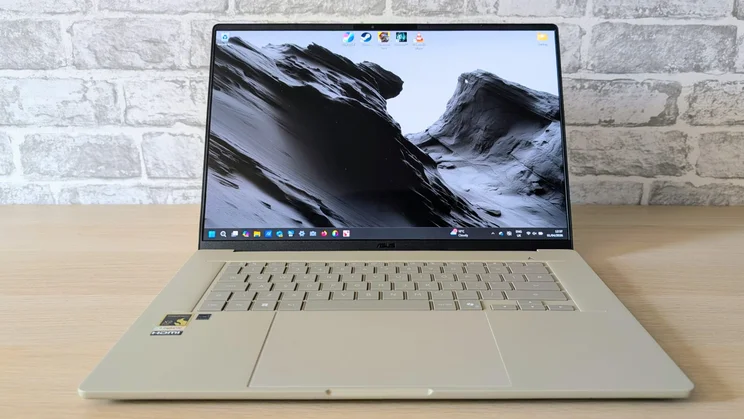
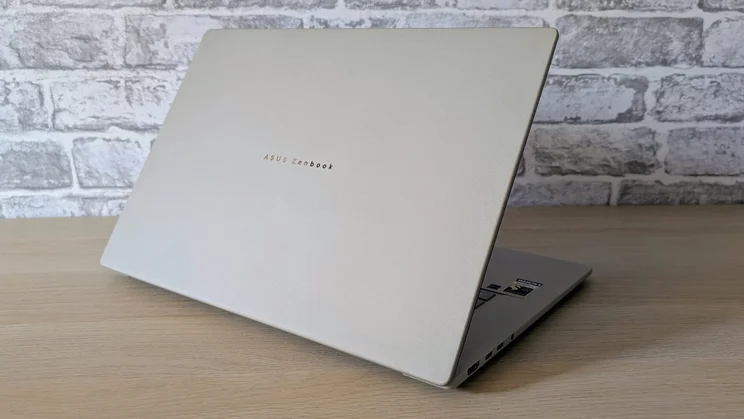
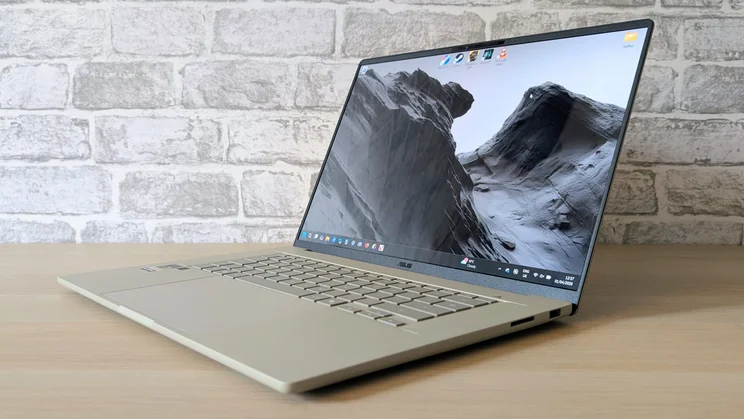
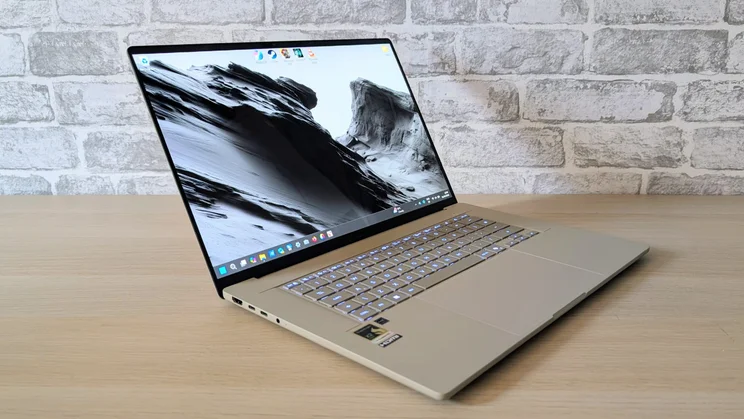
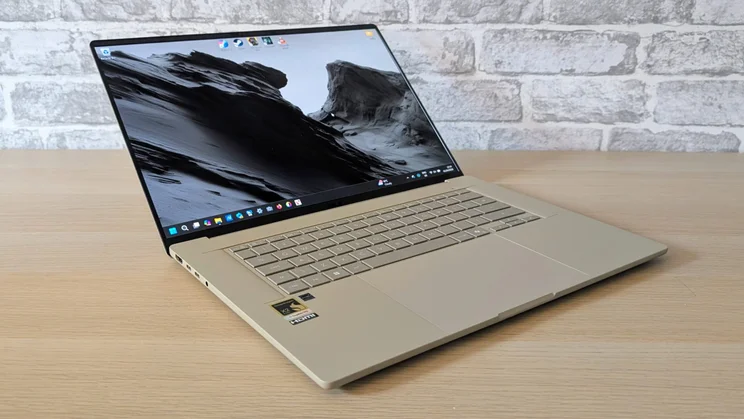
Physically, the Zenbook A16 looks much like a larger version of the Zenbook A14. Like the A14 and the stunning Zenbook S16, it’s built from magnesium-aluminium alloy and what Asus calls Ceraluminium, a substance designed to combine the strength of aluminium and the tactility of ceramic. Which it does.
Aesthetically, the A-series Asus laptops are more austere and industrial than the ornate and flamboyant S-series. I prefer the latter, but I also like Pre-Raphaelite art, so that says more about my artistic tastes than Asus’s design philosophy.
Looks aside, the body of the A16 is scratch-resistant and doesn’t show fingerprints or grease marks, and that’s more important than looks alone. There’s only one colourway for the range-topping model – Zabriskie Beige – although according to Asus, cheaper models will be available in Iceland Grey.
At 354 x 243 x 16.5mm, the A16 is impressively compact for a 16in laptop. The MacBook Air is rather slimmer at just 11.5mm, but what’s 4mm between friends or lovers? The Apple laptop is smaller in terms of width and depth, but given that it has a smaller screen, that’s to be expected.
According to Asus, the A16 weighs 1.2kg but my sample tipped the scales at 1.06kg, which is even more impressive for a 16in laptop. That’s lighter than a 13.6in MacBook Air. Granted, LG make a few lighter full-sized laptops, but they have the structural integrity of a soggy Tesco Meal Deal baguette.
The A16, meanwhile, feels reassuringly stiff and solid and meets the US MIL-STD-810H military-grade standard for resistance to vibration, temperature extremes, pressure change and other Bad Stuff.
It’s a sign of the attention to detail in the design of the A16 that you can easily open the lid on its “EasyLift” hinge with one finger, even though there’s little weight in the base to counterbalance the operation.
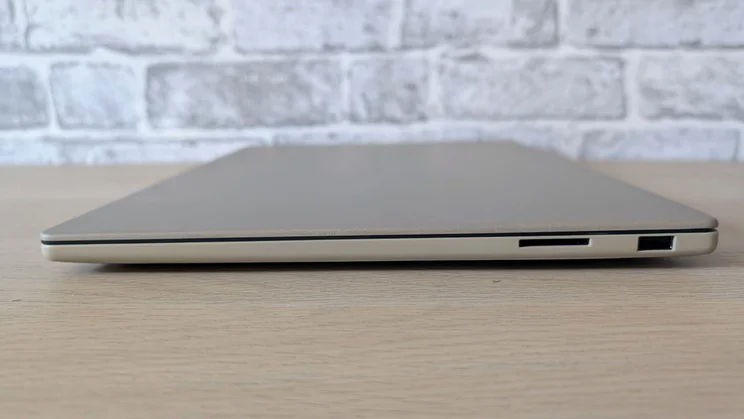
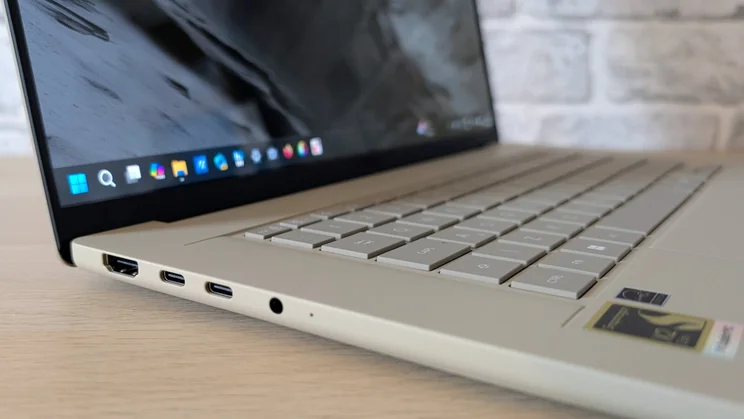
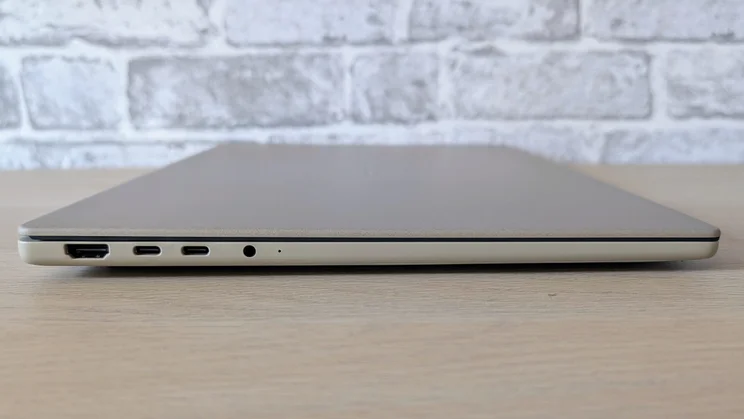
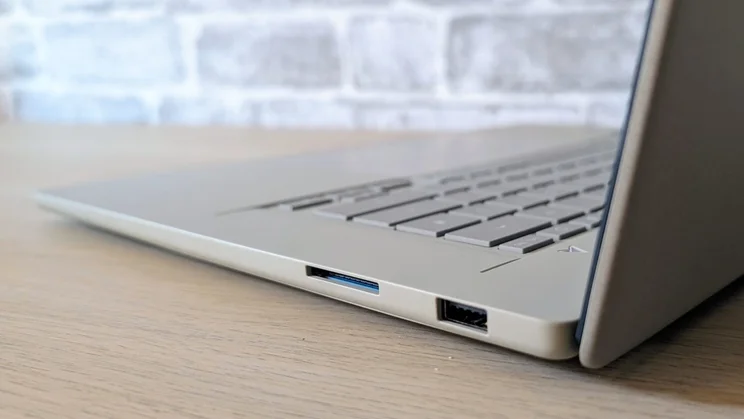
Despite its slender profile, the A16 comes with a full suite of physical ports. On the left, there are two 40Gbits/sec USB-C ports (each supporting charging and DP Alt Mode video), an HDMI 2.1 video output, and a 3.5mm audio jack. On the right, there’s a 10Gbits/sec USB-A port and an SD card reader.
I’d rather all the charging and video output options were not on the same side, but that’s a feature of many laptops, including the MacBook Air, so I can’t beat the A16 up over it.
Wireless communications are bang up to date, the Qualcomm C7700 card supporting Wi-Fi 7 and Bluetooth 5.4. And the Samsung-made 1TB SSD in my review machine was up there with the Zenbook A16’s main rivals, delivering good sequential read and write speeds of 5,545MB/sec and 3,226MB/sec.
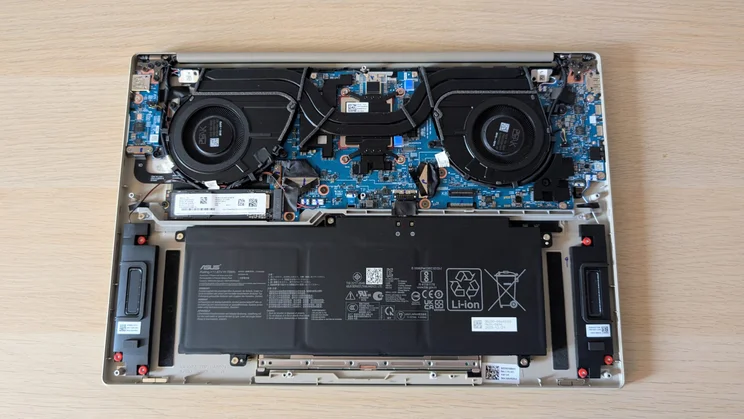
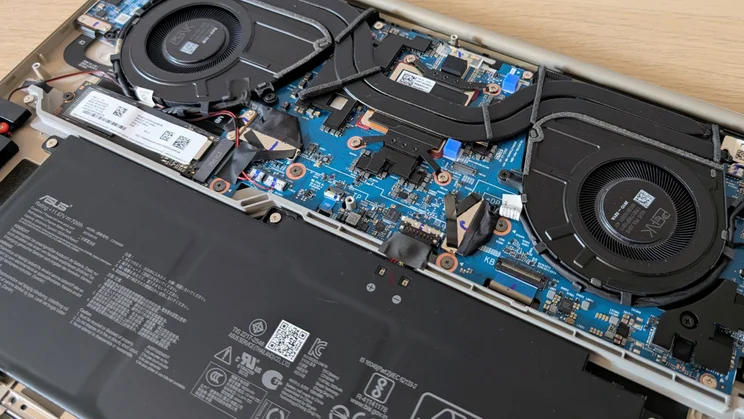
Getting inside the A16 is easy, but once inside, you’ll find everything soldered in place, except for the M.2 2280 SSD. Replacing the battery is a straightforward enough operation, though – it’s held in place by just a handful of screws.
Keyboard, touchpad and webcam
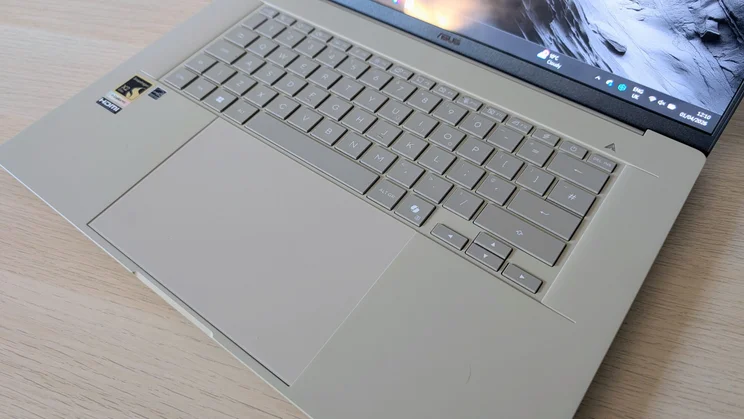
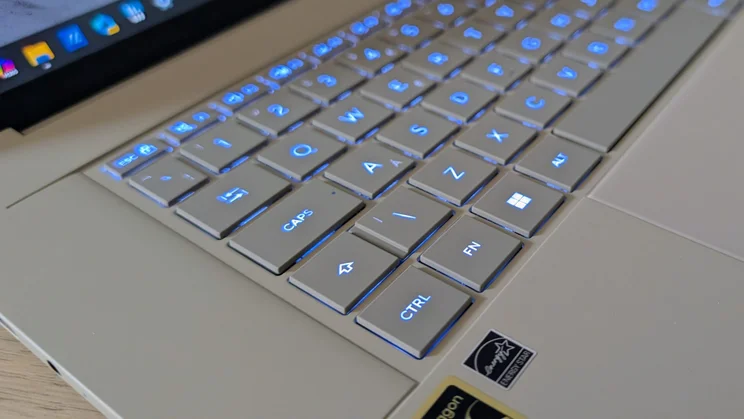
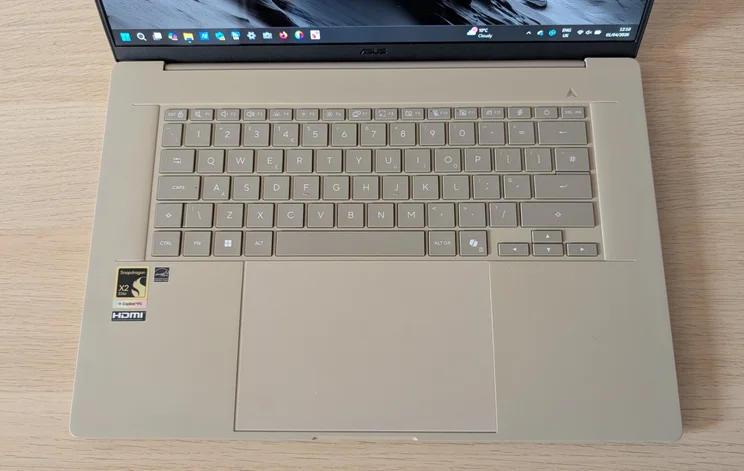
The A16 boasts a typically high-quality Asus keyboard. The layout and keycap graphics are hard to fault, apart from the fact that all the arrow keys are half-height, despite there being ample space to make them full size. The three-stage white backlight means you can carry on working no matter how stygian your surroundings.
The keys themselves have a light yet positive action, and the 1.3mm of travel ends with a firm, well-damped end-stop.
The 150 x 100mm Mylar-surfaced touchpad may not be as big as the one fitted to the Acer Aspire 16 AI, but it’s large enough to support even the most extravagant gestures and works perfectly. The corner-click action is clean and quiet.
The touchpad also supports what Asus calls Smart Gestures, which means you can swipe along the edges of the pad to adjust the volume, display brightness, and control video playback.
The webcam is a standard 1080p affair, but the images it produces are sharp, colourful, bright and realistic, which is all I want from a webcam. The camera also supports all the Windows Studio Effects and Windows Hello Facial recognition.
Display and audio quality
The A16’s 120Hz 2,880 x 1,800 OLED display is simply superb. Maximum brightness is high in both SDR at 490cd/m2 and HDR at 1,049cd/m2 modes, and there’s ample colour with 163.7% coverage of the sRGB colour space, 115.9% DCI-P3 and 112,8% Adobe RGB.
Colour accuracy is exemplary. Lock the screen into the sRGB, DCI-P3 and Display P3 profiles in the MyASUS control panel, and you get Delta E variances of 0.82, 0.71 and 0.68, respectively. There’s a word for that: superb.
The screen has a glossy finish to maximise the immersively limpid qualities that distinguish all good OLED displays, but despite that, reflections from bright lights never proved to be a distraction.
The six-speaker (two tweeters, four woofers) sound system is a perfect partner to the excellent display, generating a deep, rich and sonorous sound that’s not short on volume, detail or stereo separation.
Performance and battery life
Given that this new Snapdragon X2 Elite Extreme has 18 cores and a maximum boost frequency of 4.7GHz compared to 12 cores and 4.2GHz from the previous generation of Snapdragon X Elite CPUs, it should come as no surprise that we are looking at a massive increase in performance.
One of the more obvious signs that Microsoft and Qualcomm have improved the Prism emulation layer is that the Handbrake CLI video conversion part of our benchmark now runs, whereas previously it refused to.
Despite the drag that emulation invariably causes, the Zenbook A16 still scored a very healthy 375 points, comfortably ahead of the M5 MacBook Air and not a million miles shy of the likes of the Acer Aspire 16 AI and the 14in M5 MacBook Pro.
It’s also worth noting that Qualcomm is promising an OTA system update soon, which it claims will boost overall performance by around 10%. If that proves to be true, the A16 should be able to score over 410, which makes it an even more impressive performer.
In the Geekbench CPU test, the A16 scored 3,664 single-core and 22,662 multi-core. That’s better than the Intel Core Ultra X7 358H in both tests and better than the M5 chip in the MacBook Air in the multi-core, though not the single-core, test.
The Cinebench R24 test underscores the Snapdragon Elite X2E-94-100’s multi-core dominance: the only laptop we’ve tested which can better the A16’s 1,361 is the Alienware 16X Aurora with its 20-core Intel Core Ultra 7 255HX, which scored 1,632.
Measuring AI performance is a slippery business at the best of times, but Qualcomm’s chipset is clearly up with the best of the x86 opposition with a quantised score of 8,173 in the Geekbench AI 1.7 ONNX CPU test. That compares to 7,843 for the Core Ultra X7 358H and 9,917 for the AMD Ryzen AI Max+ 385.
Given the leap forward in gaming performance that Intel has made with its Arc B390 integrated GPU, it’s no longer good enough to just say that a thin and light machine like the A16 isn’t expected to play games, so there’s no need to concern ourselves with such matters.
Here again, the Zenbook A16 impressed, running the Returnal benchmark at an average of 46fps and the Cyberpunk 2077 test at an average of 30fps, with both tests running at Full HD, in the High detail setting without ray-tracing lighting effects.
Fortnite fans will be happy to know that there’s now support for Epic Online Services’ Easy Anti-Cheat, but anyone wanting to play DOOM: The Dark Ages is out of luck because it refuses to run.
Despite the impressive performance and tight packaging, the A16 suffers from no thermal issues. Under prolonged maximum stress, the CPU and GPU settled down to around 95% and 80% utilisation, respectively, but fan noise never became intrusive, and the base plate only became a little warm around the vent grille.
Finally, battery life was mighty impressive. In our battery run-down test using the VLC media player with the display brightness set to 170cd/m2, the Zenbook A16 ran for 19hrs 49mins on its 70Wh battery. That’s better than the M5 MacBook Air, the Samsung Galaxy Book6 Pro and the Acer Aspire 16 AI.
As a combination of performance and efficiency, the new Snapdragon X2 chipsets have rewritten the rule book.
Asus Zenbook A16 review: Verdict
At the time of writing, the Asus Zenbook A16 is easily the best full-sized slim and superlight laptop on the market. It weighs next to nothing, has a superb OLED screen, an excellent sound system, and the looks and build quality are second to none.
Add to that the impressive performance, excellent thermals and long battery life, and you have a recipe for laptop perfection. The MacBook Air 15 is thinner, and the Aspire 16 AI is cheaper, but neither is so perfectly balanced as the new Asus Zenbook A16.


