To help us provide you with free impartial advice, we may earn a commission if you buy through links on our site. Learn more
- Best Wi-Fi extenders, at a glance:
- How we test Wi-Fi extenders
- The best Wi-Fi extenders you can buy in 2025
- 2. TP-Link RE505X: Best Wi-Fi 6 extender
- 3. TP-Link RE235BE: Best Wi-Fi 7 extender
- 4. Devolo Magic 2 Wi-Fi 6: Best powerline and Wi-Fi extender
- 5. TP-Link RE700X: Best extender for fast Wi-Fi 6 speeds
- Is a Wi-Fi extender definitely the answer?
- What speeds can I expect?
- What’s the difference between a repeater and a powerline extender?
- Might I be better off with a mesh Wi-Fi system?
- Does my extender need Ethernet sockets?
- What other features should I look for?
- We have years of experience testing Wi-Fi extenders, and we subject all the products we review to the same series of real-world tests
- We evaluate Wi-Fi extenders mainly on speed and range, but ease of setup also plays a part in the overall score
- Our favourite current Wi-Fi extender is the TP-Link RE300. It’s only basic, but it’s cheap, very easy to use and effective
- If you’re looking specifically for an extender to broaden the reach of your Wi-Fi 7 network, our hot tip is the TP-Link RE235
- However, if you need a more belt-and-braces approach to extending your Wi-Fi network, we recommend the Devolo Magic 2 Wi-Fi 6 Whole Home kit. It’s expensive, but gives you solid coverage in even the most challenging domestic environments

If all you want is a quick way to extend Wi-Fi coverage into the spare room you don’t have to spend the Earth on exotic hardware. That’s why our favourite extender is still the venerable TP-Link RE 300. It only supports Wi-Fi 5 but at less than £30, this discreet little box ticks all the boxes.
If you want the very best extender with the longest reach and best speed however, look a little lower in our list, where we have choices that stretch your Wi-Fi network far beyond the limits of your existing wireless network.
If you want to find out more about Wi-Fi extenders and what makes them tick, click through to our buying guide here. Otherwise, read on for our recommended options.
Best Wi-Fi extenders, at a glance:
- TP-Link RE300: Best budget extender | Check price at Amazon
- TP-Link RE235BE: Best Wi-Fi 7 extender | Check price at Amazon
- Devolo Magic 2 Wi-Fi 6: Best Wi-Fi and powerline extender | Check price at Amazon
How we test Wi-Fi extenders
Every Wi-Fi extender we review goes through extensive hands-on testing. Each unit is installed in a real home, at an appropriate distance from the main Wi-Fi router according to the manufacturer’s recommendations. If it’s a powerline system, we connect the base unit to the main router via gigabit Ethernet and, again, situate the remote unit according to the instructions.
We then work through the setup process, allowing the extender to connect to the existing home network and apply its default settings. We’re looking for how quick and easy this is, and whether it picks the best configuration for optimal performance.
To test network performance, here are the steps we take:
- We use a laptop equipped with an Intel Wi-Fi 6 or Wi-Fi 7 network card supporting 2×2 MIMO, depending on the technology supported by the extender we’re testing
- We connect this laptop to the extended network, then take it to various areas of the home and copy a standard set of files to and from a NAS (network attached storage) appliance, which is connected by Ethernet to the main router
- By measuring the average read and write speeds, and comparing them to those achieved when connecting directly to the router, we can measure how each extender helps Wi-Fi range and performance
If the extender has advanced features, we’ll also factor these into our review; we’ll thoroughly explore the configuration portal, whether that’s app- or web-based, to see how responsive and user-friendly it is, and, if the unit has an Ethernet port, we test network performance over a wired connection as well.
The best Wi-Fi extenders you can buy in 2025
1. TP-Link RE300: Best budget Wi-Fi extender
Price when reviewed: £33 | Check price at Amazon

- Works well
- Cheap
- Easy to use
- Not the fastest
- No Ethernet port
Reviewed by Jonathan Bray
TP-Link’s RE300 is basic, but it’s incredibly easy to set up via the TP-Link Tether app and it comes with a couple of extra modes to help you make the most of your current wireless network. We found it worked best in default mode, where speeds averaged 11.3MB/sec in testing. If you’re a tinkerer, however, you can also set it up so it uses the faster 5GHz band as a dedicated link to your existing network and the 2.4GHz band for your devices.
Either way, the RE300 works really well. We found speed to be good enough for basic purposes and connectivity reliable, plus it doesn’t take up too much space in your plug sockets, leaving plenty of room for other devices to use the sockets next to it. The only thing it lacks is an Ethernet port (buy the TP-Link RE330 instead if this is critical), but this compact unit offers solid performance for not a lot of money.
Key specs – Radio bands (maximum speed): 2.4GHz (300Mbits/sec), 2 x 5GHz (866Mbits/sec); Ethernet ports: None; WPS button: Yes

2. TP-Link RE505X: Best Wi-Fi 6 extender
Price when reviewed: £50 | Check price at Amazon

- Cheap
- Solid speeds
- Easy to use
- Not Wi-Fi 7
Reviewed by Stuart Andrews
If you haven’t yet moved to the latest tech and your router is still a Wi-Fi 6 device, you may not need to splash out on the latest and greatest extenders. In this case, you won’t do much better than the TP-Link RE505X.
On paper, its speeds aren’t amazing. With 1,200MBits/sec on the 5GHz band and 300Mbits/sec over 2.4GHz, there are faster Wi-Fi 5 extenders out there. In practice, however, the RE505x delivers a fast, stable connection in places your router might not be able to reach. We measured speeds of more than 50MB/sec in our testing.
As a bonus, if you have a TP-Link router that supports its OneMesh technology, you get hassle-free, seamless connectivity wherever you are in your home. And best of all, you can find it usually a lot cheaper than equivalent Wi-Fi 7 devices.
Read our full TP-Link RE505X review
Key specs – Radio bands (maximum speed): 2.4GHz (300Mbits/sec), 5GHz (1,200Mbits/sec); Ethernet ports: 1 x Gigabit; WPS button: Yes

3. TP-Link RE235BE: Best Wi-Fi 7 extender
Price when reviewed: £73 | Check price at Amazon

- Reasonably fast and versatile
- Easy to set up and operate
- Good value
- Dual-band only
Reviewed by Darien Graham-Smith
If you’ve just bought a Wi-Fi 7 router you might not need a wireless extender, but in some properties there may well be some areas that still need a helping hand. If you have a security camera at the end of your garden for instance, or your garden office is in need of a more reliable connection to your home network.
In that instance, the TP-Link RE235BE is currently the best extender for you. It’s a fairly simple dual-band extender and TP-Link’s top-of-the-line Wi-Fi 7 product in this category, at least until the RE655BE arrives later in 2026.
And while it won’t be setting any records for speed (the fastest we were able to persuade it to transfer files was 44.1MB/sec), it does support faster connections at up to 2,884Mbits/sec over 5GHz than any of the Wi-Fi 6 extenders on this page, and the price is pretty good.
Read our full TP-Link RE235BE review (late 2025)

4. Devolo Magic 2 Wi-Fi 6: Best powerline and Wi-Fi extender
Price: £275 (whole home kit) | Check price at Amazon

- Solid performance
- Works where Wi-Fi doesn't
- Passthrough mains connection
- Expensive
- Performance depends on your mains layout
Reviewed by Stuart Andrews
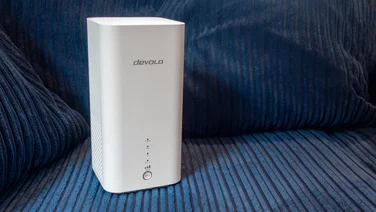
Devolo’s Magic 2 WiFi 6 straddles the world of wireless extenders, powerline and mesh Wi-Fi and offers an effective alternative to traditional wireless network hardware. By combining fast 2,400Mbits/sec G.Hn powerline with dual-band 802.11ax Wi-Fi, it delivers the best of all worlds: solid connectivity, even to tricky-to-reach places, and impressive top speeds.
It’s fast and reliable (although bear in mind the speeds you achieve will depend on the layout and quality of your home’s wiring), and at the time we tested it it was the fastest powerline system we had reviewed.
Devolo has since introduced the Magic 2 WiFi 6 Next, which offers faster WiFi speed, but that’s much more expensive (£480 for the whole home kit), and delivers the same powerline data rates, so we’re sticking with our recommendation of the WiFi 6 for now. For those places Wi-Fi simply can’t reach, it might prove your only option.
Read our full Devolo Magic 2 Wi-Fi 6 review
Key specs – Maximum Wi-Fi speeds: 1,800Mbits/sec; Powerline speed: 2,400Mbits/sec; Ethernet ports: 2 x Gigabit per unit; WPS button: Yes; Other features: Mains passthrough

5. TP-Link RE700X: Best extender for fast Wi-Fi 6 speeds
Price: £65 | Check price at Amazon

- Fast performance
- Simple to use and set up
- Sleek antenna-free design
- Obviously, not Wi-Fi 7
Reviewed by Stuart Andrews
The RE700X may not boast support for Wi-Fi 7 but that doesn’t mean you should dismiss it out of hand. With speed rated at up to 2,402Mbits/sec over 5GHz, it’s actually still pretty quick.
In fact, it’s the second-fastest Wi-Fi 6 unit we’ve tested. In our hard-to-reach kitchen, it hit download speeds of 45.1MB/sec . In the upstairs office, speeds were lower but still reached a respectable 32.9MB/sec.
In a similar vein to the rest of TP-Link’s extenders, this model is easy to set up and configure using TP-Link’s Tether app, and it also supports the company’s OneMesh technology for seamless roaming around the house.
The RE700X isn’t the cheapest wireless extender right now but it is a little less expensive than most Wi-Fi 7 extenders and we’ve seen it dip as low as £55. At that price it’s a bargain.
Key specs – Radio bands (maximum speed): 2.4GHz (574Mbits/sec), 5GHz (2.4Gbits/sec); Ethernet ports: 1 x Gigabit; WPS button: Yes

Is a Wi-Fi extender definitely the answer?
Before you buy an extender, check that it really is the performance of your wireless network that’s slowing you down and not just a slow internet connection. You can use a broadband speed checker to measure download speeds at different distances from your router, and see how the speed drops off as you move around your home.
It’s also worth trying out a few different wireless settings, such as switching radio bands, before you splash out on a new bit of kit. You might find that this gets you a better signal from your existing equipment and that there’s no need to buy an extender at all.
What speeds can I expect?
Some extenders promise data rates as high as 10.8Gbits/sec, which is equivalent to around 1.35GB/sec and far faster than most broadband connections. In reality, for all sorts of technical and practical reasons, the speeds you see in your own home will be far, far lower, with much of the bandwidth lost in the connection between the extender and the router, let alone the connection between the extender and your laptop or devices.
As a rule, we’d be happy with anything over 120Mbits/sec (15MB/sec). To put that into context, Netflix recommends a connection speed of at least 5Mbits/sec for HD streaming and 25Mbits/sec for 4K video. A good, solid Wi-Fi network should easily be fast enough to cope with multiple simultaneous high-resolution video streams.
Up until recently, most extenders and Powerline kits only went as far as the Wi-Fi 6 standard, but we’re seeing a growing number that can go faster with Wi-Fi 6E and Wi-Fi 7 support. If you only have a Wi-Fi 6 router, you can save some cash by partnering it with a Wi-Fi 6 extender, but the newer models may give you a faster connection between the extender and devices that support Wi-Fi 6. What’s more, there’s an argument that buying one of these makes more sense if you plan to upgrade your network in the future.
What’s the difference between a repeater and a powerline extender?
These are the two main types of extender and they do the same basic job. However, they work in different ways. A Wi-Fi repeater is a single box that relays data back and forth between your router and your wireless devices using Wi-Fi signals alone. If – for example – your router is located at the front of the house, and your home office is at the rear, you can install a repeater at the midway point to boost the signal in the office.
A powerline networking kit consists of two little boxes (sometimes more) that plug into mains sockets around your home. Box number one connects to your router via an Ethernet cable, while box number two broadcasts a wireless signal from wherever it happens to be situated and relays the data back to the first box over your mains electrical wiring.
Powerline systems are often more expensive than repeaters but they’re a fuss-free way to extend a network connection into places that are otherwise hard to reach and can be simpler to set up.
Might I be better off with a mesh Wi-Fi system?
Mesh networking systems work in a similar way to Wi-Fi repeaters but they give you the option of placing multiple nodes all over your home to cover a larger area than a single extender could manage. You can learn more, and explore our recommended models, in our guide to the best mesh Wi-Fi routers.
If you don’t have a huge house, however, a mesh system may be overkill. A regular extender is a lot cheaper and a lot easier to install. Configuring a mesh system normally involves setting up a whole new router, whereas with most repeaters you can simply plug it in, press a button and that’s it.
Does my extender need Ethernet sockets?
In this wireless age, Ethernet sockets might seem a bit outdated. But some devices, such as printers and set-top TV boxes, only support wired connections, and connecting these or a PC to your extender via Ethernet will give you a more reliable and often faster connection than wireless.
Naturally, however, connecting devices to an extender via Ethernet won’t be as fast as a direct wired connection to the router because the signal still needs to travel from your router to the extender over the airwaves first.
What other features should I look for?
Most Wi-Fi extenders have what’s called a “web portal”, which offers a selection of advanced features (some offer a mobile app as well). This is accessed via a web browser, either on your phone or your laptop. Simply type in the address provided by the manufacturer – which is often printed on the extender itself or, failing that, it will be in the manual somewhere.
Some of these web portals will let you operate a guest network, with its own name and security settings, so visitors can connect to the internet without having access to your local devices.
You might also get access or parental controls, which let you decide exactly who can connect, while scheduling lets you shut off the connection at certain times – useful, perhaps, if you don’t want kids going online in the middle of the night.
Think about physical features when choosing your extender. Most units plug directly into a mains socket, and some models are so big that they block neighbouring outlets from use. A mains passthrough socket on the front can also be very useful if you’re running low on mains sockets and this certainly isn’t something you can take for granted.