
To help us provide you with free impartial advice, we may earn a commission if you buy through links on our site. Learn more




- Luxury build
- Good levels of accuracy
- Great battery life
- Still can’t target power in structured workouts
- NFC payments work, but it's clunky
Huawei’s family of smartwatches is bewildering to behold, with seemingly dozens of different models available at any one time. But one model has stood out with the best balance of build, features and battery life: the Huawei Watch GT series.
This year’s Huawei Watch GT 7 Pro is the best I’ve tried yet, and I haven’t even had the chance to test its most interesting new feature: improved skiing metrics. I plan to update this review in January, however, when I return from Italy on my next planned trip. Even without this feature, it’s the best wearable you can get from the Chinese tech giant.
What do you get for the money?
As with most wearables, several different models are available in the GT 7 and GT 7 Pro family of smartwatches. I was sent the Huawei Watch GT 7 Pro, in green, to test, so that’s the model I’m focusing on here, but the standard Watch GT 7 shares many of the Pro’s features and is significantly cheaper, so it might be worth investigating. I’ve detailed the differences in a separate section below.

Design
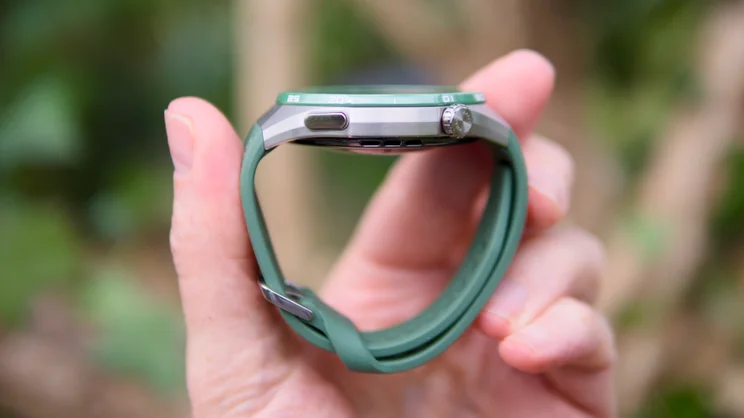
The Watch GT 7 Pro is an absolute peach of a flagship smartwatch. The model pictured here has a green ceramic bezel and colour-matched, stretchy elastomer wristband. Its 46mm case is built from tough, lightweight titanium alloy. There’s scratch-resistant sapphire crystal glass on the front, protecting a 1.47in, 466 x 466 resolution, 3,000-nit OLED display. The watch is 5ATM water-resistant and IP69-rated.
You can also get this watch in yellow or black with elastomer straps, and in silver with a matching metal link wristband; all of the models look fabulous. It’s a real touch of luxury at a bargain price (£379) and particularly impressive when you consider the Apple Watch Ultra 4, which also has a titanium case and sapphire crystal glass, costs more than double at £799.
It’s comfortable to wear, too, and the new tuck-under “crossover” buckle keeps the watch snug on the wrist. I normally prefer a nylon hook-and-loop strap to elastomer as I’ve found that’s the most comfortable way to keep the watch tight without discomfort. You need a decent fit, as that keeps the heart rate readings accurate during exercise.
The one caveat is that the GT Pro 7 is only available in 46mm, which may be too bulky for those with very slender wrists. This is where the GT 7 comes in; it’s available in a smaller 41mm size. If you go for the smaller size, though, you miss out on the GT 7 Pro’s biggest strength: its battery life.
The watch is rated for 21 days of light usage (and 12 days typical), the same as last year’s Huawei Watch GT 6 Pro. However, it now lasts a massive 51 hours in trail running mode, an improvement of 11 hours over its predecessor, thanks to Huawei’s new AI-XDR tracking algorithm, on which there’ll be more below. Compared with the Apple Watch Ultra 4, it lasts 19 days longer in regular use, and six hours longer in trail running mode.
It can’t match the Garmin Fenix 8 Pro, which delivers up to 34 days of light use and 67 hours of GPS tracking, but that’s a much more expensive watch at £900.
New features
Smartwatch manufacturers rarely let a new release go by without adding an extra feature or two to the toolbox, and the Huawei Watch GT 7 Pro is packed with new stuff. As noted above, the most interesting addition is the vastly expanded Ski tracking mode. I haven’t had the chance to test this yet, alas, but I will definitely be taking it along on my next trip because the metrics look impressively comprehensive.
Not only do you get post-run analysis of each run you embark on, but the watch comes with piste maps and route planning – more than 3,000 resorts are available, each one covering difficulty levels and lift types. And there’s much more in-depth analysis available as well, from turn frequency to max g-force and turn radius, so you can really get stuck into the numbers.
Huawei has added to the cycling mode, too. On mountain roads, you now get pace advice on your planned route so you don’t go all out too early, and warnings on descents when sharp corners are approaching.
A new Physical Readiness score is available within the watch’s Health Insights app, which analyses your sleep, recent workouts, heart rate, HRV (heart rate variability) and stress levels to provide a score, so you know what type of workout you can shoot for without overdoing it and risking injury. There’s also a better golf mode, along with mini workouts that suggest brief activities throughout the day to boost your activity levels.
And last, but by no means least, we have the aforementioned AI-XDR algorithm, which uses data from the watch’s gyroscope and accelerometer sensors to fill in the gaps when the GPS isn’t, or can’t be, connected to satellites. It’s primarily designed for trail or ultra running; you want long battery life, but 100% accuracy may not be as important.
It’s also designed to help in urban settings when your run takes in underpasses or long tunnels. Instead of simply connecting the dots with a straight line when you re-emerge, the GT 7 Pro uses data from those other sensors to detect any changes in direction while you were out of satellite contact and will attempt to fill in the gaps.
What are the differences between the Huawei Watch GT 7 Pro and the Huawei Watch GT 7?
The Huawei GT 7 Pro is the flagship watch in the series, but the GT 7 might suit, depending on your requirements and budget. It comes with the same new tuck-under “easycross” strap as the GT 7 Pro, the new skiing and cycling modes and the Physical Readiness score. But it lacks the GT 7 Pro’s golf mode, and it’s built from less exotic materials.
The watch’s body is made from stainless steel, you don’t get sapphire crystal glass, and it isn’t rated for free-diving, either. But if you can do without those features, the GT 7 is largely the same, and it only costs £279.
In fact, for slimmer wrists, the 41mm Watch GT 7 might be a better choice, although as I said, battery life does suffer: in light use it delivers up to 14 days, typical use is rated at 7 days and trail-running GPS tracking at 32 hours.
How did I test the Huawei Watch GT Pro 7?
I’d been wearing the GT 7 Pro for two weeks before writing this review. I’ve run around 40km in that time and took it to Berlin, where I walked thousands and thousands of steps around the halls of IFA. So, I’ve given it a reasonable workout, I’d say, although I haven’t had any time to test the new skiing features yet.
To gauge accuracy, I compared HR readings from each workout with my Polar H10 chest belt, and distance and pace readings with my third-generation Stryd footpod, which in my experience is the most reliable way to record those metrics.
I compared the GPS traces on those workouts to the ones generated by my trusty Garmin Forerunner 955, paying particularly close attention to how the GPS trace looked on the map when I ran through tunnels near where I lived, as that’s one of the things Huawei’s new AI-XDR positioning algorithm is supposed to compensate for.
How did the Huawei Watch GT 7 Pro perform?
Before I dive into the numbers, I’m starting with AI-XDR. I live near the Central Line in London, and so I have plenty of opportunity to run underneath it on my training runs. There’s also a long pedestrian underpass nearby, so I’ve had ample opportunity to see how effective AI-XDR is at compensating for gaps in GPS data.
So far, my experiences have been mixed. Below are two particularly tricky below-ground sections. They’re not long, but they’re not straight, so it’s a good opportunity to see if the watch can use its sensors to approximate my route.

On the first, I run down a steep ramp, turn right, and then curve left uphill to re-emerge at street level. The GT 7 Pro traced the route pretty well here; much more successfully than the Garmin Forerunner 955 on my other wrist, which struggled with a far more jagged line.
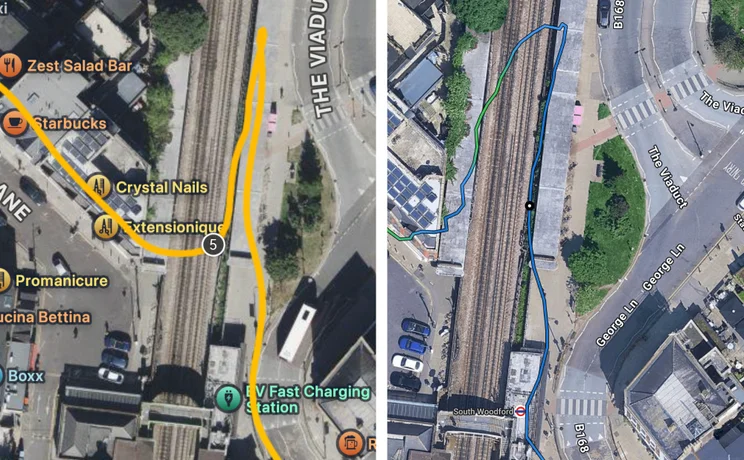
On the second, I run down a ramp, turn right under the railway, then right again up the other side. The trace should be U-shaped, but smoothing gets the better of the GT 7 Pro here, and it delivers a much more approximate trace than before. Here, the Garmin wins out.
Finally, I run through the 100m underpass, but instead of running straight through, I doubled back before the end and ran the other direction, then turned around and did the same again, eventually emerging on the other side having run five times the distance. Alas, the GT 7 Pro didn’t seem to spot my changes in direction at all here.
In general, though, I’ve been more impressed with the accuracy of the GPS traces than I have with previous Huawei wearables. General GPS accuracy is very good, too, closely matching my Stryd pod to within 1% for all the runs I completed, and heart rate was right on the money with no drop outs or flat spots to speak of.
Other areas of performance seemed on the money, too. I was happy with the accuracy of the sleep tracking, which matched up with my bed times by and large, and the quality (or lack of) of my sleep, scoring me in the low 70s while I was at IFA, up late and up early, then back into the 80s when I got home.
Battery life is impressive, too. Although I haven’t tested it through multiple drain-and-recharge cycles, it’s on course for at least two weeks of use, with the always-on display enabled and five to six runs tracked. That’s very, very impressive.
And although I’m not a fan of the Huawei Health app in general, I do like how the new Health Insights section picks out short-term analyses and long-term health trends based on the data stored in your Huawei account.
Is there anything I didn’t like about the Huawei Watch GT 7 Pro?
As usual with Huawei watches, there are some irritations with the way the watch’s core features work. Setting up custom workouts, for instance, is relatively straightforward. However, you can’t set a power target, even though the watch records that metric, or any grade-adjusted pace metric, either.
And although you can set up your own structured running workouts in the app, you can’t seem to do that for gym-based workouts. The app does, to its credit, have a huge selection of workouts to choose from, from yoga and Pilates to tai chi, but sometimes you just want to set up some simple repetitions and to do that you have to set them up on the watch, which is fiddly.
And while I’m all for more data, I have to say I’m a little disappointed with the Physical Readiness scores. It did appear to reflect my recovery status, and that helps with gauging how hard to train, or whether to take a day off or push it. But I’d like Huawei to go further and provide workout sessions on the watch, as Garmin has done for years.
It’s also fair to point out that the GT 7 Pro can’t quite keep up with Apple regarding general smartwatch features. Take NFC payments as one example. While Huawei watches support this, the way it works is clunky. You have to set up an account with third-party app Curve, and then jump through various hoops to get it working on the watch. It’s just not as seamless or as quick and easy as it is on an Apple Watch. You can use the GT 7 Pro with either Apple or Android phones, though, which is something.
Should you buy the Huawei Watch GT 7 Pro?
The Huawei Watch GT 7 Pro is an impressive smartwatch that can do a lot, but, like other Huawei wearables, it has weaknesses. If you don’t mind working around these, it will repay you big time in other areas.
It’s a great-looking smartwatch that’s comfortable to wear and made from luxurious materials, ensuring it should look great for years to come. It’s accurate, the battery life is superb, and it measures all the health metrics you’re likely to want.
Perhaps most significantly, the Huawei Watch GT 7 Pro is very reasonably priced. At £379, I think this wearable is a bit of a bargain.


