
To help us provide you with free impartial advice, we may earn a commission if you buy through links on our site. Learn more
- How much do they cost and what competition do they have?
- What do you get for the money?
- What’s the design like?
- How comfortable are they?
- How easy are they to control?
- How good is the microphone quality?
- How good is the noise cancellation?
- What’s the sound quality like?
- Should you buy the Technics EAH-A1000?










- Balanced, insightful sound
- Supremely comfortable
- Fantastic feature set
- Minor ANC niggles
- Physical controls feel a little cheap
- May sound too clinical for some
Technics’ reputation as a manufacturer of high-end turntables and DJ gear precedes it, but the EAH-AZ1000 wireless earbuds established the brand as a major player in the mainstream headphones market.
Those earbuds won our top award last year and were crowned Wireless Earbuds of the Year at our Product of the Year Awards in January. The Japanese company hopes to repeat that success with its latest over-ear headphones, the Technics EAH-A1000, which use the same Magnetic Fluid driver technology as their in-ear stablemates.
That bass-enhancing, distortion-reducing tech is just one of their many charms, however. The EAH-A1000 are very capable noise-cancelling headphones, deliver judiciously balanced audio, class-leading multipoint connectivity, some of the best call quality around, and replace Sony’s 1000X The Collexion as the most comfortable headphones I’ve worn all year.
But with stiff competition from Sony, Sennheiser and Sonos, among others, are they the standout purchase their flagship true wireless equivalent were? Let’s find out.
How much do they cost and what competition do they have?
The Technics EAH-A1000 cost £399, a significant jump from the EAH-A800 they replace at the top of Technics’ over-ear range, which cost £300 at launch. That was over four years ago, however, and prices have crept up across the board since.
Our number one pick, Sony’s WH-1000XM6, launched at £399, but are currently available for £349. The recently released Sonos Ace Ultra also cost £399, as do the Bose QuietComfort Ultra Headphones Gen 2, which are £50 less than at release. A £330 price tag for the Best Buy-winning Sennheiser Momentum 5 Wireless makes them the most affordable flagship choice, while the Apple AirPods Max 2 (£499) and Bowers & Wilkins Px8 S2 (£629) are more expensive options for those wanting seamless iOS integration or the best sound quality the Bluetooth headphones world has to offer.
What do you get for the money?
That kind of outlay requires serious specs and features, along with premium design, to justify it. The EAH-AZ100 certainly have two of the three.
They operate wirelessly over Bluetooth 6.0, support the SBC, AAC, LDAC and LC3 codecs, and support multipoint pairing with up to three devices. That multipoint capability remains class-leading; most over-ear headphones still only support simultaneous connections with two devices. They also support lossless audio via USB-C.
The USB-C port on the right earcup is the only physical connection option; there’s no 3.5mm port, though Technics supplies both USB-C-to-USB-C and USB-C-to-3.5mm cables in the box. Technics also includes a zippable, hard-shell carrying case.
The headphones weigh 306g and have physical control buttons on the outside of the right earcup. Four microphones in each earcup (three feed-forward and one feedback) handle noise cancellation and calls, and use AI-assisted beamforming to reduce background noise and isolate your voice.
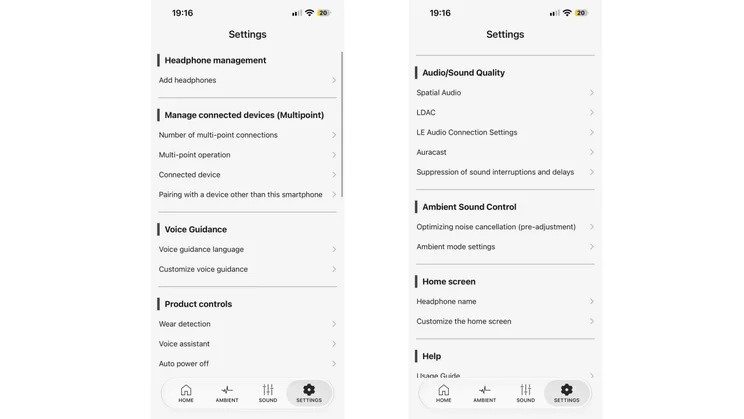
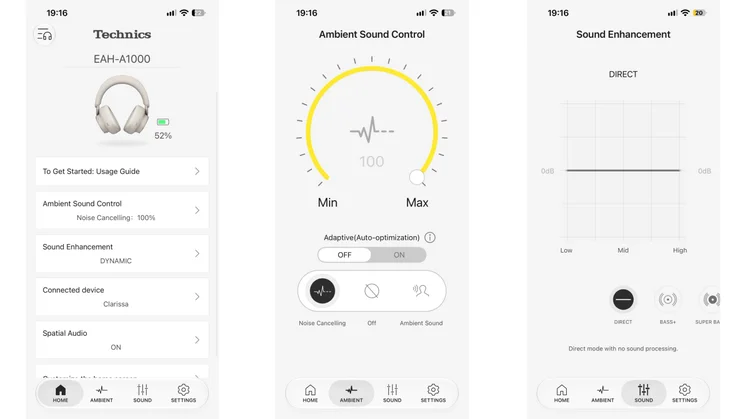
Elsewhere, the EAH-A1000 offer Spatial Audio with Dolby Head Tracking, 45-hour battery life with ANC on (active noise cancellation), wear detection, voice assistant support, Auracast and sound enhancement options via the Technics Audio Connect app. EQ options include the default and flat “Direct”, “Super Bass+” and “Dynamic” presets, and an eight-band graphic equaliser to create up to three custom EQs.
Overall, the feature set offers few surprises, but ticks all the main boxes.
What’s the design like?
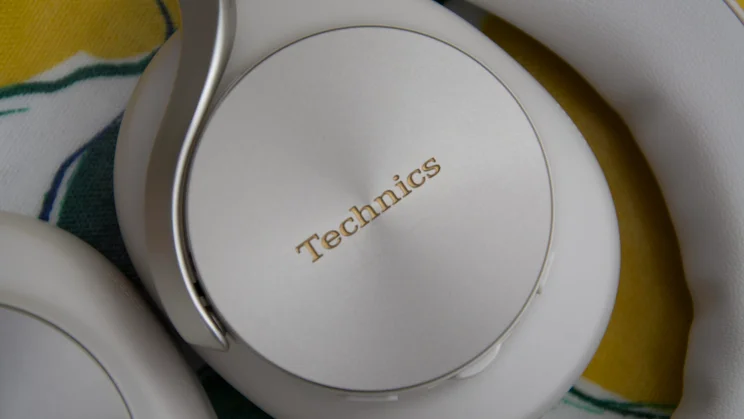
I mentioned premium design earlier, and the A1000 certainly look the part. I was sent the “Greige” model to test and think it’s very stylish. The black variant is sleeker, and the darker tone really helps the etched gold Technics logo pop, but I prefer the grey/beige blend.
The metal disc on the outside of the earcups is classy yet eye-catching, and the colour-matched “flow arms” that attach the cups to the headband and let them swivel and fold are an enormous improvement over the A1000’s predecessors. These metallic elements add weight, making the A1000 heavier than options like the Sony WH-1000XM6 (254g) and Bose QuietComfort Ultra Headphones Gen 2 (236g). However, as we’ll discover shortly, this doesn’t mean much.
While I love how the A1000 look, they don’t feel like £400 headphones. The metal plate on the left earcup creaked strangely when I pressed it in, and although the flow arms are an aesthetic success and functionally sound, on closer inspection, premium build quality and craftsmanship aren’t the first words that come to mind.
How comfortable are they?
Any reservations I had about the EAH-A1000’s design went out the window when I put them on. Although not the lightest of their breed, they balance their weight perfectly. The memory foam headband cushion distributes pressure so well that I didn’t notice it while wearing them, and the earcups are just the right level of snug. The earpads’ suppleness is brilliantly judged, too, creating an effective passive seal without applying any unnecessary pressure.
The best tribute I can pay to the EAH-A1000 is that I wore them for the majority of my return flight between London and San Francisco. That’s an 11-hour journey, and they never felt like they were cramping my ears or causing irritation. I even managed to nod off with them on, which is rare; I typically switch to earbuds when my eyelids start to droop.
How easy are they to control?
Technics has kept the EAH-A1000’s physical control layout simple, with just three buttons on the right earcup. The top one toggles between noise-cancelling and ambient sound modes, with the bottom one handling Bluetooth pairing and power. Between them is a “slide control” that handles general playback and volume control.
Pushing the slide control in different directions to increase or decrease volume works really well, but the multi-tap-and-hold gestures are less user-friendly. I got used to them after a while, but was grateful I could avoid them most of the time, as I rarely fast-forward or rewind my music.
Although they don’t affect ease of use, the A1000’s control buttons contribute to the headphones’ less-than-premium feel. They’re plasticky and lack the satisfying tactility I’d expect from headphones costing this much money.
How good is the microphone quality?
Technics has been a trailblazer in this area of late, and the EAH-A1000 perform very strongly here, too. With AI beamforming assistance, the eight-mic setup did a phenomenal job in quiet environments. My voice recordings and voice notes sounded incredibly crisp, phone calls went smoothly, and I happily used the A1000 for online meetings at home.
The A1000 also excelled in areas with relatively minimal ambient noise. During a call while walking along residential roads, they picked up my voice cleanly, and the occasional passing vehicle had little to no impact on the conversation.
However, as ambient sound, or your proximity to it, increases, the headphones inevitably start to struggle. Background noise was immediately noticeable in recordings made a metre away from my laptop with a YouTube video playing at 70% volume. Not only was it noticeable, but this noise caused certain words I said to be dropped. A real-world example came when I logged into the team’s morning meeting while on a train. While giving my shout-outs, the list of the stops was loudly announced over the tannoy, almost entirely drowning out what I said. I was sitting right under the speaker, though, and once the announcement had ended, things improved immediately.
So, they may not be miracle workers, but as long as you’re not right next to an egregiously loud source, the Technics EAH-A1000 will serve you very well for calls.
How good is the noise cancellation?
The EAH-A1000 did an excellent job reducing external distractions on my aforementioned flights to and from San Francisco. Their ANC not only effectively attenuate low frequencies like humming engines; it also cuts out a reasonable amount of mid-range noise and some treble. I was particularly impressed that the click-clack of keyboard typing in the office was inaudible, even without music playing.
The A1000’s noise-cancelling defences aren’t impenetrable. Seasonal coughs in Aldgate Tower made their way to my ears every once in a while, and announcements were still audible on public transport. However, Technics is now up there challenging the best around in the ANC department.
It offers granular control of noise cancellation on a scale of 1 to 100, plus an Adaptive mode that analyses your ears and surrounding noise before automatically optimising the attenuation applied. I generally prefer setting ANC strength myself, but found this latter mode did an admirable job of meeting my noise-cancelling needs in varied situations.
The Ambient Sound mode is also user-controllable. At 100% transparency, I locked into my surroundings without any issues when playing audio at low-to-moderate volume. Compared with the Beats 360 I was also testing at the time, the A1000 piped in the voices of those around me slightly louder and clearer, although both did a fine job in this regard.
A bump in the noise-cancelling road
I have one caveat about the A1000’s noise-cancelling performance: sudden movements affect it quite dramatically. I first noticed this while on a bus ride from Deptford to Lewisham. As the vehicle rumbled along, bumps in the road caused brief hiccups in the noise cancellation, which was rather distracting. This also happened a couple of times on the Tube, but it was never a problem when I was navigating London on foot, in a car with decent suspension or 40,000ft in the sky.
What’s the sound quality like?
I thoroughly enjoyed my varied listening sessions with the EAH-A1000. What first struck me was the soundstage they create. It’s spacious, even without spatial audio switched on, and entirely convincing. That’s the ideal canvas for showcasing the A1000’s laser-like precision and insight across the frequency spectrum.
Each instrument and percussive element on Bachman-Turner Overdrive’s You Ain’t Seen Nothing Yet was accurately and confidently defined when streaming it over AAC on an iPhone 13 Pro. This clean, natural reproduction was even more apparent when listening to the same song over LDAC on a Google Pixel 11.
The even-handed presentation of the guitar and subdued vocals during the opening of Bob Seger’s Night Moves was impressive, and later parts of the track highlighted their ability to transition between quiet, soft sounds and louder, more forceful elements. Few pairs of headphones transition between the two ends of this scale as smoothly as the A1000. Whether a track demands mid-range delicacy or top-end sparkle, these headphones deliver.
However, some people may find their delivery a touch too smooth. It’s not a glaring sonic weakness, but the EAH-A1000’s polished approach isn’t as bracing or impactful as their competitors on tracks that grab you by the scruff of the neck and take you on a ride.
Controlled but too clinical?
I wouldn’t go so far as to say their handling of Nirvana’s Smells Like Teen Spirit was restrained, but the fearsome opening guitars were a little more clinical than on similarly priced Bose, Beats and Sony over-ears. That will be a pro for some and a con for others. I respect Technics’ decision to stick to its guns and prioritise accuracy and control over effect. I wouldn’t have minded if they’d bumped the volume ceiling up slightly, however; at maximum volume, the A1000 aren’t the loudest over-ear headphones around.
That control is evident in their low-frequency response. Technics says the acoustic control chamber in its new Magnetic Fluid driver setup helps optimise driver movement and deliver bass “with both depth and definition”.
After spending a couple of hours listening to a playlist of four-to-the-floor anthems like the Low Steppa & Johan S remix of Heller & Farley Project’s Ultra Flava, Dooms Night by Azzido Da Bass, and Camisra’s Let Me Show You, I can’t argue with that description. The low-end is just how I like my steak: juicy yet lean. The A1000’s bass has no excess flab. I would nudge you towards the Dynamic EQ if you listen to a lot of dance music, though. It’s punchier at both ends of the frequency curve, yet remains clean and spacious.
In some ways, Spatial Audio support feels somewhat at odds with the judicious default tuning, but having it, in all its Dolby Head Tracking glory, is handy for watching films and video content. I turned it on while watching Mortal Kombat II and The Super Mario Galaxy Movie on the plane to the US; it wasn’t a game-changer, but it did eke out a sliver of additional immersion in what were wholly unimmersive circumstances.
Should you buy the Technics EAH-A1000?
It’s an amazing time to be a consumer if you’ve got £400 to spend on a pair of premium noise-cancelling headphones; you really are spoilt for choice. The arrival of the Technics EAH-A1000 makes that choice even harder.
They’re my favourite over-ears of the year so far, knocking the Sony 1000X The Collexion off top spot thanks to a marginally more comfortable fit and a far more accessible price tag. I can’t say how they stack up against the Sennheiser Momentum 5 Wireless, as I didn’t review them. However, they received a glowing review from Simon Cocks and are £70 cheaper, so the better choice if you don’t want to pay top dollar.
I spent some time using the WH-1000XM6 earlier this year and, like everyone else, including Jon Bray, who gave them our Best Buy award, loved them. The Technics EAH-A1000 push them in every area and beat them in a couple, but minor niggles over ANC and build quality mean they have to settle for a close second in the battle for flagship over-ear supremacy.


