
To help us provide you with free impartial advice, we may earn a commission if you buy through links on our site. Learn more
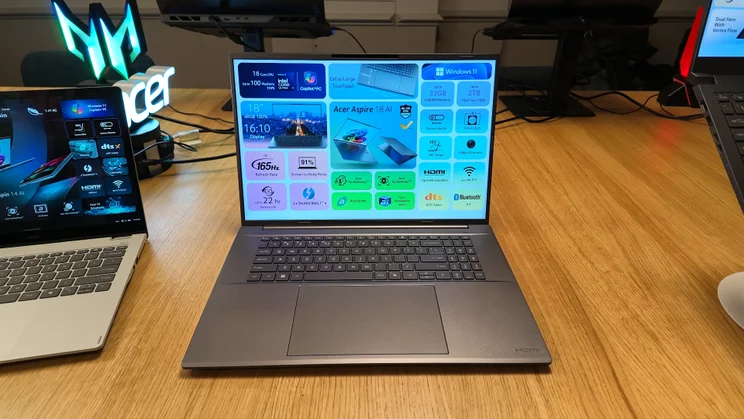
Acer’s more budget-friendly Aspire AI series of CoPilot+ laptops is getting a new member – and it’s a big one. The Acer Aspire 18 AI was unveiled just ahead of Computex 2026, bringing with it the largest display yet to grace an Aspire machine – a vast 18in WUXGA IPS screen with a 16:10 aspect ratio, 165Hz refresh rate and 400 nits peak brightness.
The hefty Aspire 18 AI was announced alongside a slew of new Acer products, including the X 16 AI laptop, the Predator Atlas 8 handheld gaming PC and two laptops powered by new Snapdragon Silicon: the Swift Spin 14 AI runs on the latest Snapdragon X2 series while the Aspire Go 15 debuts the brand-new, budget-friendly Snapdragon C platform.
Acer Aspire 18 AI
This is the largest machine in the Aspire series to date, settling in as the most “premium” entry in what is broadly a more affordable line of laptops. The 18in display pairs its 1,920 x 1,200 resolution with 100% production of the sRGB gamut and a 1,200:1 contrast ratio. The four-cell 71Wh battery is said to allow for up to 22hrs of video playback or 17hrs 30mins of web browsing.
Configurations include Intel processors up to Core Ultra 9 386H, Intel Graphics, up to 32GB of LPDDR5X RAM and a maximum of 2TB of storage via dual M.2 PCIe Gen4 SSD slots. Around the edges, it has two Thunderbolt 4 ports, one HDMI 2.1 port and two USB-A 3.2 Gen 1 ports, while wireless connectivity extends to Wi-Fi 7 and Bluetooth 5.4.
The whole package, as you’d expect, is a chunk. It weighs 2.2kg and has a footprint of 400 x 272mm (WxH) with a folded thickness of between 12mm and 19mm, depending on your configuration.
Acer Aspire X 16 AI
For something a little more portable (read: much more), we also have the latest version of the Aspire X 16 AI joining the party. This is a 1.6kg machine that measures 355 x 250mm (WxH), and is between 10mm and 16mm thick, again depending on which configuration you choose.
We once again have Intel processors, with options up to Core Ultra X9 388H and this time Intel’s more potent Arc Graphics, up to 32GB of LPDDR5X RAM and the same 2TB SSD capacity as the Acer Aspire 18 AI.
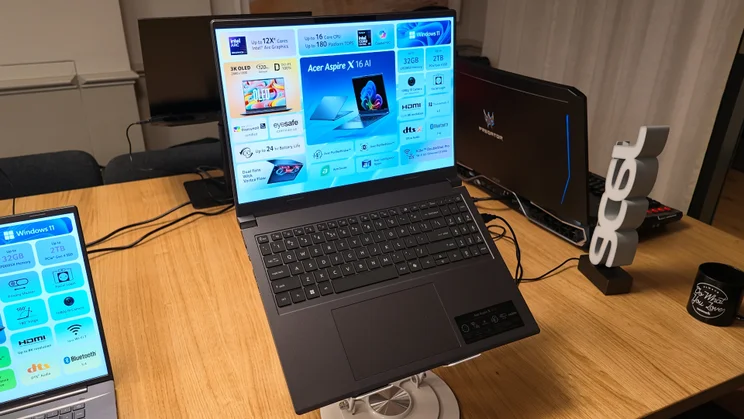
The display is up to a 16in WQXGA+ (2,880 x 1,800) OLED panel with a 120Hz refresh rate and a 16:10 aspect ratio. It is said to produce 100% of the DCI-P3 colour gamut, is rated for DisplayHDR True Black 500 with a peak brightness of 500 nits to match. Keeping the lights on is an 84Wh 4-cell Lithium-ion battery that Acer claims can run video playback for up to 24 hours or web browsing for up to 19 hours.
Around the edges are a generous selection of ports: 2x Thunderbolt 4, 1x HDMI 2.1, 2x USB-A 3.2 (one Gen 1 and one Gen 2), a 3.5mm jack, a microSD card reader and an RJ45 Ethernet port. There’s also Wi-Fi 6e and Bluetooth 5.4 wireless connectivity.
Acer Aspire Go 15 and Swift Spin 14 AI
Here we switch from Intel chips to Snapdragon, with the Acer Swift Spin 14 AI running on either the Snapdragon X2 Elite or X2 Plus and the Aspire Go 15 having the honour of being the first laptop to feature the new entry-level Snapdragon C chipset.
The latter pairs the Snapdragon C with a Qualcomm Adreno GPU and up to 8GB of RAM and 512GB of onboard storage. The display is a 15.6in panel with a 16:9 aspect ratio and a resolution of 1,920 x 1,080. The battery is 53Wh and around the edges we have two USB-C ports, one USB-A port, an HDMI 1.4 port and an audio jack. Wireless connectivity runs to Wi-Fi 6e and Bluetooth 5.4.
The Swift Spin 14 AI, as the name suggests, is another Copilot+ machine, like the above Aspire X 16 and 18. Whether you choose the configuration with the Snapdragon X2 Plus or go all-out with the X2 Elite, the machine will be fitted with the Qualcomm Hexagon NPU that is capable of performing up to 80 TOPS (trillions of operations per second).
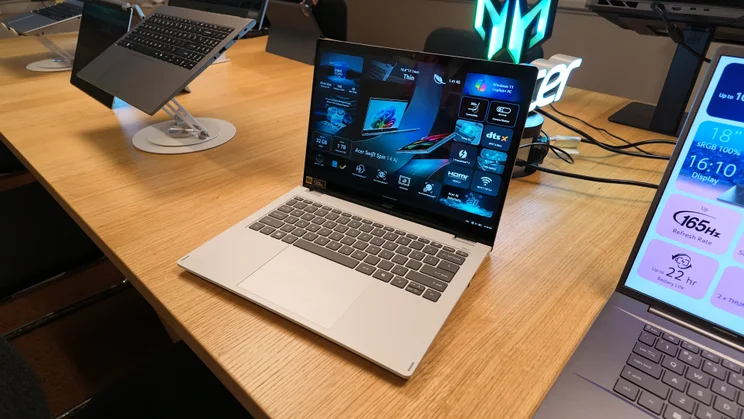
The rest of the loadout includes up to 32GB of RAM, up to a 1TB PCIe Gen 4 SSD and a 65Wh battery that is apparently able to run the laptop for up to 23 hours of video playback or 16hrs 30mins of web browsing. Also included is a 100W USB PD adapter for fast charging.
The display is a 14in WUXGA (1,920 x 1,200) IPS panel with a 16:10 aspect ratio, a 1,200:1 contrast ratio, peak brightness of 300 nits and a 120Hz refresh rate. Wi-Fi 7 and Bluetooth 6.0 are supported here, and you’ve got a bevy of useful ports around the edges: two USB-C ports, two USB-A ports, an HDMI 2.1 port and an audio jack.
It’s pretty lightweight, too, weighing in at 1.34kg. The footprint is 314 x 230 (WxH) and the thickness is between 15.9 and 16.5mm, depending on the exact specifications.
Acer Predator Atlas 8
Finally, we turn to the Acer Predator Atlas 8, the latest entry into the ever-growing handheld gaming PC market. The most notable inclusion here is that the Atlas 8 runs on the new Intel Arc G3 processors – with a choice of either the standard G3 or the G3 Extreme – both of which are said to deliver superior performance and battery efficiency.
To that end, there are two different battery configurations to choose from (presumably the larger with the G3 Extreme and the smaller with the standard G3): the one with an 80Wh battery weighs “under 810g” while the version with a 60Wh battery is a smidge lighter, at 770g.
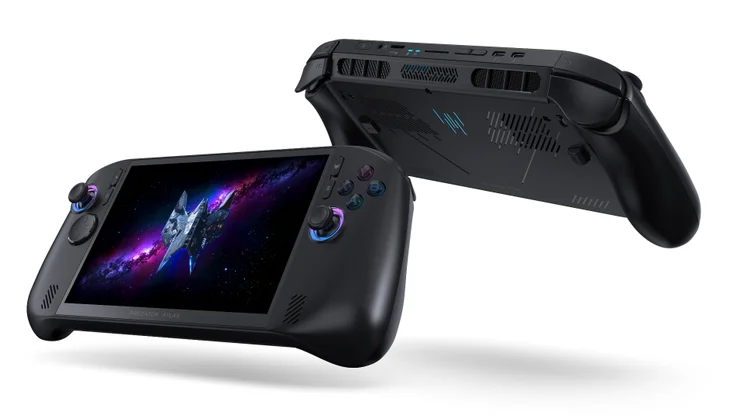
Memory and storage variants come in at up to 24GB and 1TB (PCIe Gen 4 SSD) and the display is an 8in WUXGA (1,920 x 1,080) IPS panel. VRR support is present and correct, brightness goes up to 500 nits, the aspect ratio is 16:10 and the refresh rate reaches a smooth 120Hz.
Graphics come courtesy of Intel Arc chips, with the B390 likely paired up with the G3 Extreme processor and the B370 probably linked to the standard G3. At the top end, the graphics include ray tracing support and AI upscaling.
For cooling, the Predator AeroBlade system is said to be the first metal fan in a handheld, which apparently delivers superior cooling performance over previous Predator handhelds.


