To help us provide you with free impartial advice, we may earn a commission if you buy through links on our site. Learn more
It’s a regular event for me to nip along to a TCL showcase at either MWC at the start of the year or the September IFA expo in Berlin (where I am currently). As such, I’ve got into something of a rut in which I’m never particularly surprised by what I see. Iterative improvements to its smartphone family and the latest version of the paper-like Nxtpaper display technology, sure, but nothing that feels like true evolution.
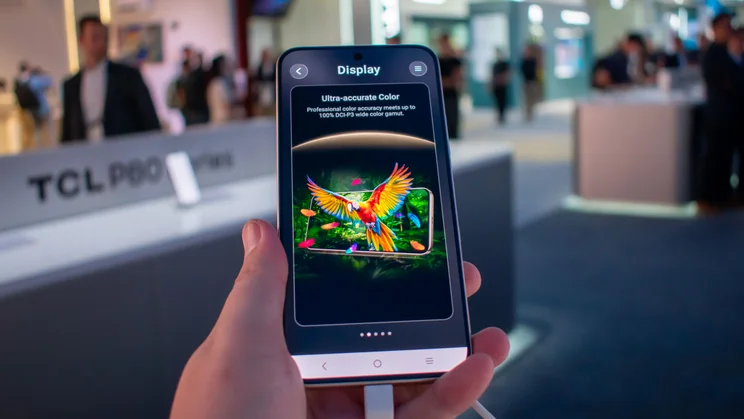
As such, it is with genuine delight that I tell you just how good the TCL P80 Ultra’s display is. Combining the brand’s wonderfully tactile matte displays with the colour and contrast of an AMOLED panel, it really is a fantastic screen. I only used it for a brief time but after putting it through all the testing I could think of on the spot, it feels like it has real potential to be my favourite smartphone screen yet.
There are three members of the new TCL P80 series but I’m most interested in the P80 Ultra, so let’s start there.
TCL P80 Ultra
As I have made clear, the new display is the banner feature here. It’s a 6.83in AMOLED panel with a 1.5K resolution, brightness up to 3200 nits and a peak refresh rate of 120Hz.
That’s good enough but, as with many TCL phones, there’s the Nxtpaper layer sitting over the top, which provides the paper-like feel that makes my brain purr to use and bats away annoying glare from nearby light sources.
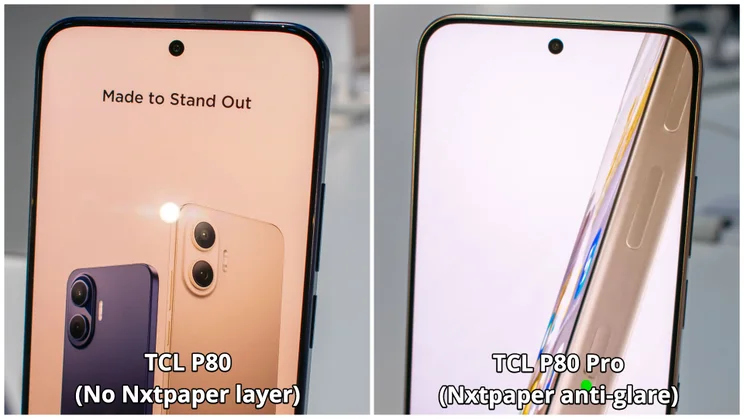
I love these displays for the satisfying feel of them but that glare reduction is an extremely close second. You can see below the difference between this and a non-Nxtpaper display when I shone my phone’s torch on both. Granted the background tone of each is a little different but it’s like the torch isn’t even shining on the right image.
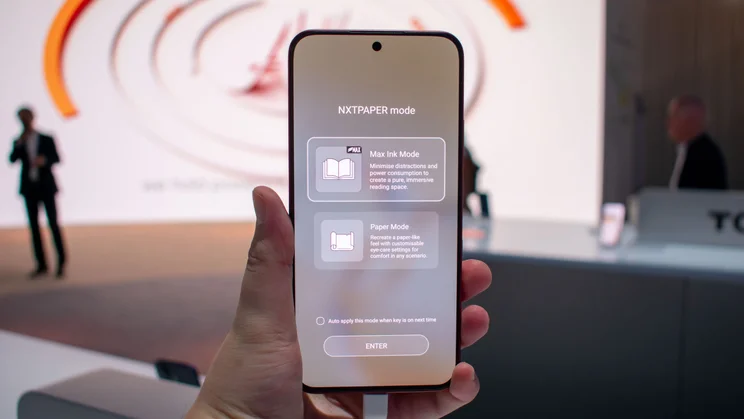
The other Nxtpaper feature to note is that the P80 Ultra can switch to an e-ink style via the dedicated slider on the right side. With this, you can opt for the Paper mode, which presents your normal homescreen in an e-ink style, great for ebooks and the like, or Max Ink mode, which cuts out background distractions and presents a simplified screen for a more focused reading experience.
These features have always been appealing but, until now, they’ve been restricted to LCD displays, meaning that you had to choose between the Nxtpaper benefits and the bright, bold colours, endless contrast and deep, rich black level that you get from OLED screens. That’s why the P80 Ultra feels like such an improvement – all of TCL’s work in refining the Nxtpaper experience no longer comes with the caveat that you’re saddled with an LCD display.
Looking past the screen, the build is decently lightweight, measuring 78 x 8.3 x 163mm and weighing 197g. The dust and water resistance rating is IP68, meaning it’s dustproof and can survive a dunk in 1.5m of water for up to 30 mins, and there are three colour options available: the gorgeous Burgundy seen here, Midnight Blue and Sunlit Gold.
Running the show is a 4nm Mediatek Dimensity 7400 Ultra chipset, clocked up to 2.6GHz and backed by 8GB of RAM and “up to” 512GB of storage – no word on the minimum capacity for the entry-level model at this time. The battery is a healthy 5,800mAh cell that supports wired charging up to 45W and can apparently go from empty to full in around 65mins.
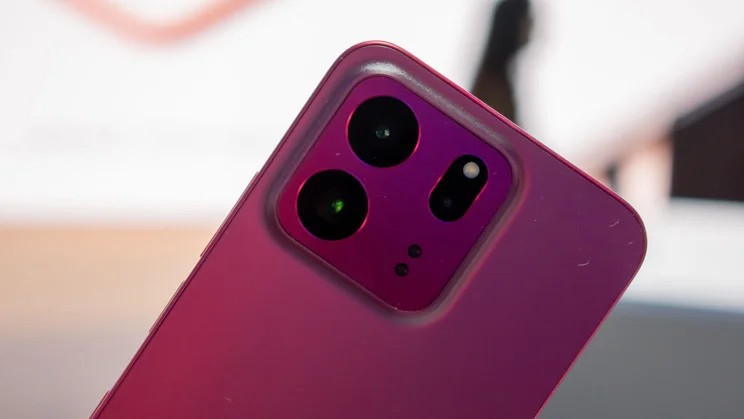
There’s a triple-camera system on the rear of the phone, with the 50-megapixel main lens joined by a 50-megapixel 3x periscope telephoto camera and an 8-megapixel ultrawide. Over on the front is a 32-megapixel selfie camera.
I’m not that thrilled about the low pixel-count on the ultrawide but everything else sounds quite positive on the hardware front. Especially considering that the TCL P80 Ultra is said to start at just £480, which puts it in the lower end of the mid-range category. Telephoto cameras are still something of a rarity at this price, so if the P80 Ultra performs well in my testing, it could well be a strong contender in this cutthroat corner of the market.
TCL P80 Pro
The TCL P80 Pro is a little cheaper, starting at £430, but it is fitted with the exact same display as the Ultra model – a 6.83in AMOLED with that gorgeous Nxtpaper coating.
In fact, the vast majority of the specs are the same here: same measurements, same IP rating, same battery and charging capacity, same processor, RAM and storage options.
As far as I could tell from this first look, there are only three differences from the Ultra model. The first is that the Pro doesn’t come in the Burgundy colourway, with only the blue and gold (below) options available, and the second is that it’s a little lighter, at 191g.
That weight difference is likely explained by the third difference – there’s no telephoto camera here. The rest of the suite is the same, at least, with a 50-megapixel main shooter and 8-megapixel ultrawide on the rear and a 32-megapixel selfie camera on the front.
For the sake of a £50 saving, that doesn’t feel like too much compromise to me. Of course, I’ll have to fully test the performance, battery life and remaining cameras to see how they stack up to the competition around this price – mostly notably the Google Pixel 10a – but as with its Ultra sibling, the P80 Pro has the potential to be a dark horse in the mid-range market, even for those who aren’t instantly allured by the paper-like AMOLED display.
TCL P80
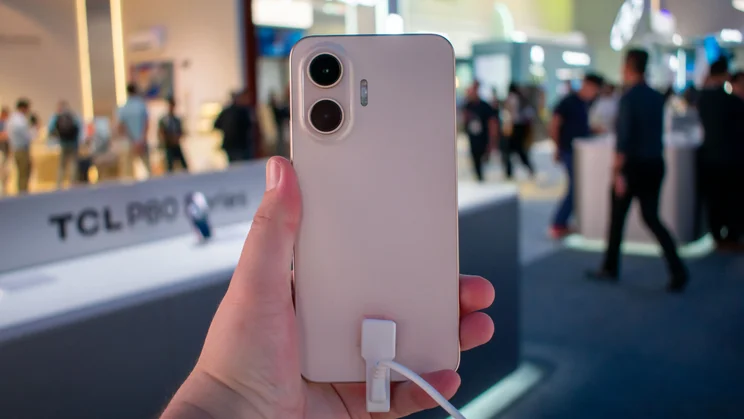
The one black sheep of this family, at least as far as I can tell from this first look, is the standard TCL P80. Now to be clear, there’s plenty to like about it – the 7.5mm thickness and 178g weight make it wonderfully pocketable, the cameras are identical to the Pro, and the display is the same, crisp 6.83in AMOLED.
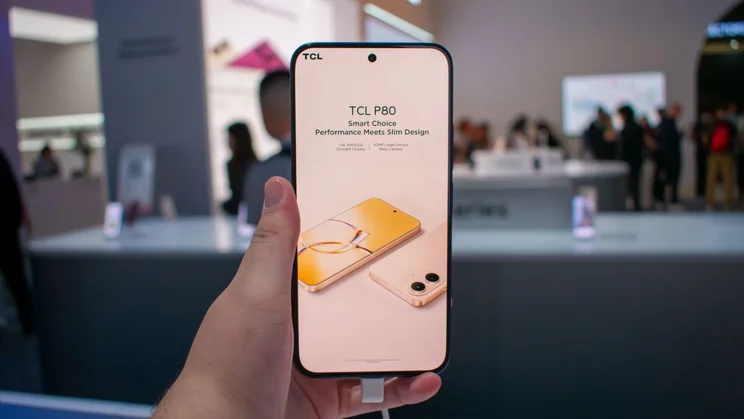
It does not, however, feature that gorgeous Nxtpaper covering. Additionally, the 5,000mAh battery is smaller than the other two (charging is still 45W, at least) and the Mediatek Dimensity 7300 Ultra processor is marginally weaker, clocked up to 2.5GHz. There’s still 8GB of RAM but storage only goes up to 256GB.
The P80 starts at £400 – it’s currently unclear if that’s for 256GB of storage or a 128GB variant – and that list of downgrades just doesn’t feel worth it to me for the sake of £30.
As I say, however, this was just a first look. And my initial impressions are far from final verdicts – perhaps the TCL P80 will surprise me when it comes time for testing. Keep an eye out for my full reviews in the near-future, especially if you want to try out that incredible combination of AMOLED display and Nxtpaper paper-like feel.