To help us provide you with free impartial advice, we may earn a commission if you buy through links on our site. Learn more












- Lighter, more durable build
- Six years of software support
- Excellent battery life
- Outdated cameras
- No wireless charging
- 512GB model is overpriced
The flagship Samsung S26 series is so fresh that it’s still cooling on the windowsill but the brand is already turning its attention to cheaper models with the release of the Galaxy A57. For all its dominance at the top-end of the market, Samsung has a more iffy track record with mid-range phones, struggling to escape the all-encompassing shadow of Google’s Pixel A series.
Although a solid improvement in a couple of areas, the Galaxy A57 is not the phone to turn things around. As this Samsung Galaxy A57 review will show, it gets a lot right – the design is particularly impressive – but it also falls down in one of the key areas that people prioritise: cameras. With rivals offering significantly better shooters, the Galaxy A57 will have a hard time convincing anyone but Samsung diehards to give it the time of day.

Samsung Galaxy A57 review: What you need to know
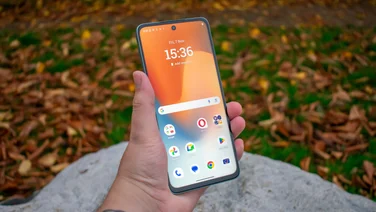
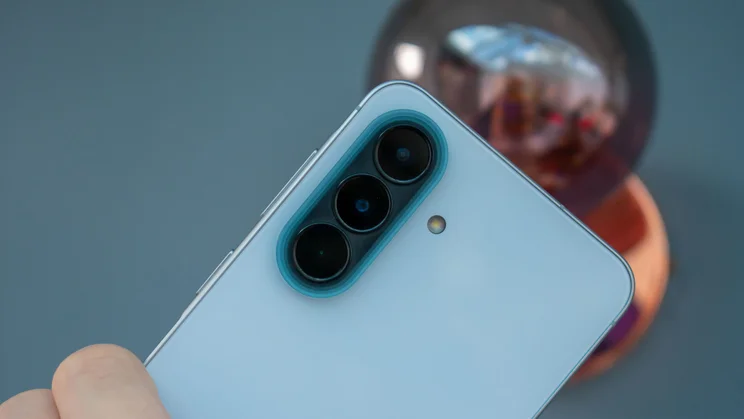
Compared to last year’s Galaxy A56, the big change with the Samsung Galaxy A57 is the design. It’s now dramatically lighter and quite a bit slimmer, making for a more sleek and attractive profile. The dust and water resistance is better, too, upping from IP67 to IP68.
The processor gets a standard generational update, going from the Samsung Exynos 1580 to the Exynos 1680, with the same peak clock speed of 2.9GHz. It is joined by either 8GB or 12GB of RAM and 256GB or 512GB of internal storage, while the battery is once again a 5,000mAh cell that supports 45W charging.
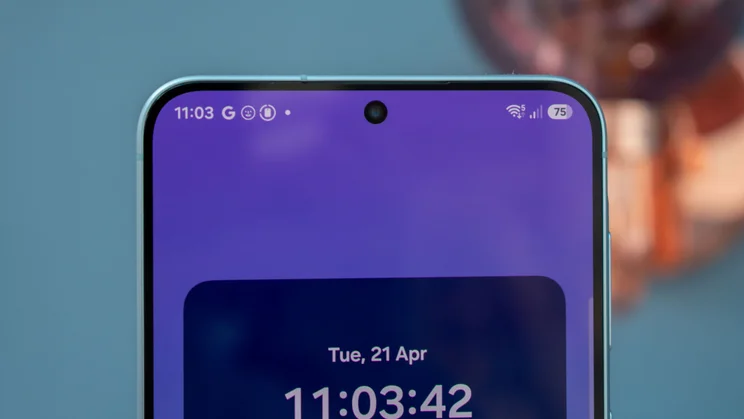
Both the display and camera setup are identical to last year: the 6.7in AMOLED screen has a resolution of 2,340 x 1,080 and a peak refresh rate of 120Hz, the selfie camera sat atop it is a 12-megapixel sensor with an f/2.2 aperture, and over on the rear we have the 50-megapixel (f/1.8) main camera, 12-megapixel (f/2.2) ultrawide and 5-megapixel (f/2.4) macro lens.
Price and competition
The base model with 8GB of RAM and 256GB of storage costs a little more than last year, at £529 (compared to £499), but it’s still very competitive with its key rivals. The 256GB Pixel 10a, for instance, costs £549, while the 256GB iPhone 17e is £599.
The addition of a 12GB/512GB variant to the range is good to see but the accompanying price tag is far less welcome. It costs a staggering £699 – a full £170 additional premium for twice the storage and an additional 50% of RAM. This is still cheaper than the 512GB iPhone 17e (an even more ridiculous £799) but the huge price increase puts the Galaxy A57 up against competition that it’s simply not equipped to face.
The OnePlus 15R, for instance, starts at £649 for 256GB of storage or £729 for 512GB, and has far better performance, a 165Hz display and an enormous 7,400mAh battery. Or there’s the Xiaomi 15T Pro, which nets you a fantastic 5x telephoto camera, powerful performance and 512GB of storage for the same £699 as the Samsung.
Even more damning is the OnePlus Nord 5, which costs just £449 for the same 12GB of RAM and 512GB of storage as the Samsung. And finally, the Honor 400 Pro is unique among Chinese rivals because it matches Samsung’s six years of software support, and can be picked up in the sole 512GB configuration for £549.
Design and key features
It’s mad to think that just two years ago, I was criticising the Galaxy A55 for feeling chunky and unwieldy. By comparison, the A57 is a world away, with much skinnier dimensions (77 x 162 x 6.9mm) and a breezy weight of 179g. That’s over 30g lighter than the Galaxy A55 and nearly 20g less than last year’s A56.
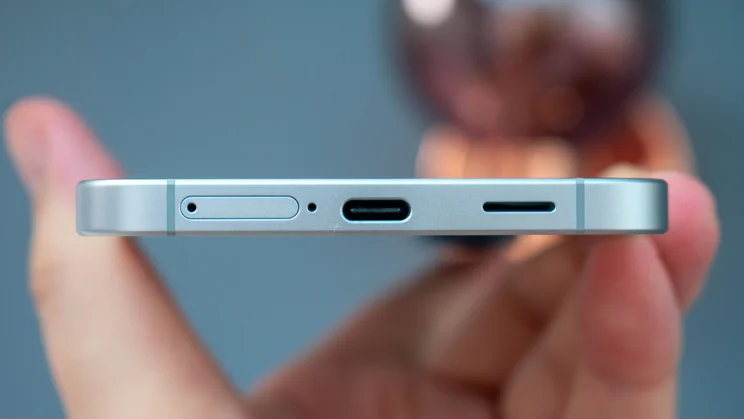
Between the 6.9mm thickness and the lightweight build, the Galaxy A57 feels superbly slight in the hand. It’s still nicely robust, however, with a sturdy aluminium frame and sheets of Gorilla Glass Victus+ on the front and rear – though the backplate glass is glossy rather than my preferred matte, so it doesn’t feel as premium as it could. There’s also the improved IP68 rating, which certifies it as dust-tight and able to withstand submersion in 1.5m of water for up to 30 minutes.
We have a swatch of four new “Awesome” colourways, with the Icyblue model reviewed here joined by Navy, Grey and Lilac alternatives. The latter is my favourite as it brings a much-needed splash of colour to the otherwise muted lineup.
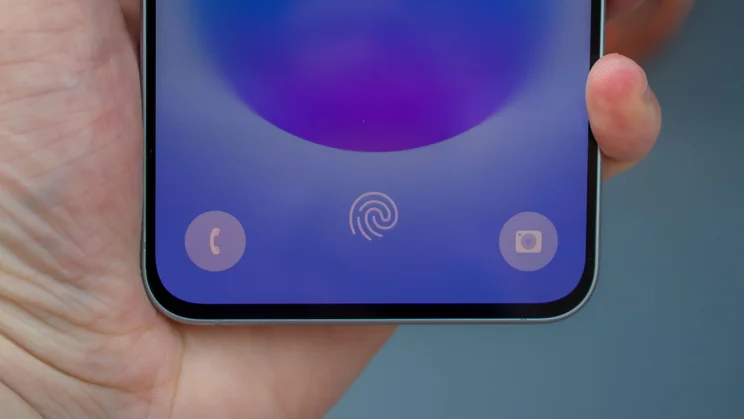
Connectivity is a little more fleshed-out than last year’s model, with support for Bluetooth 6.0 and Wi-Fi 6e out of the box. And as you’d expect, there’s an optical fingerprint sensor beneath the display and face unlocking via the selfie camera, both of which proved consistent enough in my testing.
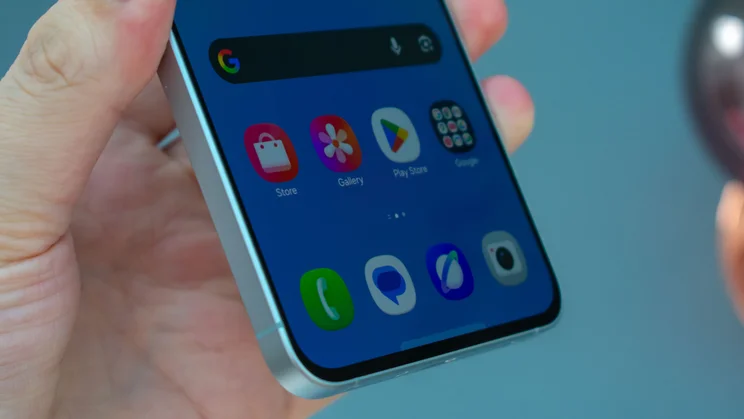
Software is Samsung’s OneUI 8.5 launcher based on Android 16 and comes with the same six years of OS updates and security patches offered to previous generations of the mid-range A-series. You also get a couple of new AI tricks this year, with Voice Transcription and an expanded Circle to Search that can “find the look”, tracking down and displaying multiple items from an outfit in the same search.
Display
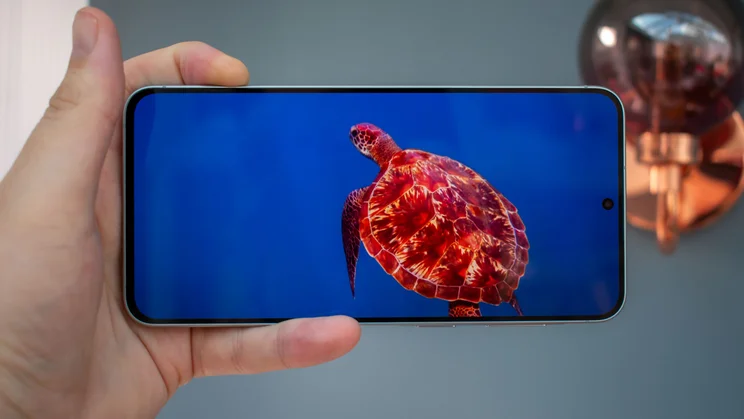
The 6.7in AMOLED screen is solid enough, with a fairly standard 2,340 x 1,080 resolution and a peak refresh rate of 120Hz. Brightness proved strong in my testing, hitting 1,124cd/m² on adaptive brightness with a torch shining on the light sensor and soaring to a peak of 1,614cd/m² when displaying HDR content.
There are two colour profiles, with Vivid punching the shades up a bit for more impactful streaming and gaming, while Natural shoots for authentic sRGB reproduction. On the latter, I recorded a gamut coverage of 95.8% with a volume of 97.8%, and the average Delta E came back at 1.26. That’s not quite on the money for our target of 1 or under but it’s closer than the A56’s result of 1.37.
Performance and battery life
The Exynos 1680 may have the same 2.9GHz peak clock speed as the Exynos 1580 used in last year’s Galaxy A56 but the overall core loadout is a little more powerful: there are four 2.6GHz performance cores, instead of three, and the remaining efficiency cores are clocked up to 1.95GHz, as opposed to 1.9GHz.
We see the results of these changes play out in the Geekbench 6 CPU tests, with the single-core results coming in roughly the same as the Galaxy A56 – unsurprising, due to the identical 2.9GHz prime cores. The improvements come in the multi-core portion, where the Galaxy A57 delivered speeds that were 16% faster than the A56.
These figures are in the same ballpark as the Google Pixel 10a and only a little behind the OnePlus Nord 5 but, as tends to be the case, the iPhone is so far out in front that it’s barely worth comparing the two. In the single-core test, the iPhone 17e secured a lead over the Samsung of 153%, while multi-core results were 97% faster.
So it can’t hold a candle to Apple’s silicon, but the Galaxy A57 is competitive enough in relation to its Android brethren at CPU operations.
The same cannot be said for GPU performance. I found that the Samsung Galaxy A57 handles medium-weight games smoothly enough, with fairly consistent framerates in Asphalt Legends, but the Geekbench 6 Vulkan test shows that you can get better GPU performance from rivals.
Casual gamers will get on fine with the Galaxy A57, but as you can see below, anyone who regularly plays intensive 3D games will get on better with the Pixel or the OnePlus.
We’re back to positives with the battery test, where the Galaxy A57 ran our standard looping video for 31hrs 51mins before tapping out. That’s almost four hours longer than its predecessor and broadly a very good result for this kind of money.
The 45W wired charging is decent, bringing the battery from empty to 50% in 22 minutes in my testing, and achieving a full charge in around 1hr 10mins. The only downside here is the lack of wireless charging – both the Pixel 10a and the iPhone 17e offer this, so Samsung is behind its mid-range rivals in this regard.
Cameras
To quote myself from last year: “I was disappointed to see no camera improvements in the Galaxy A55 last year, so it’s even more of a letdown that the Galaxy A56 is once again fitted with that same trio of rear lenses.” Imagine then, how I feel about those self-same suspects sidling up with the Galaxy A57.
That’s now four generations of the A-series using the same camera setup. This refusal to even nudge the needle is becoming a problem, leaving the A57 with an outdated setup that falls behind the competition.
The main lens is the least problematic of the bunch, with shots in good lighting producing sufficient detail and solid dynamic range.
It does reasonably well after dark, too. Detail isn’t that strong but colours are natural and bloom from artificial light sources is managed effectively.
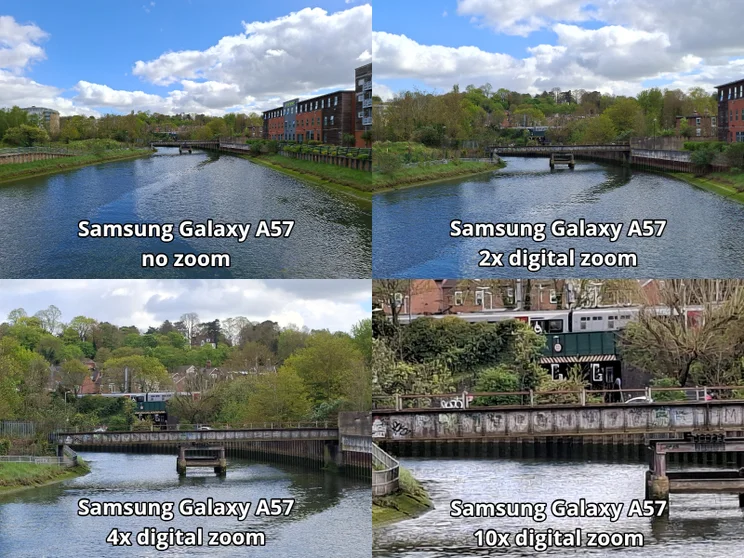
The cracks start to show when we bump up the zoom, however. The Galaxy A57 only magnifies to a 10x digital zoom and by that point, quality is so weak that it’s not worth using. 2x digital zooms are fine but anything beyond that is a mess.
The 12-megapixel (f/2.2) ultrawide also underwhelms on the detail front, particularly towards the edges, and the contrast is very soft, so images look quite washed out. Colour tone is consistent with the main lens but that’s about it for positives.
The 5-megapixel (f/2.4) macro camera is deadweight that really should have been jettisoned by now, producing weak, blurry images that are simply not worth bothering with.
It’s a shame to see video unimproved, too. What you get is solid enough, shooting 4K at 30fps or 1080p at up to 60fps, but rivals around this price shoot 4K at 60fps.
Samsung Galaxy A57 review: Verdict
In a rare move (and motivated by the vast gulf in prices) I’m going to separate the 256GB model from the 512GB for the verdict. The latter is absolutely not worth buying, it costs too much and offers too little, falling well short of other options in that price range.
The 256GB model has more appeal to it, with its wonderfully slight and lightweight build being the main draw – though performance, battery life and display quality aren’t bad either. And, of course, that excellent software support remains a key advantage. Samsung fans looking to avoid the high prices of the S series will find the A57 to be the ideal, cost-conscious alternative.
If you’re brand-agnostic, however, the Google Pixel 10a is better value overall. The cameras are stronger, the battery lasts longer and you get an extra year of software support.