To help us provide you with free impartial advice, we may earn a commission if you buy through links on our site. Learn more
- Wire-free setup
- Super accurate position
- Impressive object avoidance
- Garden needs full Wi-Fi coverage
- Boundary adjustment can be fiddly
Installing a robot lawnmower used to be a complicated affair, but that’s slowly changing. With the advent of vision-assisted navigation and connected, super-accurate Network-connected GPS systems, devices like the Husqvarna Automower 308V can be set up in minutes. What’s more, they can be set up to mow multiple different areas without much upheaval.
And it looks like the price of mowers offering this sort of tech is coming down, too. The Husqvarna Automower 308V isn’t what you would ever call cheap but a couple of years ago, mowers with these sorts of capabilities weren’t available at this sort of price at all.
Husqvarna Automower 308V: What do you get for the money?
So, exactly how much is the Husqvarna Automower 308V? Well, it’s £1,249 and the near-identical Aspire R6V is even less, at £999. The only difference between the two is the area of coverage they’re rated for. The 308V is good for areas up to 800m2, while the Aspire R6V will “only” cover 600m2. For most UK suburban gardens, the cheaper mower would suffice.
For context, the main competition for the Automower 308V comes from the Segway Navimow i208. It’s cheaper by £250, offers a similar set of features including network-connected GPS (or Network RTK as it’s more commonly known) and can mow lawns up to 800m2 in size – but it lacks the 308V’s ability to mow in different patterns.
So is the Husqvarna worth the extra over the Segway? The contents of the box are relatively spartan. You get the mower itself and the charging station, a 10m mains cable and a set of plastic soil screws for securing the charging station to the ground. Oh, and there’s also a set of spare blades (worth around £25), but that’s your lot. No need for reels of boundary wire; no need for hundreds of pegs.
In fact, as long as you already have a waterproof outdoor socket, the most demanding part of setup is going to be securing the adapter brick to a nearby vertical surface with a drip loop below it to prevent rainwater dribbling down the cable. With the mower docked, you can expect it to take 100 minutes to charge from empty and its 4Ah battery can deliver up to 100 minutes of run time; that was easily enough time to mow my tiny garden with plenty of capacity to spare.
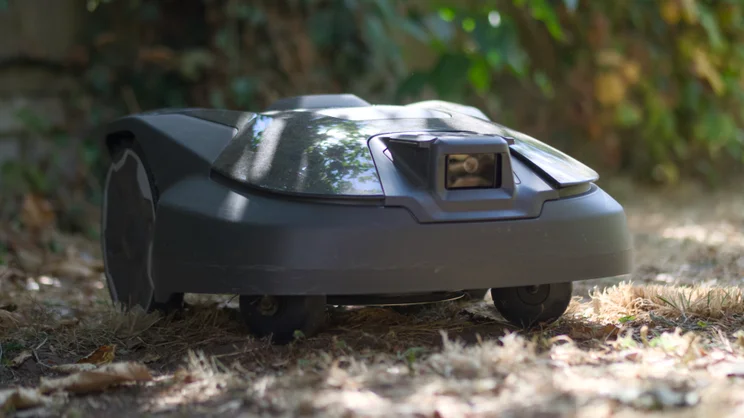
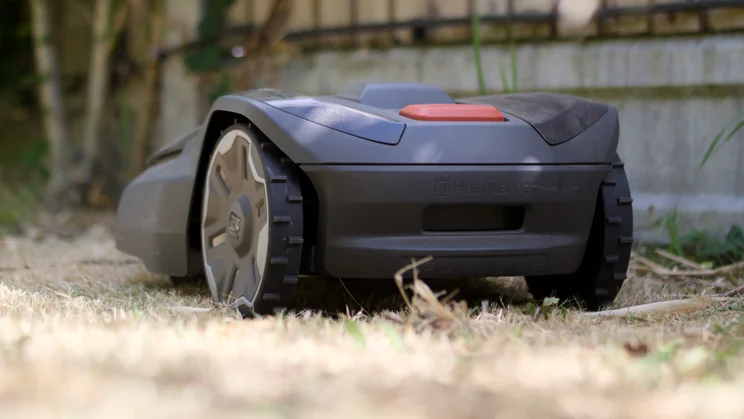
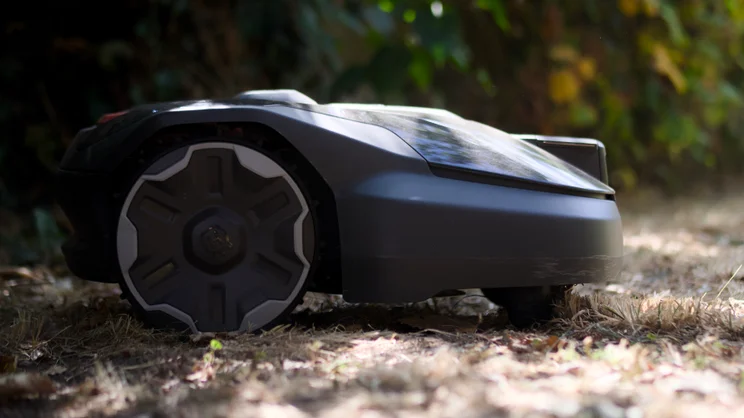
At 10kg, the mower itself is relatively lightweight – it’s around a third the weight of the Segway X430 Stuart Milne reviewed recently – and that means it’s easy enough to lift up and relocate if need be. Measuring 45cm wide, 25cm tall and 59cm long, it’s compact enough to squeeze into the smallest gaps around most domestic gardens. And it’s IPX6 rated, so it won’t mind getting caught out in the rain.
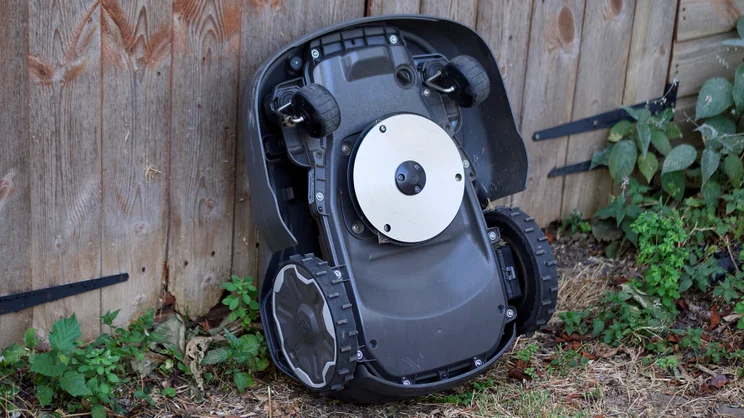
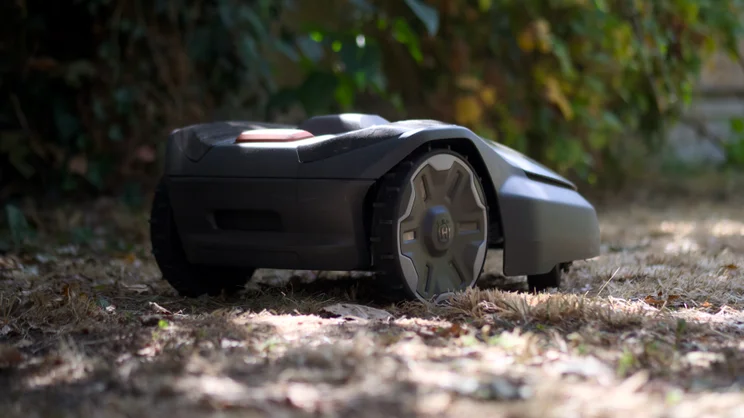
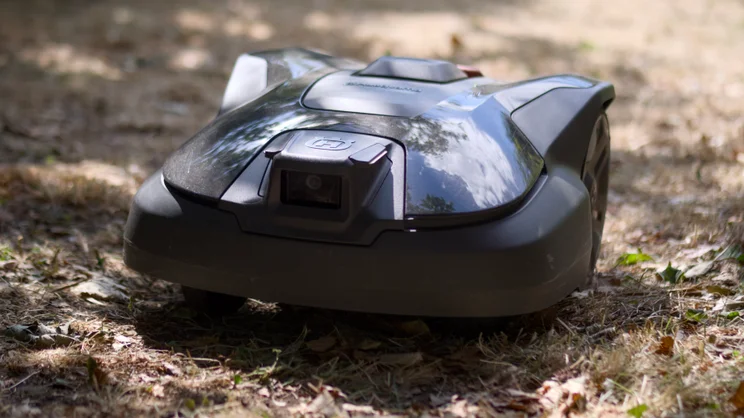
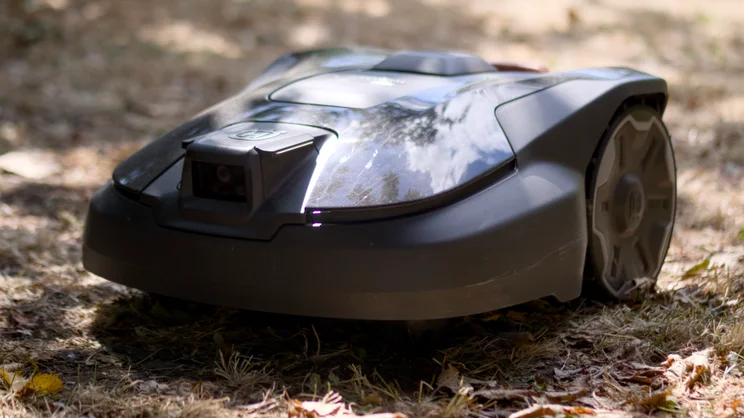
In design terms, it’s pretty standard robot lawnmower fare and it looks very similar to the Husqvarna Nera 305e we reviewed a few years back. It has a couple of large drive wheels with fairly aggressive treads at the rear of the mower, with a pair of smaller castor wheels at the front for stability, while three razor-style blades mounted to a stainless steel disc provide a cutting width of 22cm.
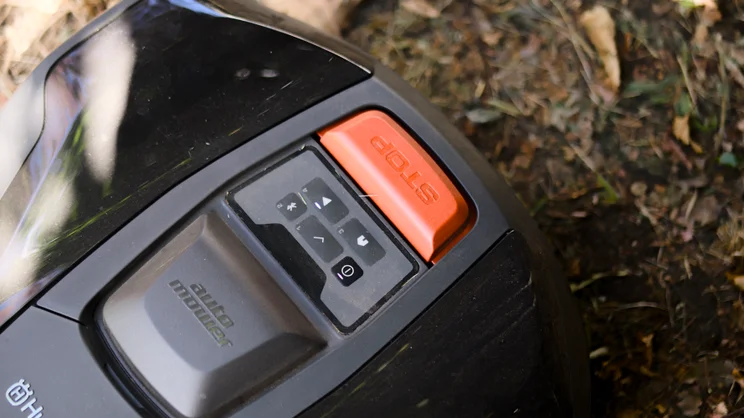
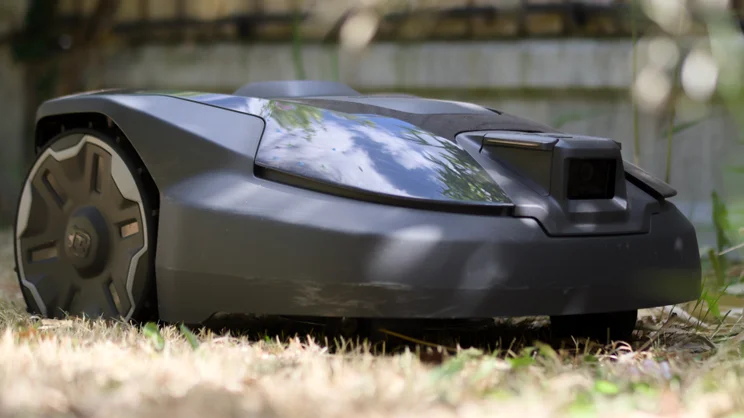
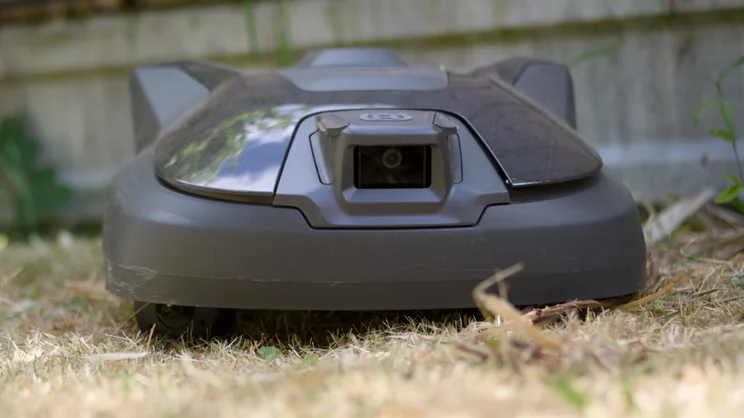
In the nose of the mower is a camera used for object detection and navigation when the GPS signal is weak, and up top is a small selection of physical controls: one large orange emergency stop button, a selection of blister buttons, and a dial under a small plastic hatch to control the cutting height of the blades. You can set this between 20mm and 50mm. If your lawn has a slope in it, the 308V can also cope with inclines of up to 40% within the mowing area, which is pretty darned steep, and 15% near the boundary.
What this cheaper Husqvarna doesn’t have is the secondary rear cutting disc of the 305E NERA, which means it can’t get quite as close to edges, but it isn’t too much of a bind to occasionally go around strimming the edges when they get too long.
Is it difficult to set up?
The setup process is relatively simple by robotic lawnmower standards, but there are a couple of requirements you need to be aware of. Once you’ve established a power supply for the base station so the mower can charge itself, you’ll need to make sure your garden is fully covered with a Wi-Fi signal.
It needs this primarily for accurate positioning: while the mower’s onboard GPS is reasonably precise, it isn’t good enough to prevent it going rogue and beheading your prize petunias.
For that sort of precision, the 308V needs a secondary signal from a static GPS station to provide a corrective reference signal. That’s where the Automower 308V’s Wi-Fi connectivity comes in. It uses this to communicate with Husqvarna’s remote servers, which provide the static GPS signal, allowing the mower to position itself with pinpoint 5cm accuracy.
If you can’t get Wi-Fi out to the furthest reaches of your garden, you can add a cellular connectivity module to the mower or set up an EPOS receiver in your own garden (exact positioning operating system), but these add significantly to the cost at £175 and £280 respectively.
The only other major requirement is a clear view of the sky either at (or very near) the base station so it can get a strong satellite signal. You don’t need a full view of the sky everywhere in the garden: in zones where you might have heavy tree cover, the 308V can use its front-facing camera to look ahead and mow wherever it sees grass.
With those critical needs taken care of, you need to define your mowing zone(s), and this is done simply by driving the mower around the perimeter of your lawn using the screen of your phone as the remote control. I found this a bit on the fiddly side as the robot didn’t respond instantaneously to my inputs, but it didn’t take too long once I’d mastered it. When this is complete, it’s possible to tweak the virtual boundary wire manually in the app.
You can create up to ten maps and even carry the mower to a different area entirely – your front lawn, for instance – as long as it remains in range of your Wi-Fi network.
The only gripe I have here is that adjusting the virtual boundary can be tricky, and that’s primarily because the edit mode provides no visual reference from which to work. While the main map view underlays a satellite image for a bit of visual context, that disappears on the edit screen, ironically where it would be most useful.
How did I test the Husqvarna Automower 308V?
I tested the 308V in my long, slim suburban garden, which I consider to be a bit of a challenge. It’s quite bumpy and the grass is, well, a bit on the tatty side. Unruly shrubs create an uneven, unpredictable border and there’s some tree cover at the one end to test out how reliable the GPS is when conditions aren’t ideal.
I also asked the Automower 308V to squeeze itself down the rather narrow passage next to my garden office, and into the area around the front of my shed and garden office to see how well it would deal with tight spaces. Finally, I positioned several objects on the lawn and observed how the mower coped with them to test out its object avoidance.
How well did it mow the lawn?
I was impressed with how methodically the 308V found its way around the narrow confines of what I call a lawn. By default, it mowed once around the perimeter of the area, and then cut the grass in the centre in long stri pes. The first cuts were pretty comprehensive.
Cheaper robot mowers will bumble about in a random pattern until the battery runs out or a time limit expires, which isn’t particularly efficient. The 308V, however, mows quickly, and that’s better for your grass as you haven’t got wheels churning over it all the time. It mowed my tiny patch of garden in as little as 19 minutes.
You don’t have to stick with boring old stripes, though. Other mowing patterns are available, such as checkerboard, triangular and “irregular”. Plus, you can rotate the patterns so they align in different orientations; that’s not just a gimmick, by the way; varying the direction in which you mow the grass keeps it healthier.
It’s just a shame you can’t assign different patterns on a per day basis via the mowing scheduler – instead, you have to switch that in the app manually.
As with most robot mowers, you will need to tidy any particularly tall or shaggy areas before you run it the first time. I did that to mine first, but deliberately left in a few messy areas to see how it would cope: although it avoided these for the most part, it did get stuck on one particularly wild clump next to the garden office.
Largely, though, the 308V went about its business without fuss. Your neighbours will certainly appreciate the lack of noise it makes, too; it’s rated at 63dBA, which might seem loud, but even standing a metre or so away from it, I could barely hear it.
Object avoidance was just as impressive as general mowing. It avoided a shoe and a bucket I dropped on the lawn, and although it did have a tendency to bump into my rotary clothes airer, it only ever seemed to nudge it gently before turning and neatly circumventing it.
The only negative I’d mention is that the smaller front wheels do seem to balk at fairly low immovable objects, like large roots and paving slabs that stick up more than a couple of centimetres.
Should you buy the Husqvarna Automower 308V?
The Husqvarna Automower 308V is an excellent robotic lawnmower that’s stuffed with tech. Its network RTK system makes it super easy to set up and use. And it mows neatly and efficiently, avoiding obstacles as it goes.
If you do need the 800m2 coverage that this mower provides, then at £1,249 it’s decent value – although the Segway Navimow i208 is cheaper, it can’t mow in different patterns like the Husqvarna.
For an even bigger bargain, though, I’d recommend you look to the Automower Aspire R6V instead. It’s the exact same mower as this, just with a smaller capacity battery and a rating of 600m2. Either way, you will not be disappointed.