
To help us provide you with free impartial advice, we may earn a commission if you buy through links on our site. Learn more
- Epic battery life
- Strong performance across the board
- Supremely colourful and accurate display
- Display still only Full HD and 60Hz
- No touchscreen
- Much more expensive the outgoing model
When Qualcomm dropped its new Snapdragon X laptop chipsets back in late 2024, the mere fact it made Windows-on-ARM a practical undertaking was good enough. That performance was middling and not up to Apple’s ARM chips was, perhaps, overlooked.
Roll on to 2026, and Qualcomm has upped its game. As we’ve seen with the Asus Zenbook A16, the second-generation Snapdragon X2 chips are a whole different kettle of fish. They are delivering performance and efficiency at levels that should be keeping engineers at Intel, AMD and Apple awake at night.
Now, Asus has seen fit to stick an 18-core Snapdragon X2 chip inside its already impressive Zenbook A14.

What you need to know
Other than the second-generation Snadragon X2 chipset, what are the differences between the 2025 and 2026 Zenbook A14?
To be honest, there aren’t that many. The sound system has been improved, and the wireless modem has been upgraded so it now supports Wi-Fi 7 rather than 6E.
Everything else remains as is. The battery capacity is unchanged at 70Wh, the range of I/O ports is the same, ditto the keyboard and trackpad.
The display is the same too, so it’s 1,920 x 1,200 and 60Hz, which some will think a bit basic given the biggest change between the old and the new models: it’s much more expensive.
Price and competition
Configuration tested: 18-core 4.7GHz Snapdragon X2 SoC, 32GB RAM, 1TB SSD, 1,920 x 1,200 60Hz OLED display; Price when reviewed: £1,599 (16GB RAM)
There’s only one model of the new Zenbook A14. It comes with 16GB of RAM, a 1TB SSD and can be yours for £1,599. That makes it one of the more expensive 14in laptops on the market.
Our review sample landed with 32GB of RAM, but at the time of writing, we have no firm information on the cost or availability of the 32GB model.
Direct competition for this latest model comes from the 2025 Zenbook A14. Granted, the new model has it beaten in terms of performance and battery life, but the original still does pretty well in both areas, and the display and keyboard are identical. At the moment, you can find it on sale for a mere £649 (for the 16GB RAM model), which is a bargain compared to the 2026 machine.
Obvious non-Asus competition comes in the form of the new M5 update of the evergreen 13.6in MacBook Air. It can’t match the new Zenbook A14 for battery life, but the display is brighter and sharper and even with a matching 1TB SSD, it’s £300 cheaper.
One of the lightest 14in laptops around, the 805g Acer Swift Edge 14 AI is built around a wonderfully vivid 2.8K OLED touchscreen and an Intel Core Ultra 7 258V CPU. It’s a tasty combination and all the more attractive because at the time of writing, it’s on sale for just £899.
The current Surface Laptop 13 from Microsoft uses the first-generation Snapdragon X chipset, but it’s still a solid performer, and the 3:2 Full HD IPS display has a touch interface. Battery life is excellent, and the build quality is impeccable. At £949, it’s good value.
But the obvious rival is Apple’s MacBook Neo, which has recently upended the cheap laptop market. For just £699 with a 512GB SSD, it comes a lot closer to machines like the Zenbook A14 than the £900 price difference would suggest, and you get a higher-resolution display in the bargain. For general computing needs, the Neo is all the laptop most people will ever need.
Design and features
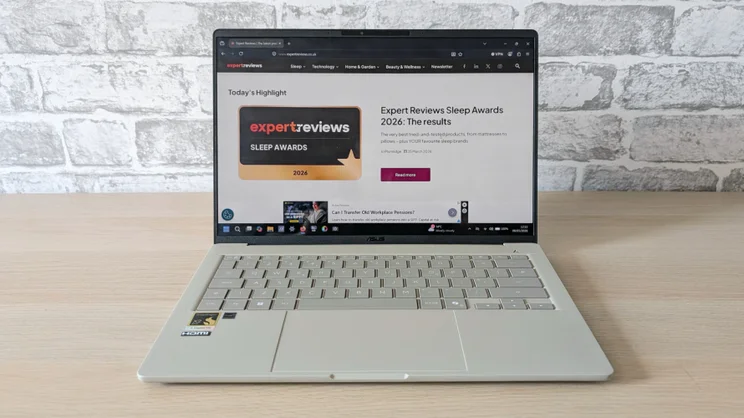
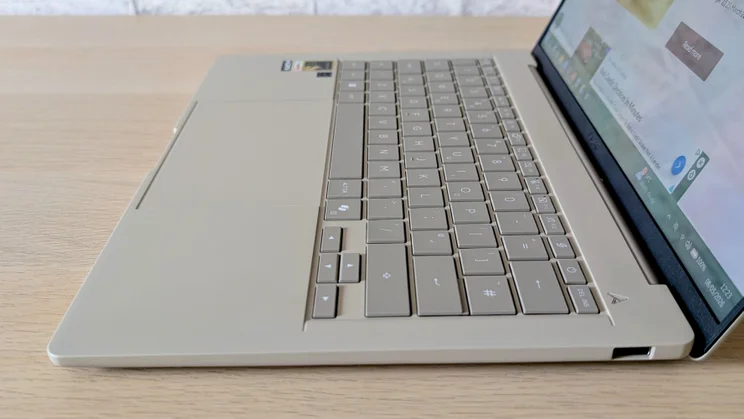
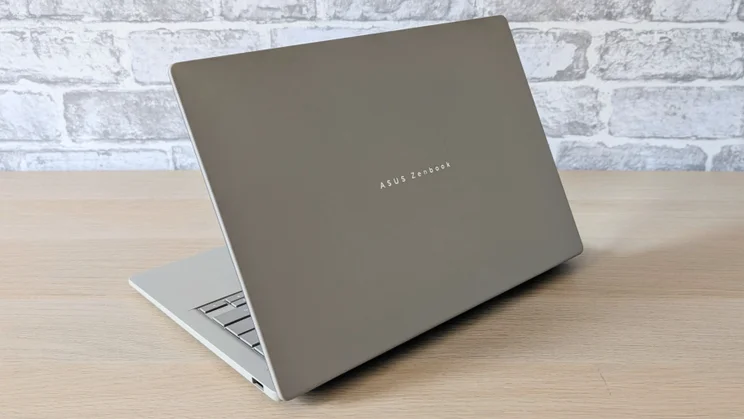
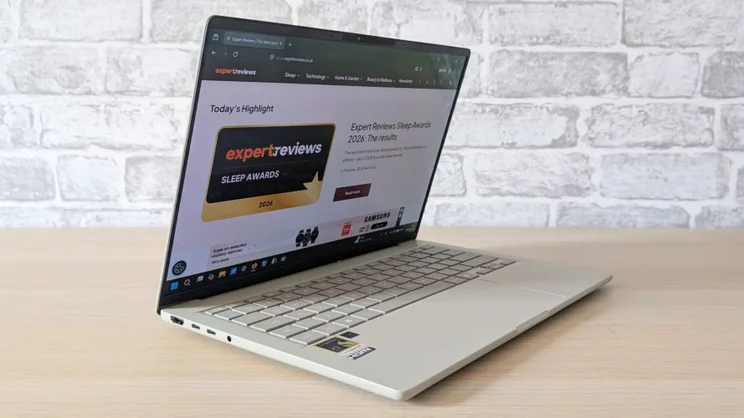
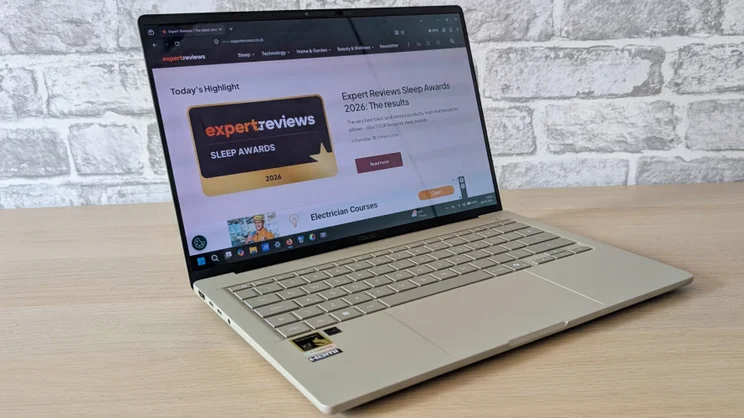
For good or ill, Asus has carried over the design of the 2025 model unchanged. As before, the new Zenbook A14 is impressively light and compact. It weighs a mere 837g, which makes the 13.6in MacBook Air look overweight, although at 311 x 214 x 16mm, it’s similar in size to the Apple machine.
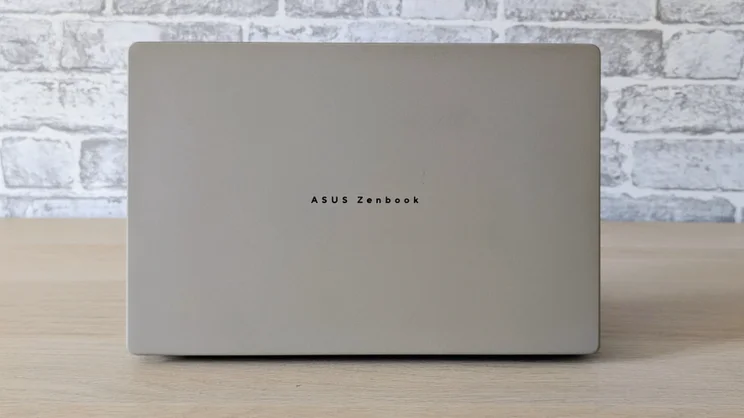
The A14 doesn’t feel at all flimsy, though. The body is made from Asus’ Ceraluminium’ material (a combination of ceramic and aluminium), which lends it a feeling of solidity and resilience and it looks great, too, although in my opinion not quite as good as the drool-worthy Zenbook S16.
It’s available in two colourways: Iceland Grey and Zabriskie Beige, and as before it meets the US MIL-STD 810H military-grade standard for resistance to particle ingress, shock and extreme temperatures.
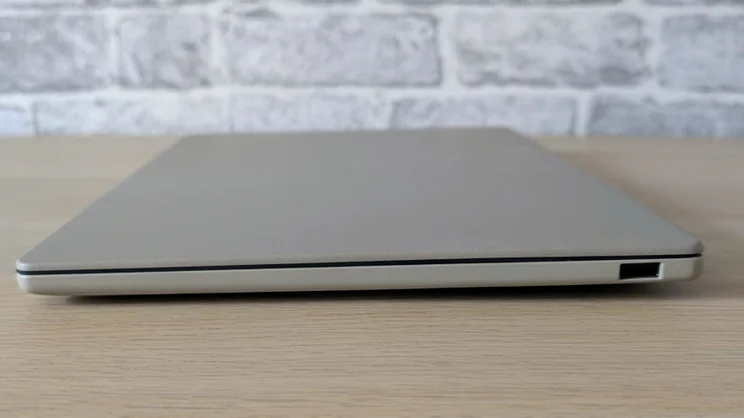
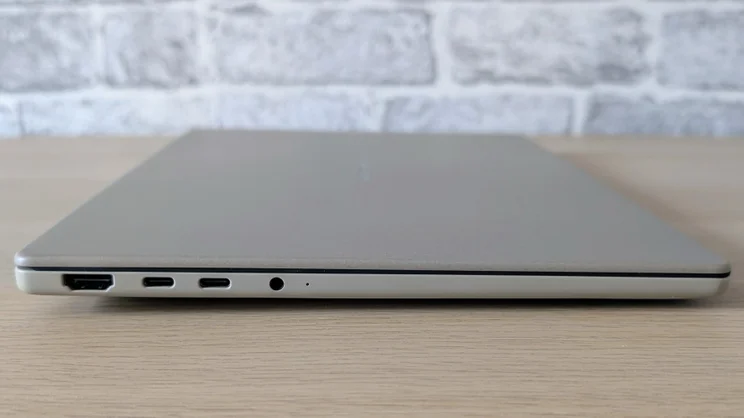
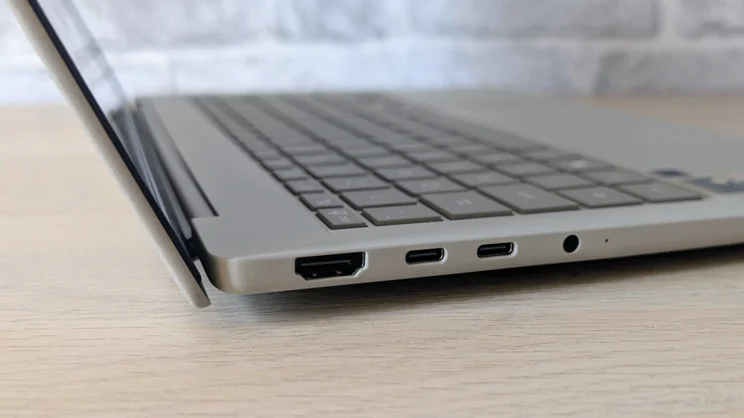
The new A14 is reasonably practical when it comes to connectivity, too. On the left edge is a pair of USB-C 4.0 data/video sockets, along with an HDMI 2.1 video output and a 3.5mm audio jack. On the right, you’ll find a solitary 10Gbits/sec USB-A port. Wireless communications are handled by the new Qualcomm C7700 silicon, which means you now get support for Wi-Fi 7 and Bluetooth 5.4.
And while it isn’t particularly upgradeable or repairable, you can remove the base easily, and both the M.2 2280 SSD and battery are accessible. Everything else is soldered in place.
Keyboard, touchpad and webcam
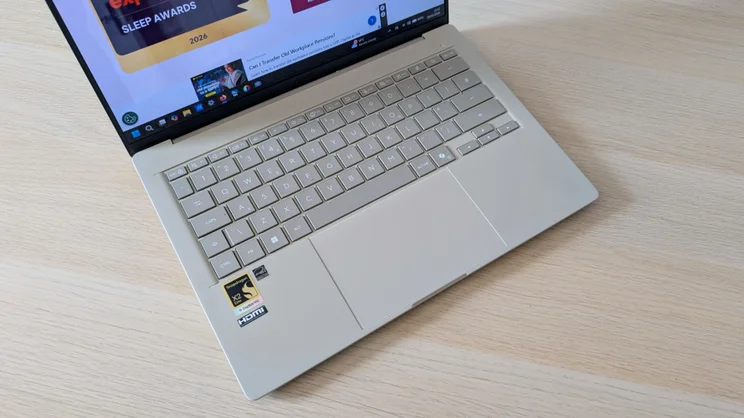
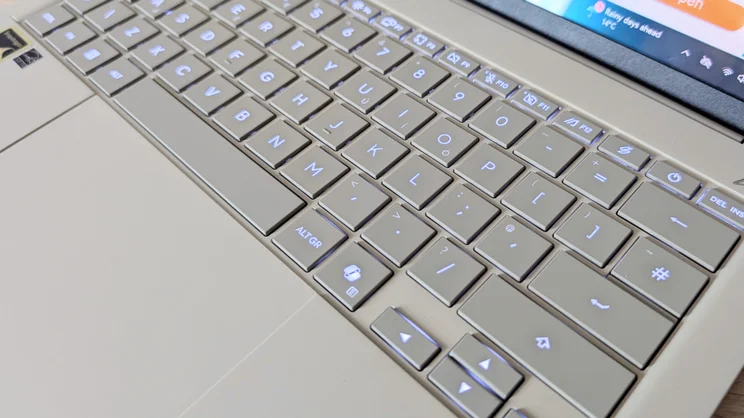
The A14’s keycaps are pleasant to the touch, and their action is crisp, the 1.3mm of travel finishing with a precise but well-cushioned end-stop. The white-on-beige graphics are easy to read with or without the three-position white backlight turned on.
The keyboard deck is more solid than you’ll find on some other slim and compact laptops, which is impressive given the weight, with even hard presses on the central keys only causing a small amount of movement in the keyboard base.
My only gripe with the layout is with the arrow keys, all of which are half-height as they are on the MacBook Air.
At 127 x 80mm, the glass touchpad is on the larger side for a 14-inch laptop. The mechanical click-action that works across the lower 80 per cent of the pad is well-calibrated and quiet. You can use it in a library without fear of disapproving looks from other patrons.
As with the A16, the touchpad supports what Asus calls Smart Gestures, which means you can swipe along the edges of the pad to adjust the volume, display brightness, and control video playback.
The A14’s 1080p camera does a generally good job. Video looks sharp and colourful even in less-than-ideal lighting conditions, and there is support for Windows Hello facial security along with the usual raft of Windows Studio Effects image enhancements.
Display and audio quality
The display is another direct carryover from the 2025 model, which is a bit of a disappointment given that it’s only a 1,920 x 1,200 panel with a 60Hz refresh rate. For context, Apple sells the Neo with a 2,408 x 1,506 display for £900 less.
To be fair, on a 14in screen, the difference between Full HD (162PPI) and 2.5K (216PPI) resolution is tough to detect even if you have your nose pressed right up against the screen. The drop in pixel density from the MacBook Air 13.6’s 224ppi to the Zenbook’s 162ppi sounds more calamitous than it looks.
Peak brightness is good. The A14’s display reached 388cd/m2 in SDR mode, and jumped to 614cd/m2 in HDR mode. But colour reproduction is even better, with the laptop capable of reproducing 117.3% of the DCI-P3 gamut. And the display is colour-accurate, too, generating DeltaE variances of 0.82 versus the DCI-P3 profile and 0.88 against sRGB. The closer this measurement gets to zero, the better, so these numbers are excellent.
The only issue here is that the screen has a high-gloss finish, which is great for video playback, but pretty reflective, which can be an issue if you’re using your laptop outdoors on a sunny day.
And as for audio quality, that has been improved no end. The new Dolby Atmos-credited drivers inside the new machine are now louder – using a pink noise source and measuring from 1m away, I measured them at 75.8dBA – more tuneful and more bass-rich than before, with a noticeably wider soundstage.
Performance
The 18-core Snapdragon X2 Elite X2E88-100 is a slightly detuned version of the X2 Elite Extreme X2E94-100 inside the Asus Zenbook A16. The principal differences are a slightly lower multi-core maximum frequency, slightly lower GPU clock and lower memory bandwidth. NPU performance stays the same with 80 TOPS available to run those pesky AI tasks that seem increasingly difficult to avoid.
That doesn’t have an alarming impact on performance, however. In our 4K multimedia benchmark, the Zenbook A14 scored 322 points, just 53 short of the A16’s 375 and roughly equivalent to the M5 MacBook Air’s 325. For a 14in compact, the new A14 has some serious poke to it.
In pure CPU performance, the new A4 is much closer to the A16 than the old A14. In the Cinebench R24 rendering test, the 2025 A14 scored 704, the A16 scored 1,361, and the new A14 scored 1,139. The new A14 then leaves the original model coughing in its dust.
Graphics performance isn’t too far shy of the Zenbook A16, either. In the Cyberpunk 2077 benchmark run at Full HD, High detail and with ray tracing disabled, the A14 returned an average of 24fps to the A16’s 30fps. If you turn on XeSS upscaling and frame generation, you can bump that up to 39fps.
I also tried playing Black Myth: Wukong on the A14 and was pleasantly surprised when it ticked over at 25fps with all performance boosters on and at Medium detail levels. I’d not describe it as entirely fluid, but it was certainly playable, which is remarkable for a compact laptop without a discrete GPU.
To give you an idea of how the graphics performance has improved between the original A14 and the new model, we need only glance at the Geekbench 6 OpenCL scores: it scored 40,351, an impressive fourfold more than the 9,610 its predecessor returned.
Moreover, under heavy stress, the new A14 demonstrated no thermal issues, running both the CPU and GPU at 100% utilisation for prolonged periods. The middle of the underside vent did get a little warm, hitting 50℃ after prolonged stress testing, but that’s nothing too out of the ordinary. Even when running full chat, fan noise can only be described as subdued.
The 1TB Micron SSD proved to be pretty nippy, too, recording sequential read and write speeds of 5,484MB/sec and 2,965MB/sec, respectively.
| Sequential read speed (MB/sec) | Sequential write speed (MB/sec) |
|
|---|---|---|
| Asus Zenbook A14 (2026) (Qualcomm Snapdragon X2 Elite X2E-881-00) | 5484 | 2965 |
| Asus Zenbook A14 (Qualcomm Snapdragon X X1-26-100) | 4498 | 2214 |
| Apple MacBook Air (M5, 2026) | 6160 | 6375 |
| Microsoft Surface Laptop 13in (Qualcomm Snapdragon X Plus X1-42-100) | 2513 | 1884 |
| Acer Swift Edge 14 AI (Intel Core Ultra 7 258V) | 3836 | 2687 |
| Apple MacBook Neo (Apple A18 Pro) | 1592 | 1495 |
Battery life
However, battery life is the Zenbook A14’s real trump card: the new machine lasted a phenomenal 29hrs 32mins in our video rundown test, making it the longest-running laptop we’ve ever tested, and by no small margin.
The new Zenbook A14 outlasted its predecessor by over nine hours and can run for twice as long as the similarly powerful M5 MacBook Air on a full charge. Granted, the MacBook has a smaller battery, at 53.8Wh vs the A14’s 70Wh, but this is still a noteworthy accomplishment.
Asus Zenbook A14 review: Verdict
When we reviewed the first Snapdragon A14 back in February 2025, it cost £1,099. The new model is £500 more, and for the extra you get more power, much longer battery life, improved wireless communications and better speakers. But you don’t get a sharper screen or touch compatibility, both improvements that, I think, the increase in price demands.
I’m not for a moment arguing that the new A14 isn’t the state of the compact laptop art. It is. Everything about it is excellent or borderline, and it’s certainly a five-star product. It’s just that I’m not wholly convinced that the improvements quite match the price jump.


