To help us provide you with free impartial advice, we may earn a commission if you buy through links on our site. Learn more


The Motorola Signature 27 indicates a brand new day for Moto. Over the past decade, mid-range ambition has driven Motorola, but the launch of the original Motorola Signature earlier in 2026 saw it set its eyes on a new flagship tier of smartphones.
While the first Signature to launch wasn’t a huge step away from existing Edge devices, the Signature 27, first announced in September, definitely is. Following that original tease, Motorola gave me some hands-on time with its new flagship in Tromso, Norway.
There’s a lot to talk about but what strikes me above everything else is just how much of a departure this is from what we’ve seen from Motorola over the last decade.
Motorola Signature 27: Specifications
- 6.78in, 2772 x 1272, 120Hz Tandem AMOLED display
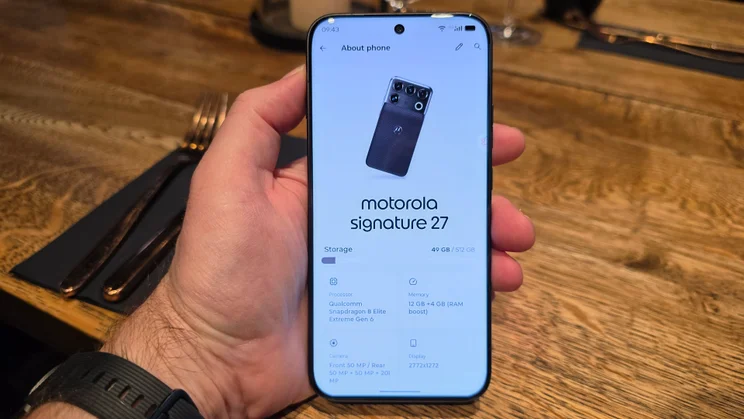
- Octa-core 5GHz Snapdragon 8 Elite Extreme Gen 6
- 12GB or 16GB of RAM
- 256GB or 512GB of storage
- 7,000mAh battery
- 90W wired charging; 50W wireless charging
- Cameras: 50MP (f/1.6), 200MP (f/2.6) 3x telephoto, 50MP (f/2.0) ultrawide, 50MP (f/1.9) selfie
- Dimensions: 77.04 x 7.99 x 162.01mm
- Weight: 227g
- IP69 dust and water resistance
- UK Price: £1,299
- UK release date: 16 November 2026
A whole new premium design
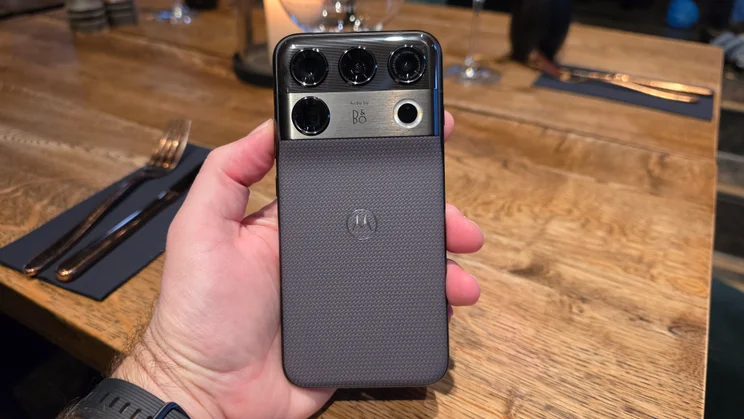
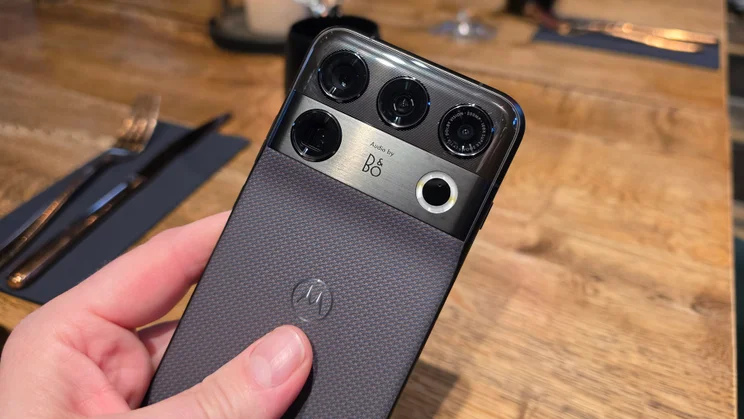
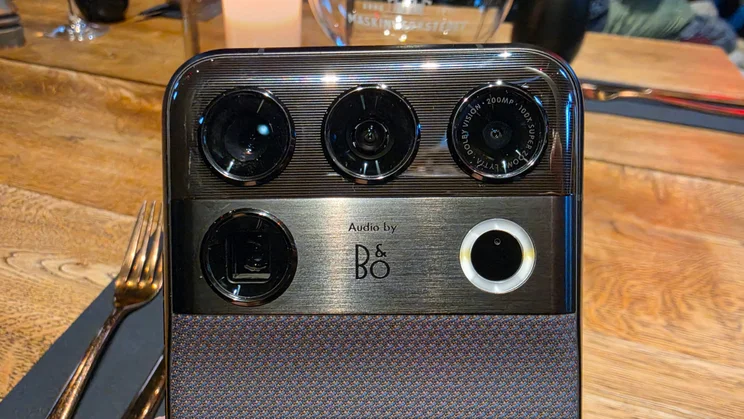
Many of Motorola’s phones have a similar look. From Edge to Razr Fold, the cluster of cameras in the top left corner has become something of a signature design from Motorola (pardon the pun). The Signature 27 sets off in a different direction, ranging the cameras across the top of the phone’s rear.
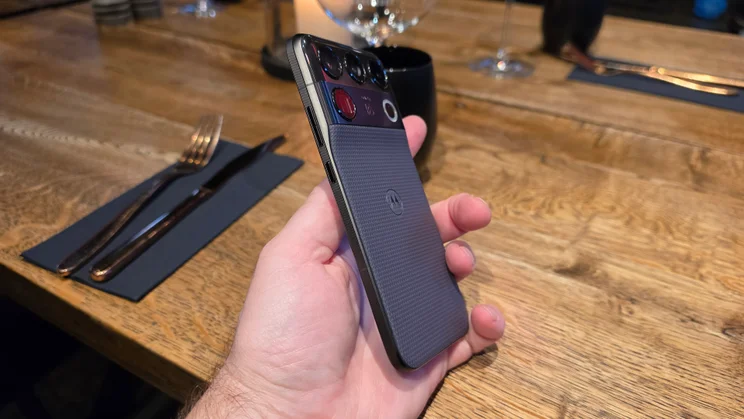
That sees the whole section raised, sporting two textured segments and adding interest to the top of the phone. While the design is verging on tropophobic, it’s certainly unique, and it’s refreshing to see Motorola not simply copying the iPhone’s style beat-for-beat, as so many other brands do.
This raised camera platform does make the top of the phone a little thicker, and it’s noticeably weightier, too. The Signature 27 isn’t a heavy phone for its size at 227g (the iPhone 18 Pro Max is 249g) and thankfully the rest of the body of the phone is slimmer at 7.99mm, so it’s easy enough to grip.
That brings me to the finishes that Motorola offers, one area where it does stick its prior design trends. The phone is available in Pantone Coal Smoke (black) and Pantone Capulet Olive (green). But these aren’t just flat glass finishes – it’s a textured finish, with the Coal Smoke pictured here feeling like a woven fabric. There’s depth to it, with flecks of orange that aren’t immediately obvious, and it’s much more tactile than a glass device.
The Capulet Olive is on trend with its green hue, and there’s no escaping the premium feel and the originality of this phone. It even bucks the trend of most other phones by having curves front and back to blend into the aluminium frame. There’s an unconventionality to the Signature 27, but the uniqueness speaks volumes to Moto’s ambitions – and I can’t knock that.
It also carries an IP68/IP69 dust and water resistance rating, which seems to be par for the flagship course these days.
The first Motorola phone with proper flagship specs
With Qualcomm’s new Snapdragon 8 Elite Gen 6 hardware announced in September, there’s a race on to be the first to get a device powered by it to market. We’ve seen Xiaomi’s offering (which isn’t available in the UK yet), and the OnePlus 16 also has it – though that isn’t coming to the UK at all.
The Motorola Signature 27 has the top version of Qualcomm’s latest chip, the Snapdragon 8 Elite Extreme Gen 6. Motorola tells me there’s a 40% larger vapour chamber to keep it cool, although in the time I spent testing the phone I didn’t get to put it under any sort of pressure. That will come in future testing, but from what I’ve seen so far, it seems fast and smooth.
This puts Motorola into the flagship phone race, squaring up against the likes of Samsung’s forthcoming Galaxy S27 Ultra – although Motorola is far ahead of Samsung’s launch schedule, which could be an important factor in its success.
That flagship power is backed by a 7,000mAh battery, with 90W wired charging. This is an area where Motorola has been delivering recently, with long battery life and fast charging, and it looks like the Signature 27 could well continue that streak. There’s 50W wired charging, too, but no magnets unless you use one of Motorola’s official cases.
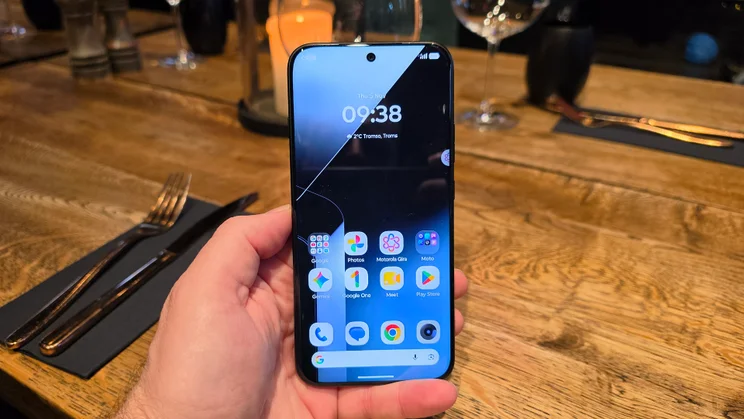
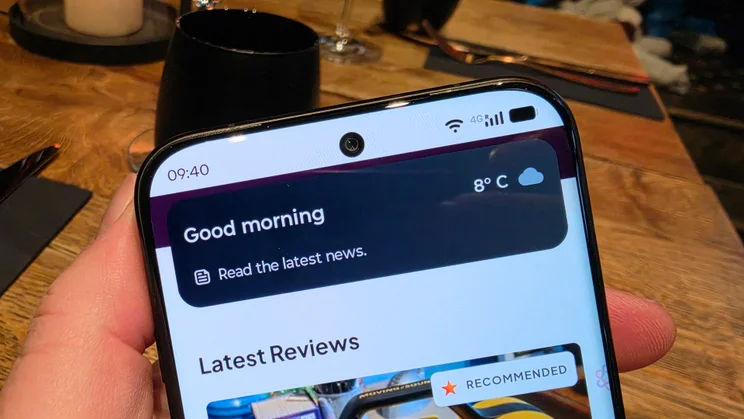
Perhaps the most exciting part for me, however, is the display. The Motorola Signature 27 is one of the first phones to have a tandem OLED screen. It’s not a new tech, it’s been in tablets like the iPad Pro and Huawei MatePad Pro, it powers the PROLED XDR display in the new OLED MacBook and it’s been used on flagship TVs.
Tandem OLED is all about brightness, with Motorola claiming that this is the brightest display on any smartphone, with a frankly ridiculous peak of 12,000 nits. To be clear, you’ll only see that kind of dazzling brightness on very particular areas of the screen during HDR video playback. I didn’t witness anything like that sort of brightness while testing the phone.
What I can say is that it should make the phone great in direct sunlight (Motorola doesn’t declare what the normal high brightness mode reaches), but as I was testing the phone above the Arctic Circle in Norway… in November, I didn’t have much sunshine to work with. I did see some luscious HDR effects from recorded Dolby Vision video, however.
My first impressions are of a display that’s very capable: the brightness, especially when using the camera, brings a richness to shooting that not all phones offer.
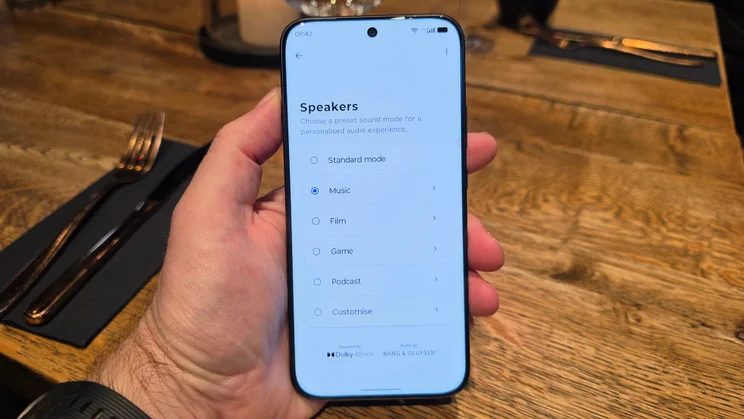
Finally, the speakers are tuned by Bang & Olufsen. I haven’t tested them to a great extent yet, but watching Netflix, I found appreciable volume and obvious spatial immersion.
Motorola’s camera shoots for the stars
That brings me neatly to the camera. It’s a triple lens set-up, comprising a 50-megapixel Sony Lytia L910 main camera with an f/1.6 aperture, a 200-megapixel 3x telephoto offering up to 100x digital zoom and a 50-megapixel ultrawide. There’s a 50-megapixel front-facing camera completing the set.
There’s a time-of-flight sensor to help focusing, which sits ringed by the LED flash on the back. One criticism related to the camera design: there are raised rings around all the cameras, but for some reason, Motorola didn’t put one around the flash. This means it looks slightly different – and when you put the phone down on its back, it wobbles a little bit. If that ring was there, it would not only bring an aesthetic symmetry, but it would be more stable when you put it down, too.
This is a phone that’s packed with features, leveraging the Snapdragon hardware’s imaging capabilities, as well as getting calibration input from DXOmark. It’s clear that Motorola wants the camera to be taken seriously.
I spent some time testing the camera, but the range of environments available before sitting down to write up my experiences were limited. I’ve already said that the display makes for a great camera experience and the star here is the main camera, which seems to put out great quality images, packed with detail and colour in daylight conditions.
At first glance, the ultrawide looks a little warmer than the main camera – something to be further investigated in a full review. The 3x optical telephoto is useful, with noticeable stabilisation at longer focal lengths.
The telephoto will use AI to enhance images (called Super Zoom Pro) over 20x zoom and at the far end it’s a little too much, basically giving you an AI image, so best avoided. But in the middle ranges it seems to take great photos.
While my video testing hasn’t been extensive, I’m already impressed with the results from the Dolby Vision capture, as well as the stabilisation. Capture is offered at up to 8k 30fps.
Soft-launching the software
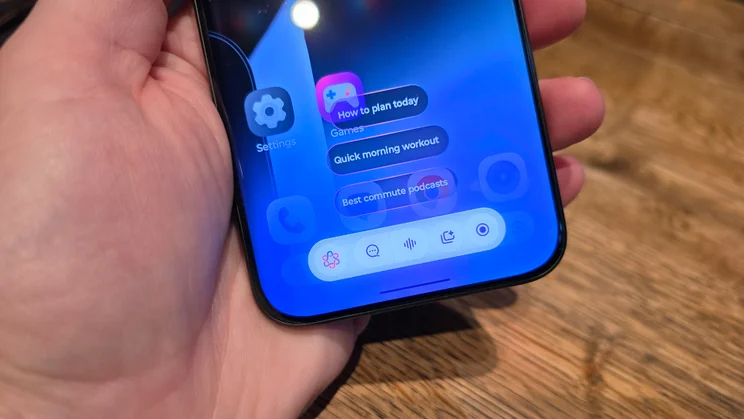
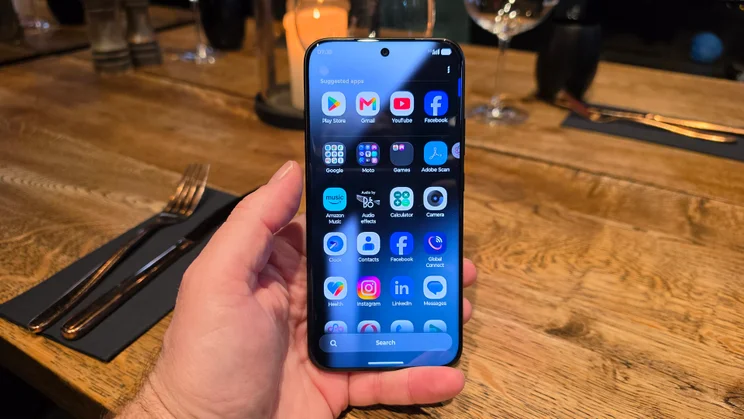
I haven’t had time to explore the software to a great degree, but the Signature 27 already seems cleaner than recent devices that have thrown out Moto AI elements all over the place. The insertion of news into the apps tray doesn’t appear to be here and there were only a couple of pre-installed apps – Adobe Scan, Opera and a few others.
Motorola’s new AI assistant Qira is also supported here – though I haven’t had a chance to test its capabilities just yet. What I do know is that Motorola is pledging seven years of software updates for the Signature 27, matching the flagship roadmaps of Google, Samsung and Honor. Moto has previously been stingy in this regard, even with its most expensive phones, so this is great to see.
The Motorola Signature 27 launches at £1,299 in the UK from 16 November. That’s cheaper than the Samsung Galaxy S26 Ultra, but it’s not the affordable alternative that some might have expected.
The price for the hardware isn’t a surprise, but it puts Motorola into competition with the best that Android has to offer. It’s definitely a bold move for Moto. We’ll see if it pays off when it comes time for our full review. Stay tuned.