
To help us provide you with free impartial advice, we may earn a commission if you buy through links on our site. Learn more

Until recently, smart glasses, specifically those with cameras, were riding the crest of a wave. They were gradually establishing a firm niche as the fashion accessory for tech nerds and content creators producing point of view videos. Over the past couple of months, however, that wave has turned aggressively against them, and a significant segment of people on social media have been calling for them to be banned.
Among reports that the glasses have widely been used to harass women, filming them without their consent and posting that content online, they’ve been dubbed, among other unfavourable terms, “pervert” glasses.
It’s enough to put you off wearing a pair in public, even if your intentions are purely honourable. That’s a tough environment in which to launch a new product, and it’s exactly where HTC finds itself with its new Vive Eagle.

What do you get for the money?
Assuming you’re happy with some people assuming you’re using your smart glasses to film people surreptitiously, and you’re happy enough to wear them out and about, then the HTC Vive Eagle are certainly an interesting alternative to the now-ubiquitous Meta Ray Ban glasses that established the sector.
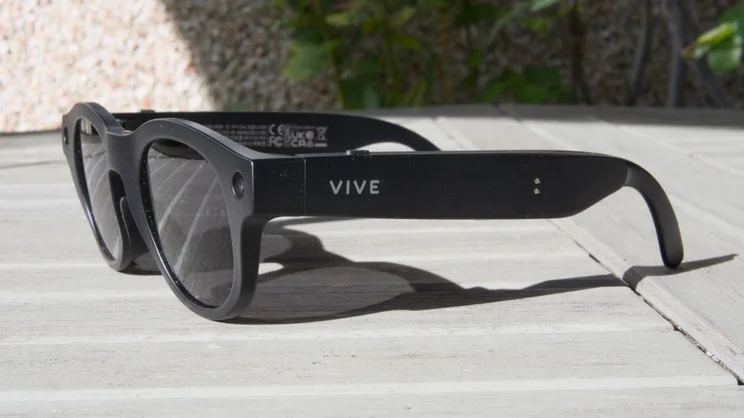
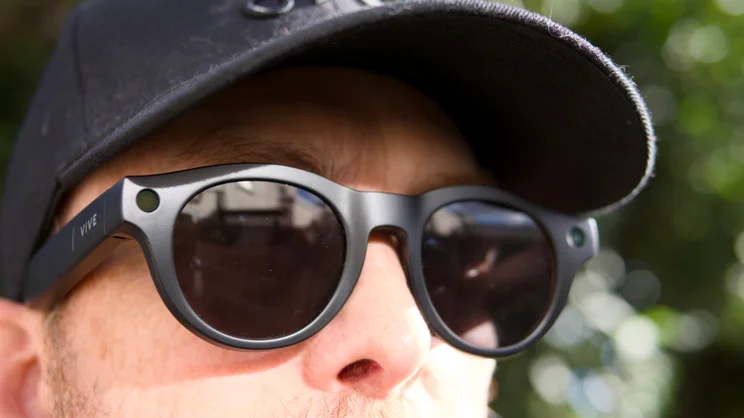
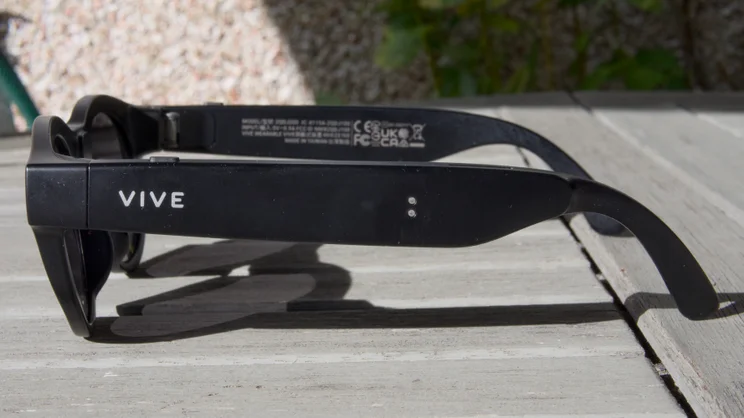
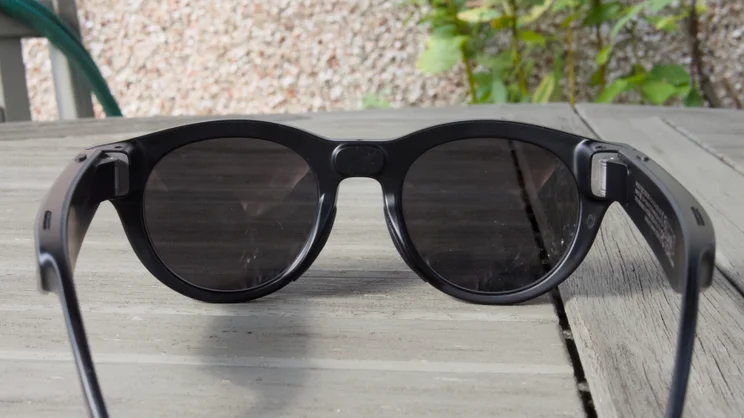
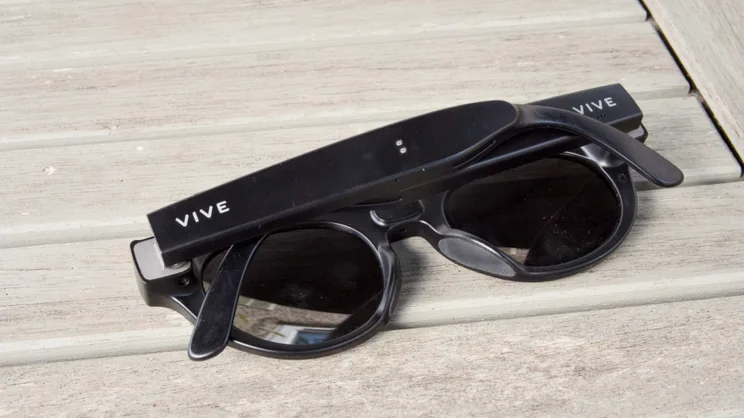
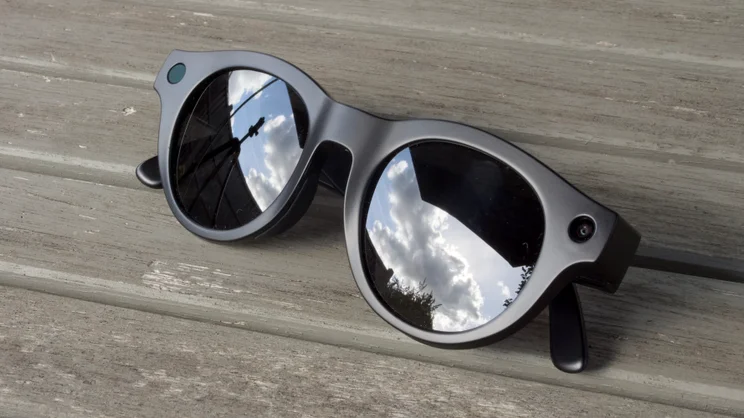
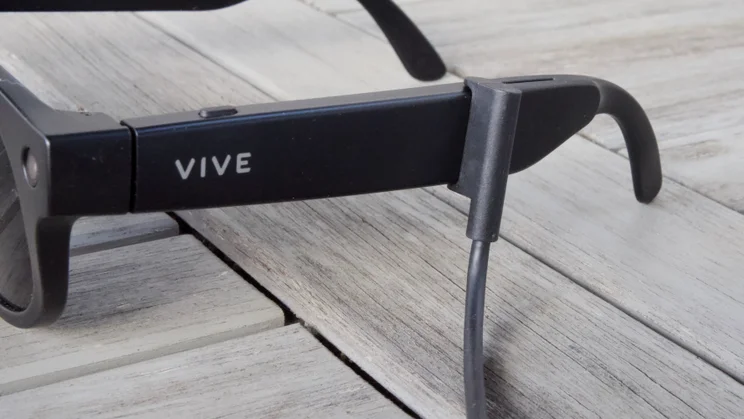
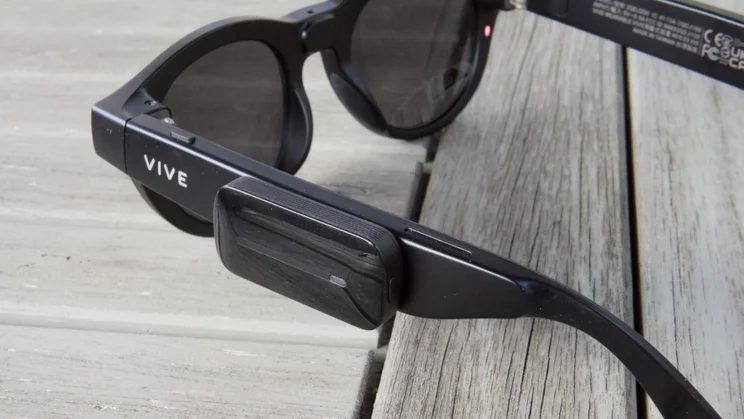
They’re no cheaper, at £429 versus £409 for the latest Gen 3 Wayfarers, but in my view they look just as chic. The pair you see pictured here is the “Pantos” style in charcoal black, but you also get them with a squarer lens and in a variety of moody colours, ranging from black, through brown and red to navy blue. Whichever style you go for, though, the HTC with their chunky arms and more obvious cameras, are more overtly techy than the Ray Bans, which is a good thing when smartglasses wearers are being accused of covert recording.
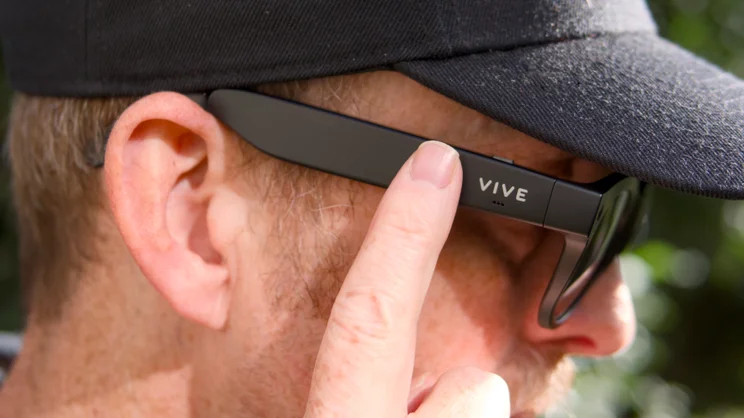
As far as physical controls go, there’s nothing unusual here. On the left arm is a single button that engages Vive AI. On the right is another button used for capturing photos and videos. The right arm’s outer surface also doubles as a touch pad, which is used to control audio. Tap this once to play or pause, swipe forwards and back to adjust the volume up and down, while double and triple taps skip forwards and backwards.
All the usual core features are present and correct, too. Hands-free photography and video? Check. Just say “Hey Vive, take a photo/video”. Speakers built into the arms, so you can listen to your music and podcasts without headphones? Check. AI scene interpretation, live translation, voice recording and transcription? Again, check.
And the technical specifications all seem to be up to scratch, too. The resolution of the camera is 12MP for still images and 3K for videos at 30fps, just like the latest Meta glasses. Internally, the glasses are powered by the Qualcomm Snapdragon AR1 Gen 1 chip, backed by 4GB of RAM and 32GB of storage, which acts as a temporary storage for photos, videos and audio before they’re downloaded to your phone. The glasses are also IP54 protected against dust and water ingress, and battery life is quoted at four and a half hours of heavy use.
It’s a fairly established playbook by this point, but the HTC have certain features that do set them apart. First up, you’re not just restricted to one LLM for the AI-driven features. You can choose between two: Google Gemini or ChatGPT. Second, the Vive Eagle, go further than Meta glasses on the privacy front.
Not only do the glasses stop recording if they sense the recording LED is obscured and they’re not being worn, they will also stop recording if someone walks up to you and says “stop recording”. HTC also says that your data is never used to train any AI model, while all requests are de-identified. And, for what it’s worth, not having anything whatsoever to do with Meta is also something that counts in their favour.
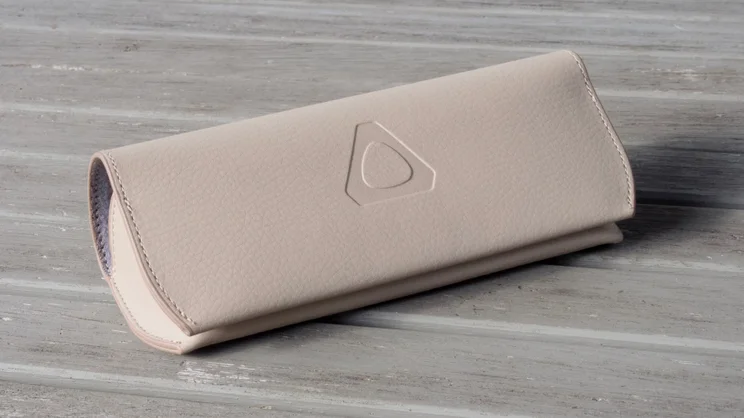
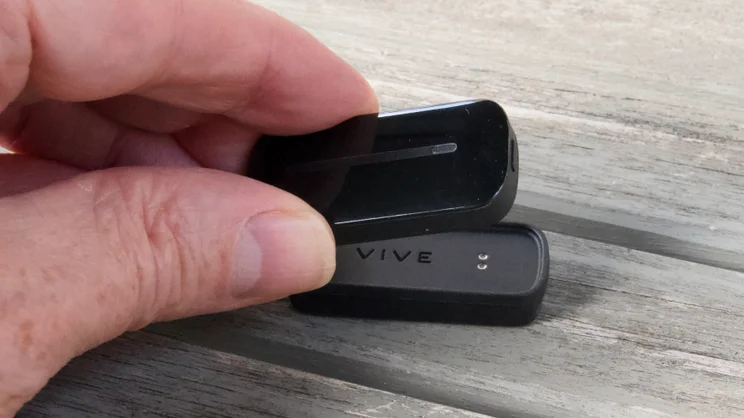
On the video front, you get automatic horizon levelling, which stops your shots looking too tilted and, if the battery life isn’t long enough for your purposes, HTC sells a magnetic puck (called the PowerBoost, £45) that snaps onto the charging points on the left arm to boost stamina. There’s no charging case, however. With the battery instead filled via a proprietary magnetic USB cable that snaps onto a pair of pins on the left arm.
How did I test the HTC Vive Eagle?
I used the Vive Eagle as my main sunglasses for around three weeks during my commute, while driving and just soaking up the sun during an unusually sunny September in London. My main focus here was capturing a range of still and moving image content, as that’s the main use case for smart glasses: to provide you with a means of quickly and easily capturing the moment, hands-free and without having to fish out your smartphone.
I also tested the audio extensively, listening to all my usual podcasts and music, and tried out the glasses’ various AI features, from live translation to voice recording and transcription, paying special attention to how loud I had to speak for the wake phrase “Hey Vive” to be recognised and how useful the glasses responses were.
How good is image and video quality?
As with most smart glasses, the camera is embedded into the frames in the upper left temple of the glasses with a bright white LED in the right temple indicating when you’re recording photos and video. This captures 12MP photographs and either 2K or 3K vertical video at 30fps.
When I tested the Oakley Meta Vanguard earlier this year, I was impressed at just how good the image quality was. With the Eagle, when I reviewed the results in the app, I found that video, quality lagged behind on detail and looked hideously oversaturated. In comparison, the Vanguard’s footage was sharper, and more naturally rendered. Image stabilisation wasn’t bad, but again the Meta produced smoother footage during my fairly undemanding walking tests.

The automatic horizon correction, as it turns out, is only applied to photos (after you’ve taken them, in the app), but it’s a nice feature, especially as photographic quality is much better than video quality. Results here are pretty close to the Oakley.

The same goes for the audio quality. It’s absolutely fine on the HTC and, importantly, it goes loud enough so you can hear it in most noisy environments. For listening to podcasts, phone calls and video calls, they’re great. But listening to music is an unsatisfying experience.
The Vanguards are much better here, producing a warmer, richer soundscape with more depth. The, HTC on the other hand, sound thin and insubstantial, and when you turn up the volume they really struggle, with complex, bassy music sounding harsh and strained.
Finally, with four microphones listening to your voice instead of six, the HTC do occasionally struggle to hear what you are saying. I found I had to speak louder and more clearly for it to pick up the wake words than on the Oakley Meta.
What about battery life?
If you’re familiar with the specs (pun intended) of the Ray Ban Meta Gen 3, you’ll know that battery life is much improved in the latest model, stretching to a stated (and impressive) nine hours. That’s an important stat for smart glasses, as you don’t really want to be topping them up at multiple points during the day.
It’s double what the HTC Vive Eagle can manage and I found that I had to be quite careful with them to keep them going throughout the day, rationing the number of video clips I was shooting. I did like that the glasses tell you how much battery life remains whenever you put them on. That makes it easy to keep track of when you need to charge, but my overall impression is that the battery life could be better.
Are the AI features useful?
I’ve got to put my cards on the table here: in my opinion, AI still isn’t ready for smart glasses, and certainly not for the HTC Vive Eagle. I tried all manner of things using ChatGPT and Gemini-powered AI features and after most requests I came away underwhelmed.
The Live translation tool is only really going to be useful for fairly basic spoken language. If someone is talking in advanced, or fragmented sentences, it quickly gets confused and the results are pretty much gobbledygook.
I tried to get it to translate a German language interview with Jurgen Klopp and, while I liked its confident delivery, it just wasn’t able to get across the overall gist effectively enough for me to understand what the erstwhile Liverpool FC manager was saying.
For printed translations it works better, but the text has to be large enough for the camera to read, and you have to be really specific about what you want it to translate. I presented it with a French translation of Attack on Titan and it had no issue with it, translating the basic speech-bubble text with only a little delay. However, for denser passage of text, I found I had to hold the page quite close to my face before it could read what was there.
Otherwise, I would say it’s fairly limited in what it can do. It can answer generic questions and look stuff up on the internet. It can also answer questions about what you’re looking at and furnish you with information about that. But it can’t do practical stuff like place phone calls, for instance; you have to hand off to your voice assistant for that, which is clunky. It won’t read out your messages, either, or natively control your audio apps, both features that Meta glasses can do.
Should you buy the HTC Vive Eagle?
The HTC Vive Eagle are a solid first step into the world of smartglasses for the company. Offering users the ability to choose between two LLMs and focussing on privacy are both obvious positives, especially given the current climate surrounding smartglasses.
Overall, however, the Vive Eagle simply can’t match what Meta is producing right now. The battery life isn’t as good, and neither is the photo and video quality. The Eagle can’t interact with your phone as comprehensively as the Ray-Bans can, and there aren’t nearly as many choices of style, either, although I do like the way they look.
I suppose the one big tick in favour of the HTC Vive Eagle is that they are not produced by Meta, and that for many will be enough. For everyone else who hasn’t yet been put off looking for a pair of smart glasses, they’re not quite good enough.


