
To help us provide you with free impartial advice, we may earn a commission if you buy through links on our site. Learn more
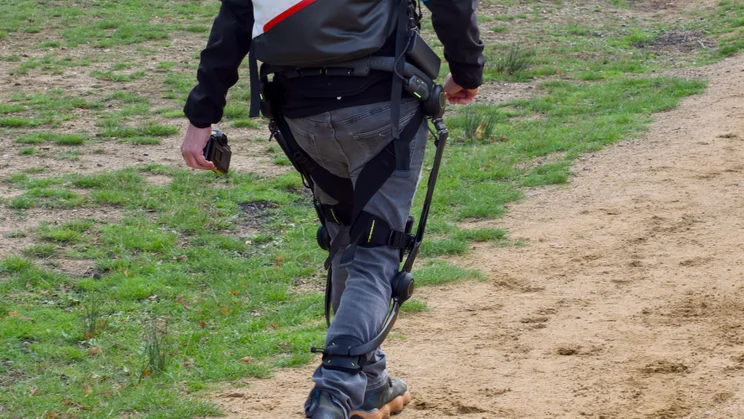

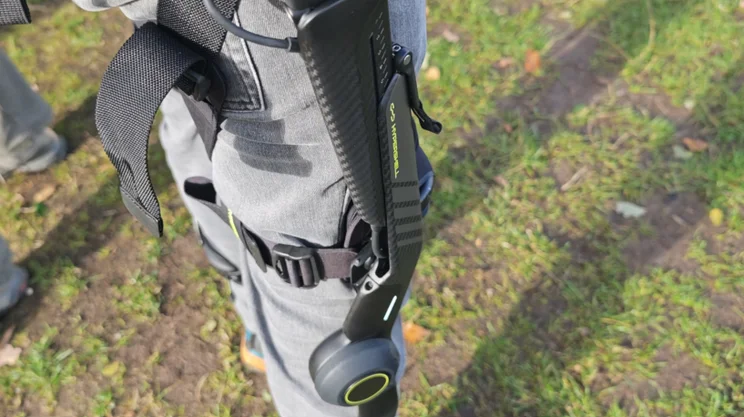
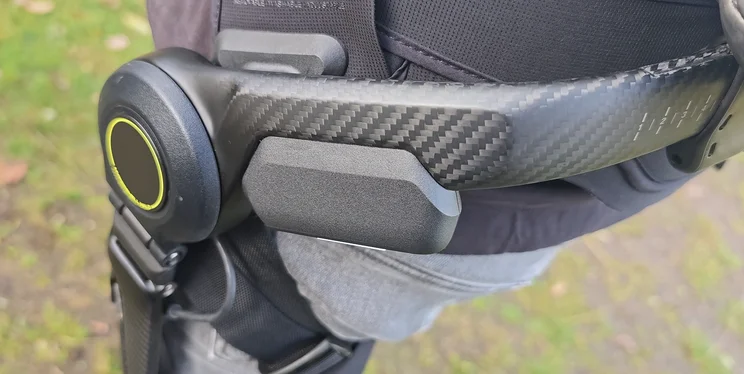




I first heard about HyperShell when it offered my the opportunity to test out the HyperShell X Ultra S, an exoskeleton designed to help you walk and run further and faster. I must confess I was impressed with it, but the company has now stepped up its exoskeleton game with the HyperShell Halo, which I had the opportunity to get “legs on” with during a demo event in London’s Richmond Park a few weeks ago.
The essential premise of the Halo is the same as the company’s previous products except that instead of just having two motors at the hip, which lift and push your upper legs, the Halo has four, with an extra pair at the knee assisting lower leg motion.
The Halo puts out more power than the X Ultra S, as a result – up to 1,490W at peak – but the extra motors do mean it’s more expensive than the previous model, with prices starting at £2,199.
However, HyperShell says it has got the weight of the knee modules down to an impressively low 170g each, and the weight of the whole contraption is a measly 2.6kg, only a few grams heavier than its two-motor predecessor.
HyperShell Halo: First impressions
One of the things I liked about the design of HyperShell’s upper-leg exoskeleton was its simplicity. You could strap that thing on and get it fully secure in a matter of seconds, once you’d got everything adjusted. With the HyperShell Halo, that process is a bit more involved.
Before you can even think of strapping it around your waist and legs, you have to ease yourself into a shoulder harness. You then attach the waist band, adjust the upper leg cuffs and tighten those before finally cinching the lower leg cuff into place. With that all done, there’s also a pair of support straps that run down the back of your hamstrings to secure.
So, set up is a bit more fiddly, that much is clear from my initial experience with the Halo. But once everything is adjusted and set up, I imagine you’d get quite proficient at doing it and you wouldn’t need to make any more adjustments other than the odd bit of tightening here and there.
The other thing that was obvious, once I was fully trussed up, is that the HyperShell Halo exerts a lot more control over your leg movements than the previous product.
As I strode out along the paths of Richmond Park, attempting not to scare the deer with my scarecrow movements, the Halo felt immediately more powerful. I tried “Hyper” mode for a few metres, but found myself almost fighting the assistance it was so strong, so I dropped the power to Eco and halfway up the assistance scale – that’s the setting HyperShell recommends for general use.
Even then, the Halo felt like it was providing considerably more help in striding along than the half-leg exoskeleton I’d tested out previously.
One of the things I was keen to test out, however, as well as walking, was how much assistance the legs provided in getting in and out of a squat. This is one of the things HyperShell claims the Halo assists with, saying it delivers a “40% reduction in knee muscle fatigue” as you lower yourself into and lift yourself out of a squat.
I can’t say I noticed a huge boost here – I still found it a struggle going down on one knee and lifting myself up again (this might have been more a result of my heavy leg workout two days previous) – but the proof of this particular claim will be how much it helps you repeat that action, and how tired you feel at the end of a day doing this repeatedly.
In terms of assistance during walking, meanwhile, HyperShell says the Halo delivers 24% energy savings and a reduction in your heart rate of 20%.
As for comfort level, the Halo seems pretty easy to get used to. The extra harness and lower leg cuffs means it feels less comfortable than the X Ultra S, but it didn’t seem to restrict my movements in any way, and I liked the fact that the new battery is now attached to your hip instead of the rear of the waist harness.
This makes it much less of a faff to swap out in the event it runs out mid-hike or run, and means wearing a rucksack is more comfortable. The batteries do deliver less range than X Ultra S: up to 20km per charge, where the X Ultra S can deliver up to 30km, but it easily coped with my quick hour-long test stroll with plenty left to spare afterwards.
HyperShell Halo hands on: Early verdict
As ever, it’s impossible to deliver any kind of full verdict without longer term testing, but after my brief demo walk with the HyperShell Halo, I must admit I was impressed.
It delivers much stronger assistance than the X Ultra S at not too much of a weight penalty, and barely restricts your movement. The only caveat is the higher price and the increase in set-up complexity. I look forward to giving it a bit more of a workout once I get my legs into a pair for a longer test in the very near future.


