
To help us provide you with free impartial advice, we may earn a commission if you buy through links on our site. Learn more
- Impressive all-round picture quality
- Great gaming specs
- Decent brightness
- No BBC iPlayer (yet)
- Viewing angle limitations
- Quite reflection-prone
The battle rages on at the premium end of the TV market, with brands including Samsung, LG, Sony, Hisense and TCL pushing new panel technologies designed to deliver brighter, more colourful experiences than ever.
Those technologies come at a price, however, and most people I speak to wouldn’t dream of spending the kind of money range-topping QD-OLED, SQD Mini LED and RGB Mini LED TVs cost. In fact, a significant proportion of my friends and colleagues have told me that £1,000 is their hard upper limit when shopping for a television.
So, although luxury flagships such as the Samsung S99H and TCL X11L deserve plenty of admiration, it’s lower-mid-range models such as the Samsung QN80H that sit in the sweet spot of performance and affordability for most shoppers. I’ve spent the past month using the Samsung QN80H as my primary television to assess how well this Mini LED TV with full-array local dimming hits that spot.
Samsung QN80H review: Key specifications
| Screen sizes available | 50in (QE50QN80HAUXXU), 55in (QE55QN80HAUXXU), 65in (QE65QN80HAUXXU), 75in (QE75QN80HAUXXU), 85in (QE85QN80HAUXXU) and 100in (QE65QN80HAUXXU) |
| Panel type | Mini LED |
| Resolution | 4K/UHD (3,840 x 2,160) |
| Refresh rates | Up to 144Hz VRR, 240Hz (via DLG) |
| HDR formats | HLG, HDR10, HDR10+ Advanced |
| Audio enhancement | 2.0-channel system (30W), Dolby Atmos, Object Tracking Sound Lite, Active Voice Amplifier, Adaptive Sound Pro |
| HDMI inputs | 4 x full-spec HDMI 2.1 (one with eARC) |
| Freeview Play compatibility | No |
| Tuners | Terrestrial, Digital, Satellite |
| Gaming features | ALLM, VRR, FreeSync Premium Pro, 4K/144Hz, Game Mode, Game Bar, HGiG |
| Wireless connectivity | Wi-Fi 6E, Bluetooth 5.3, Apple AirPlay 2 |
| Smart assistants | Bixby, Amazon Alexa |
| Smart platform | Tizen |
What you need to know
The flagship Samsung QN80H leads the brand’s Neo QLED lineup, which also includes the entry-level QN70H. The Neo QLED range sits below the Micro RGB options Samsung debuted earlier this year and the well-established S95, S90 and S85 OLED series.
Both the QN80H and QN70H use a Mini LED backlight with a quantum dot filter, but the model I’m reviewing here is powered by the more advanced NQ4 AI Gen2 Processor; the cheaper model makes do with a first-gen NQ4 AI chip. The QN80H also has a faster refresh rate (up to 144Hz versus 60Hz), and all four of its HDMI ports support 2.1 gaming features.
The TV relies on Samsung’s Tizen OS for its smarts, and supports the usual selection of HDR formats found on the Korean manufacturer’s TVs, which means there’s no love for Dolby Vision. You do get Dolby Atmos audio, though, along with the Lite version of Samsung’s Object Tracking Sound technology. Samsung also uses several AI technologies to enhance picture and sound quality. The Vision AI companion, HDR Auto Remastering, AI Sound Controller, and AI Auto Game mode are just some of the ways Samsung is harnessing the 20 neural networks in the NQ4 AI Gen2 chip.
Price and competition
The QN80H is available in six sizes: 50in, 55in (the model I tested), 65in, 75in, 85in and an enormous 100in. At the time of writing, the pricing for each is as follows:
- 50in: £749 at Amazon
- 55in: £899 at Amazon
- 65in: £1,199 at Amazon
- 75in: £1,799 at Amazon
- 85in: £2,299 at Amazon
- 100in: £3,999 at Amazon
These prices exceed those of the LG QNED85, which forms part of the brand’s 2026 “QNED evo AI” range. I’ve not tested it, but the 50in model costs £650, with the 55in, 65in, 75in and 86in models priced at £750, £1,000, £1,400 and £1,950, respectively.
There’s plenty of competition elsewhere, too. Sony’s Bravia 5, which was released last year, is a pricier alternative in 55in (£1,199) and 65in (£1,299), but the 85in model costs the same £2,299. The 75in screen size is currently on offer for just £1,499, which is a bit of a steal, while there’s also a 98in model costing £4,499.
Chinese brands Hisense and TCL also have Mini LED TVs within their 2026 ranks. The former’s closest comparable model in specifications is the Hisense U7S. It comes in the same six sizes, but the Samsung QN80H is cheaper across all but the 75in model: 50in (£899), 55in (£1,199), 65in (£1,499), 75in (£1,699), 85in (£2,299) and 100in (£4,299).
TCL’s given a couple of its mid-range Mini LED TVs the “Super Quantum Dot” treatment this year, yet they remain aggressively priced. The TCL C7L can be yours in 55in for £1,099; the 65in is £1,299, the 75in is £1,699, and the 85in and 98in are £2,299 and £3,299 apiece. If its SQD panel performs anywhere near as well as the TCL X11L’s, this is a fantastic option.
Design, connectivity and control
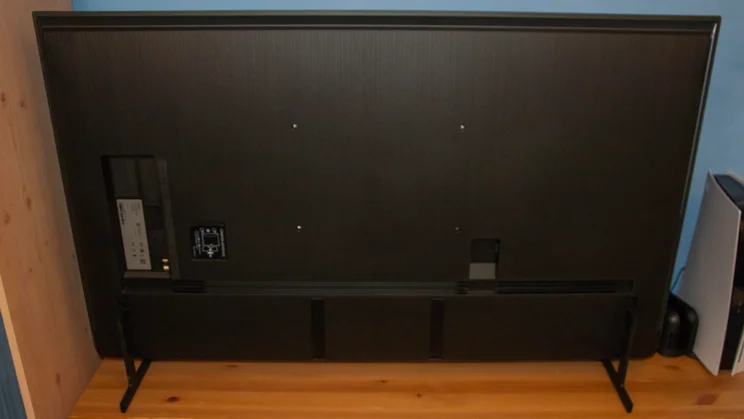
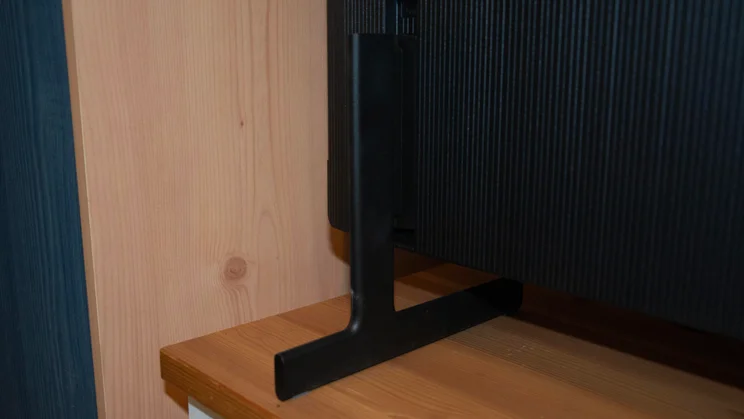
The QN80H isn’t Samsung’s most eye-catching television, but it’s relatively slender and has a flat rear. This, plus its reasonably lightweight housing, makes it a solid option for wall mounting.
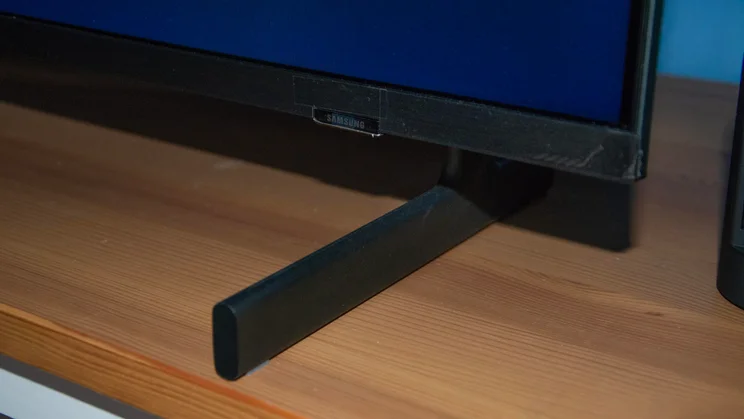
If you plan to position it on a stand, you’ve got options, which is always welcome. You can attach the blade feet centrally or at either end of the panel, and can also choose one of two heights. I went with the higher one to fit the QS90H soundbar, which I tested alongside the QN80H, underneath it.
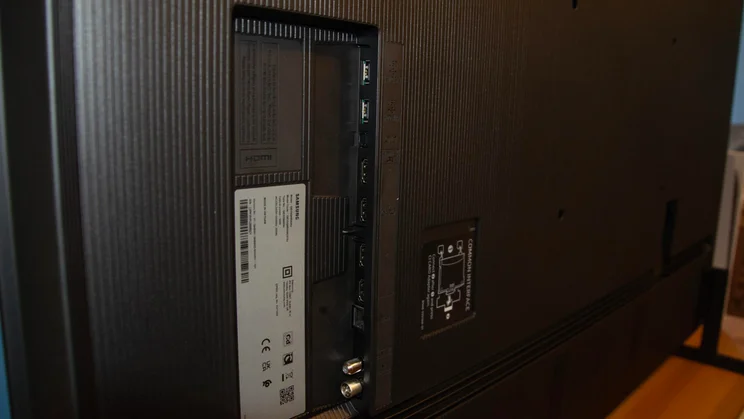
All the physical connections face to the right as you look at the screen and include four HDMI 2.1 ports (one eARC), all of which support 4K gaming at up to 144Hz. There are also two USB-A ports, an optical input, LAN port and aerial and antenna sockets. Additionally, you’ve got space for a Common Interface card; although in all my time testing TVs, I’ve never come across anyone who uses one. Wi-Fi 6 and Bluetooth 5.4 square away wireless connectivity, while the TV also supports Apple AirPlay 2 and Google Cast.
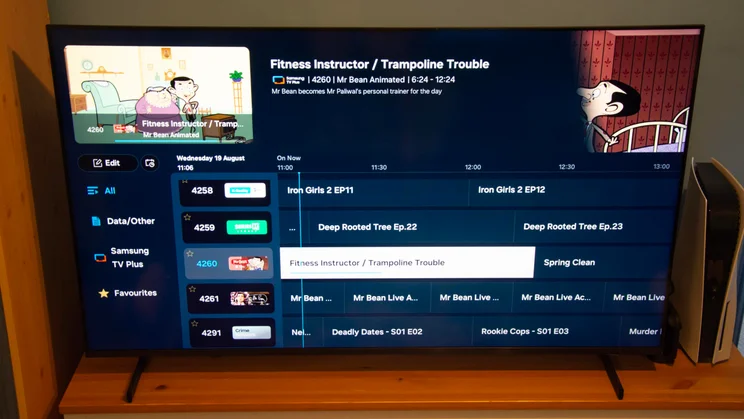
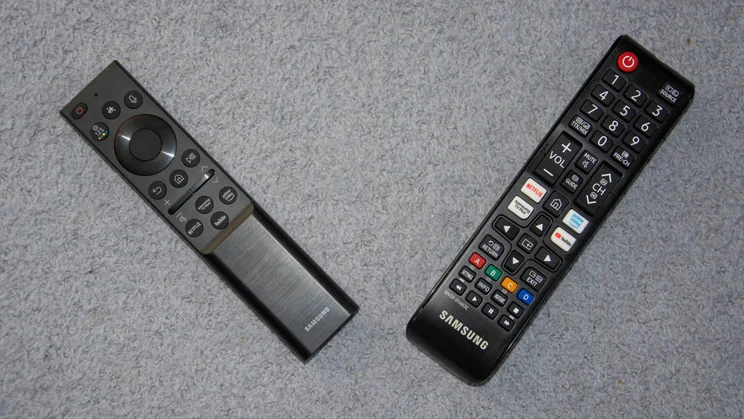
Samsung includes two remotes: the classic cluttered one with number keys, and another more pared-back affair, which I found more efficient to use. Samsung’s standard remote has been around for years now, and I still find the tiny “Settings” key infuriating. Both have shortcuts to Netflix, Prime Video, YouTube and Samsung TV Plus, but the stripped-back option made navigating the UI much simpler, with the only exception being quick access to the TV guide, which I didn’t use much anyway.
You can also use a digital remote in the Samsung SmartThings app on your phone, or Bixby and Amazon Alexa voice commands.
Smart TV platform
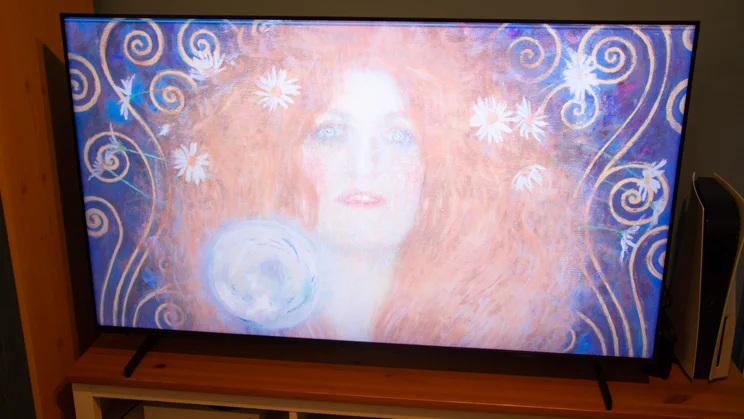
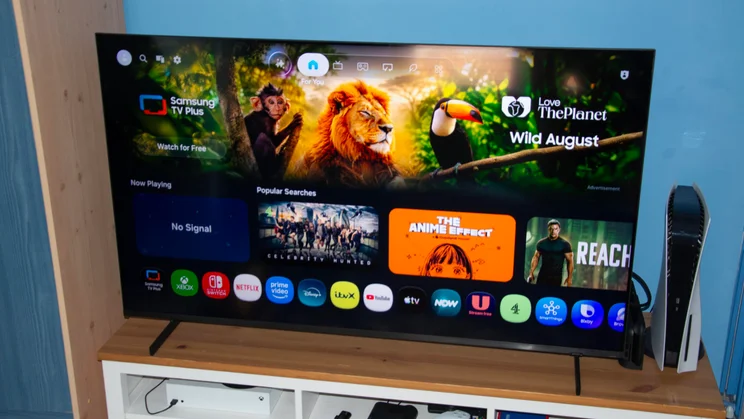
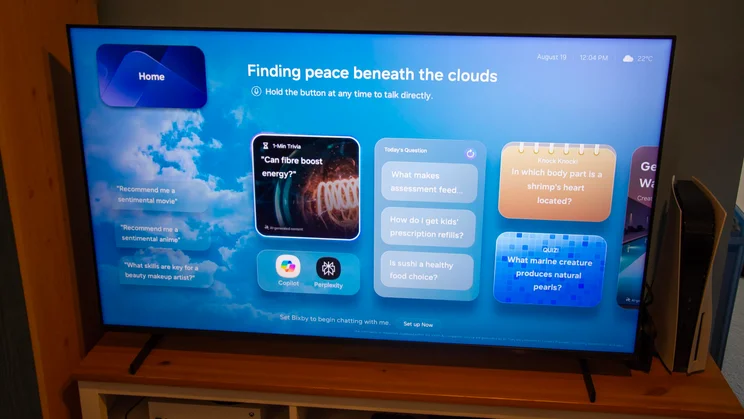
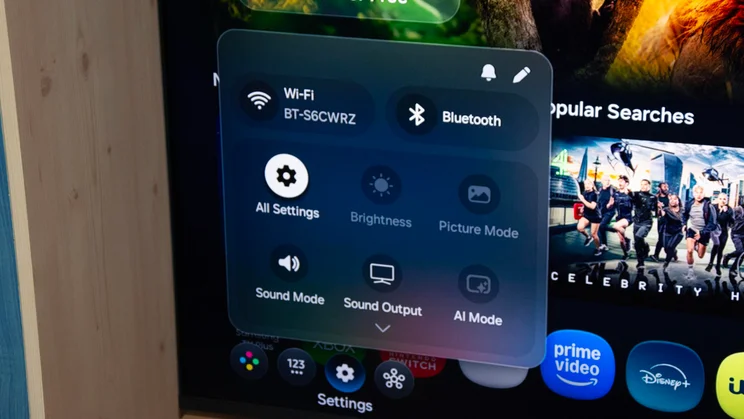
Naturally, the QN80H uses Samsung’s Tizen smart TV platform, which has undergone a bit of a makeover for 2026. The Samsung mobile-inspired interface places a logo-based navigation bar at the top of the homepage featuring shortcuts to Samsung Vision AI and the For You, Live, Games, Art, Daily and App pages. Over in the top-left corner, you’ve got a search icon, plus access to your connected devices, a quick settings menu, and the ability to switch user profiles.
Once I mastered the new setup, navigation felt completely intuitive. Rearranging apps is simple, “Continue Playing” is prominent, and there’s plenty of content available, regardless of what you’re into. There’s Samsung’s extensive list of FAST channels on Samsung TV Plus, and most of the streaming platforms and apps we’ve come to know and love (or hate how much they cost us) are present and correct. However, at the time of writing, there’s one very notable omission: BBC iPlayer. This is a pretty big miss, but one I expect Samsung to rectify in due course.
I found Tizen ran pretty smoothly. There was the odd occasion when I found myself impatiently waiting to go back to a previous page after hitting the “Return” key on the remote, and sometimes it took me a little longer than I’d hoped to find specific menus or options, but these were exceptions to the rule. Overall, the platform ran nippily and consistently, and never felt congested with too many content recommendations or ads.
Image quality
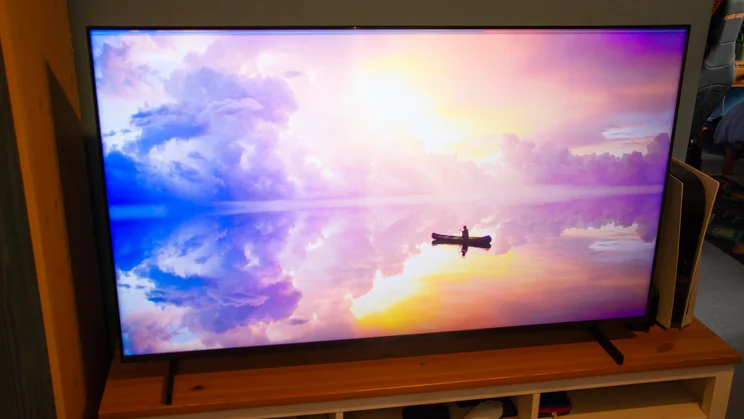
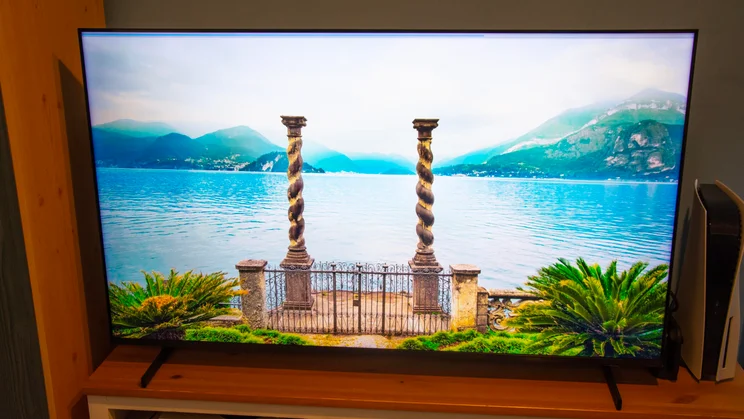
The QN80H delivers enjoyable SDR images, with its five picture presets each offering something a bit different. The Standard mode achieved the highest peak brightness when measured with a colorimeter, pattern generator and Calman Ultimate software, maxing out at 593cd/m2 on a 10% window. The punchier Dynamic mode followed closely behind, hitting 582cd/m2 on a 25% window, while Standard mode delivered a higher full-field brightness of 331cd/m2 compared to 327cd/m2.
Both proved bright enough to watch a few episodes of Pokémon on Samsung TV Plus in a well-lit room during the day, and the show proved a great tool for comparing the modes’ relative strengths. As is customary, the Dynamic mode pushed contrast and colour to the fore, and this suited the vivid landscapes and their pocket-sized inhabitants very well. Primary colours like Ash’s red hat and blue shirt really stood out, and the blended hues, though not in any way accurate by established colour standards, were a visual treat.
That said, I preferred the slightly more muted presentation of Standard mode. Contrast isn’t pushed quite so hard, resulting in a more natural-looking picture, and it’s more accurate across the board: my greyscale multipoint, saturation sweep and ColorChecker tests returned average Delta E error scores of 12.1, 8.8 and 11. In Dynamic mode, these rose to 18.5, 16.5 and 12.3.
Artistic intent retained superbly in Filmmaker Mode
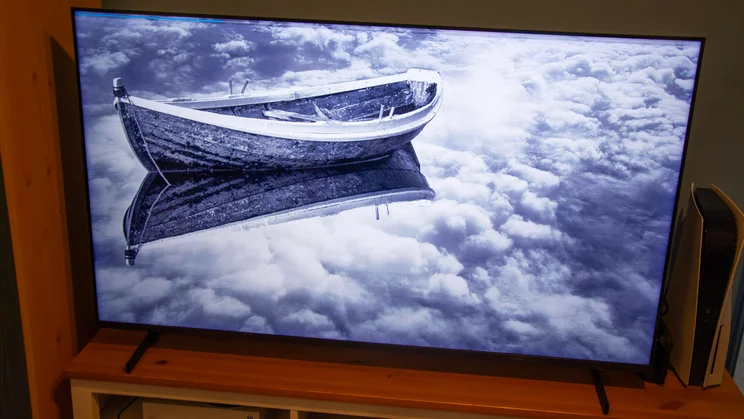
Of course, Filmmaker Mode is where it’s at if you want true “as the artist intended” accuracy, and here the QN80H pretty much nails its brief. Average Delta E scores of 3 and 2 in the greyscale and saturation sweeps are bang on the money, and a ColorChecker result of 4.3 is only marginally above the visible threshold of 3, so you’ll need sharp eyes and look very hard to spot any obvious colour deviations. The mode is noticeably dimmer, however, with peak brightness topping out at 262cd/m2. The vibrant world of Pokémon held up just fine, though, and even black-and-white footage in the rather more sombre documentary 1945, The Year That Changed History proved bright enough to watch comfortably with the curtains open.
The Auto HDR Remastering feature worked extremely well, boosting the colour range and light displayed on the panel when watching SDR content. When comparing scenes in Guardians of the River: Danube Floodplain on the Pluto TV Animals channel, engaging the mode helped shine a light (quite literally) on finer details of swans’ plumage, snakes’ scales and ripples on the river. The QN80H’s upscaling impressed me, too. When my partner and I streamed the 1997 sci-fi/horror cult classic Event Horizon on Paramount+, the crisp, detailed images genuinely surprised us. The blacks in space looked deep and dark, and although some blooming was evident around brighter objects, it wasn’t egregious. The film did highlight Dynamic mode’s weaknesses, however. While cycling through the different picture presets, the lighting on the ship stood out as far too blue, and skin tones were drastically skewed.
A couple of picture-related niggles
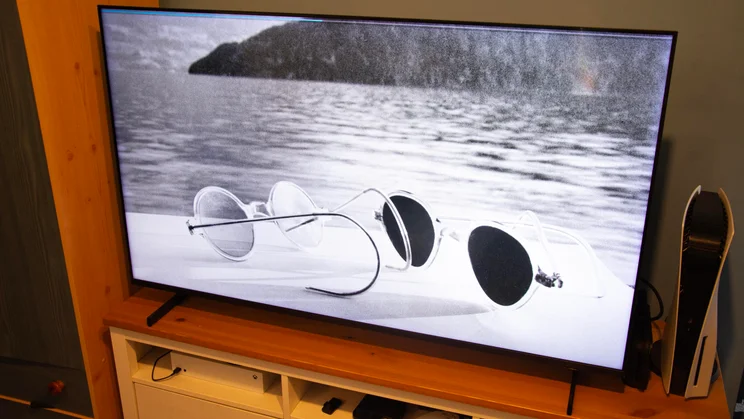
There are another couple of small flies in the SDR ointment. Without the anti-glare matte coating found on more expensive options like the R95H and S99H, the QN80H is susceptible to reflections. During the day, I found myself distracted by light coming from the window behind my viewing position. Upon shifting that position wider, I also noted some colour drop-off. It wasn’t disastrous, and is to be expected from a VA Mini LED panel, but there’s definitely a duller look to off-axis viewing.
On a brighter note, I didn’t discover any motion-handling issues. The 144Hz panel generally handles fast movement sensibly, striking a good balance between fluidity and naturality.
HDR performance
The QN80H isn’t the brightest Mini LED model on the market, even compared with cheaper Mini LED rivals from last year like the TCL C7K. That TV, which I found for under £700 in 55in at the time of writing, hit a staggering peak brightness of 2,820cd/m2 in its Standard mode. The Samsung QN80H only managed 1,379cd/m2 on a 10% window in Dynamic mode, a level of performance similar to one of our favourite mid-range OLEDs from 2025, the LG C5.
This means the QN80H is best viewed with the curtains drawn or after dark, but it still has enough luminance to operate well in rooms with ambient light. All its picture presets can output at similar brightness. In Filmmaker Mode, the QN80H’s highlights shone marginally brighter than the TCL, returning a peak brightness figure of 1,156cd/m2 on a 10% window. I recorded full-field brightness – an area where Mini LED typically has an advantage over OLED – at 638cd/m2 in Dynamic mode, and 590cd/m2 in Filmmaker Mode.
Because luminance is pretty consistent across the five presets (Dynamic, Standard, Eco, Movie and Filmmaker Mode), you’re not making a huge sacrifice by choosing one over the other. I found myself flitting between Standard and Filmmaker, depending on what I was watching, with the former adding a touch more brightness and vibrancy while covering just short of 94% of the DCI-P3 colour gamut used for HDR content.
Lagging behind RGB Mini LED in gamut coverage
I measured BT.2020 coverage at just under 73%, which is a long way off what RGB Mini LED and Super Quantum Dot TVs like the Hisense UR8S and TCL X11L can achieve. Because most mainstream video content doesn’t extend beyond the DCI-P3 color space, this issue won’t bother buyers looking for a relatively affordable Samsung TV like the QN80H. What’s more important is how well it reproduces content within the DCI-P3 gamut, which is used for most HDR material. And it does so handily.
As with SDR content, Dynamic mode is best avoided unless you’re settling in for an animated romp like Avatar Aang: The Last Airbender. Here, I was able to look past the significant discrepancies in rendering content accurately (I measured average Delta Es of 24.8, 28.8 and 15.8 in my greyscale, saturation sweep and ColorChecker tests) and revel in the heavily saturated HDR10+ Advanced spectacle. Sometimes it’s nice to say to hell with accuracy and realism and escape into an eyegasmic state.
Standard mode is a cleaner, more consistent watch for general purposes, though. While its saturation sweep results were very similar to Dynamic mode, it performed far better in my greyscale (14.5) and ColorChecker (8) tests. Avatar Aang wasn’t as striking, but for those seeking a punchy picture that’s a little less brash, it’s the ideal compromise between Dynamic and Filmmaker Mode.
True to form, what the latter lacks in luminance, it makes up for in accuracy. It didn’t measure quite as well in HDR as it did in SDR, but it was mighty close, with greyscale, saturation sweep and ColorChecker average Delta E errors of 2.3, 3.9 and 3.5.
Impressive backlight performance
The control of the full-array backlight is skilful, too. I only noticed a touch of blooming around the very brightest objects in contrast-heavy scenes while watching after dark, which is not a given on Mini LED TVs more expensive than the QN80H. Samsung has done a top job here.
All this contributes to HDR picture performance that excellently caters for a range of viewers. Those with a taste for overt, aggressively enhanced vibrancy have the Dynamic mode; Filmmaker Mode looks after cinematic purists nicely, while Standard mode is the happy medium between the two.
Gaming
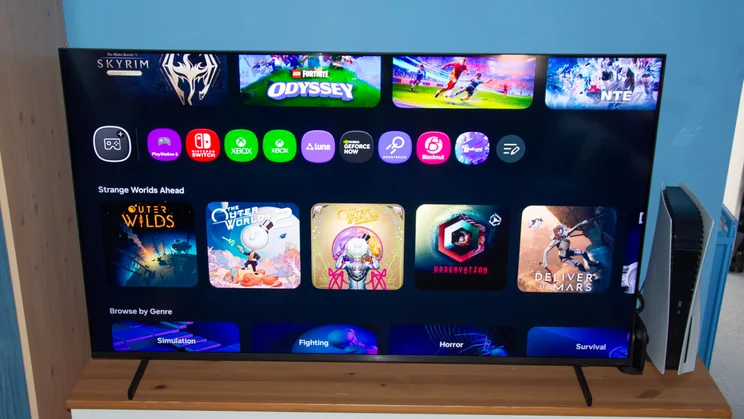
As a big gamer, you might think I’d regularly be hitting up the Samsung Game Hub, but it’s primarily useful for those who don’t own a console. It collates your connected gaming sources – in my case PlayStation 5, Xbox Series S and Switch 2 – and provides access to services like Nvidia GeForce Now and the Xbox app, through which you can play games without a dedicated console.
If you have fast internet and don’t want another device on your TV cabinet, this is great, but I’m sticking with objects I can touch, see and potentially sell at some point in the future… It’s a shame that won’t be possible with PlayStation games as of January next year.
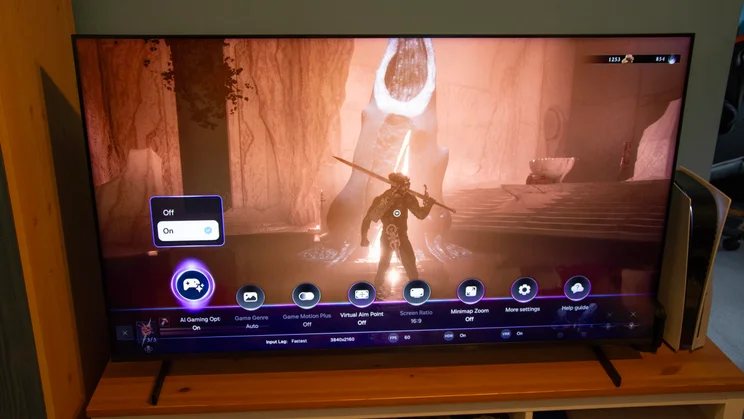
Gaming on the QN80H wasn’t quite as jaw-dropping as it was on the LG C6 OLED and Hisense UR8S, but for what you’re paying, it delivers the goods. All four HDMI ports support ALLM, VRR up to 144Hz and FreeSync Premium Pro on PC. The Game Bar provides access to gaming enhancements, including a Virtual Aim Point, Minimap Zoom, HDR10+ Gaming and several genre-specific picture presets.
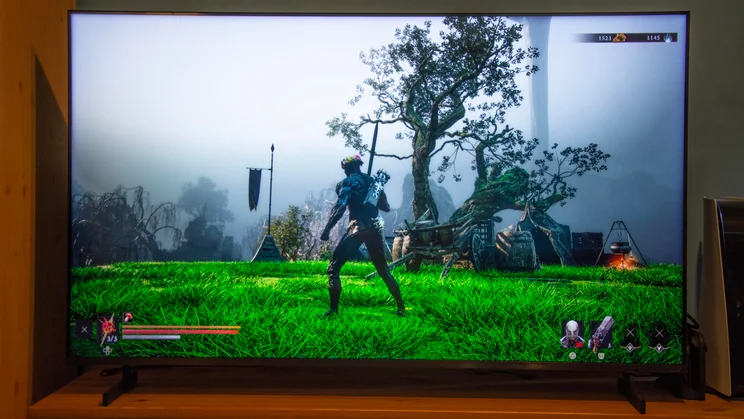
Brightness in Game mode was slightly below the peaks I recorded in Dynamic mode, reaching 1,220cd/m2 on a 25% window. Still, even games with dimly lit environs, such as Mortal Shell II, were illuminated judiciously by the Mini LED backlight. There was a decent level of detail in the dark corners of Beacons I delved into to cleanse; the armour worn by Harros’ shell was intricately depicted, and the kaleidoscope of colours in the landscapes I traversed during the prologue were visually absorbing.
Fast, fluid and flashy
Gameplay was smooth across a range of titles, including Rise of the Ronin, Beast of Reincarnation, Mistfall Hunter (when the servers weren’t borked) and Absolum. The QN80H did particularly well handling the latter game when the entire screen was full of enemies, projectiles and flashy animations.
Like the Standard and Dynamic modes, Game mode isn’t going all out for extreme accuracy, and average Delta E scores of 15.5 (greyscale), 13.6 (saturation sweeps) and 22 (ColorChecker) reflect this. But you can always game in Filmmaker Mode if you’re willing to accept increased input lag for additional fidelity. I measured input lag at 70.2ms using a Leo Bodnar 4K HDMI Video Signal Lag tester outside of Game mode, and with the mode engaged this dropped to 12.7ms. There are faster gaming TVs around, but that’s a more-than-respectable result.
Sound quality
The QN80H falls into the “you can get away without a soundbar, but I’d recommend pairing it with one” category. Despite supporting Dolby Atmos and Samsung’s Object Tracking Sound Lite, there’s only so much the 30W 2.0-channel audio system can do to create immersion. Atmos definitely expands the soundstage, but never creates the feeling that you’re cocooned in the middle of the action. It’s always obvious that the sound is coming from in front of you, and there’s not much verticality to the presentation.
OTS Lite does help move positional audio cues around the screen successfully, however. As Sokka pilots sky bison Appa to rescue Aang, I got a palpable sense of movement through the air, and it was a similar story when the gravity core in Event Horizon opened, blowing off a door and flinging Lawrence Fishburne’s character into a glass pod. The QN80H tracked the explosion’s sideways movement from left to right on screen, and the sonic impact was clearly from the right side of the TV.
The general tuning suits most types of content and articulates dialogue well enough. If you’re struggling, Samsung’s Amplify setting boosts mid-range frequencies to accentuate speech. I didn’t need to engage this in general use and, in fact, avoided doing so as the QN80H already feels a little light at the low end. Clangs and smashes have plenty of impact, but the deep, forceful bass that brings some soundtracks to life is a little lacking.
There’s an equaliser, but even with the 100Hz and 200Hz bands bumped up several notches, I got nowhere near the rich bass response I did with Samsung’s QS90H soundbar hooked up. If you buy the QN80H with the QS90H (or any other Q-Symphony soundbar), you can have them play audio simultaneously to impressive effect.
Samsung QN80H review: Verdict
The Samsung QN80H is a strong all-rounder that’s available in most popular sizes (and some enormous ones) for what I consider very reasonable money. It may not be the flashiest or brightest Mini LED TV released this year, but the 55in model I tested is money well spent.
It holds an important place in Samsung’s TV range, and although it’s not without weaknesses, it’s one of the best lower-mid-range TVs around. If you’ve decided it’s time to upgrade from your basic LED or QLED set and have around a grand to spend, the QN80H should definitely be on your shortlist.
Before you go splashing your cash, however, I recommend checking if last year’s Samsung QN90F is still in stock. It offers similar features, is brighter, has a faster refresh rate and lower input lag, and was available for £899 at the time of writing.


